Swimming Like a Ray
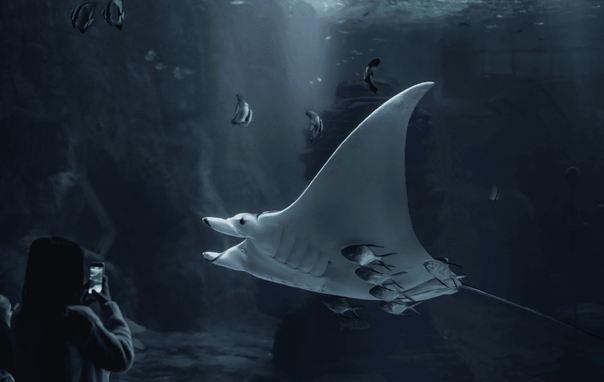
Manta rays are amazing and efficient swimmers — a necessity for any large animal that survives on tiny plankton. Researchers have built a new soft robot inspired by swimming mantas. Like its biological inspiration, the robot flaps its pectoral fins much as bird flaps its wings; this motion creates vortices that push water behind the robot, propelling it forward. For a downstroke, air inflates the robot’s body cavity, pushing the fins downward. When that air is released, its fins snap back up. With this simple and energy efficient stroke, researchers are able to control the robot’s swimming speed and depth, allowing it to maneuver around obstacles. Flapping faster helps the robot surface, and slower flapping allows it to sink. (Living manta rays also sink if they slow down.) Check out the robot in action below. (Image credit: J. Lanoy; video and research credit: H. Qing et al.; via Ars Technica)
https://www.youtube.com/watch?v=pXB9Ip7qa0o
#biology #biophysics #biorobotics #flapping #fluidDynamics #mantaRay #physics #science #swimming
 Nicole Sharp
 IRAP
IRAP
 Ramiro Godoy-Diana
 Andrew-Murphy
 Star Trek Minus Context
 Elliott 🎃
 @Om*
@Om* @Om
@Om @Om*
@Om*