📖 'Growth patterns and condition factors of fish in the Celike River, leuser ecosystem area, East Aceh, Indonesia' - an article in the @EDPSciences UN #SDGs research collection on #ScienceOpen 🔗 https://www.scienceopen.com/document?vid=d44cde73-dcc9-4553-8bc2-12e5d1e0a38d

#FishEcology #FisheriesScience #LeuserEcosystem #ScienceMastodon

Growth patterns and condition factors of fish in the Celike River, leuser ecosystem area, East Aceh, Indonesia

<p xmlns:xsi="http://www.w3.org/2001/XMLSchema-instance" class="first" dir="auto" id="d3799086e129">Fish growth patterns are the process of increasing the size and weight of a fish's body that occurs during its lifetime. This growth pattern is influenced by genetic factors, the environment, food availability and the physiological condition of the fish. Research on Growth Patterns and Condition Factors of Fish in the Celike River in the Leuser Ecosystem Area of East Aceh aims to determine the size of fish and provide an overview of fish growth patterns by analyzing the relationship between length and weight and fish condition factors. The method used is a purposive sampling method, namely determining the location of research station based on consideration of habitat characteristics in locations that are thought to have a high presence of fish, are easy to reach and represent the Celike River area in the Leuser Ecosystem Area. This research was carried out in July 2024. The total number of fish obtained was 122 individuals from 10 species belonging to seven families, namely Cyprinidae, Sisoridae, Clariidae, Channidae, Cichlidae, Balitoridae, Aplocheilus. There are two dominant species caught at this location, namely <i>Tor soro</i> and <i>Tor tambra</i>. <i>Tor tambra</i> obtained during the study amounted to 40 individuals with a total length of 70.09 - 434.4 mm and a weight of 3.96 - 811.05 g. <i>Tor soro</i>) obtained during the study amounted to 34 individuals with a total length of 61.79 - 144.33 mm and a weight of 2.89 - 32.5 g. The growth pattern of fish in the Celike River with eight fish species is negative allometric, two fish species are isometric and positive allometric, with condition factor values ranging from 0.07 to 8.88. </p>
ScienceOpen

Ecosystem model (Habitat 🌄)

An ecosystem model is an abstract, usually mathematical, representation of an ecological system, which is studied to better understand the real system. Using data gathered from the field, ecological relationships—such as the relation of sunlight and water availability to photosynthetic rate, or that between predator and p...

https://en.wikipedia.org/wiki/Ecosystem_model

#EcosystemModel #Habitat #SystemsEcology #FisheriesScience #PopulationModels #BiologicalSystems

Ecosystem model - Wikipedia

Job - Alert 🌊

🐟 Research Scientist, #postdoc, impacts of land use changes on fish populations

Deadline: 2025-05-19, until 4pm (EEST)

Location: Finland, Helsinki, Jokioinen, Jyväskylä, Joensuu, Oulu, Turku

https://www.academiceurope.com/job/?id=7485

#hiring #AquaticEcology #FisheriesScience #limnology

Ecosystem model (Habitat 🌄)

An ecosystem model is an abstract, usually mathematical, representation of an ecological system, which is studied to better understand the real system. Using data gathered from the field, ecological relationships—such as the relation of sunlight and water availability to photosynthetic rate, or that between predator and p...

https://en.wikipedia.org/wiki/Ecosystem_model

#EcosystemModel #Habitat #SystemsEcology #FisheriesScience #PopulationModels #BiologicalSystems

Ecosystem model - Wikipedia

"The recent and ongoing bluefin #tuna recovery proves that this species can be rebuilt, and managers are capable to keeping the bad actors at bay." - University of Washington 👇

#fisheries #fisheriesscience #conservation #sustainability #seafoodforthought

https://sustainablefisheries-uw.org/bluefin-tuna-in-2024-perspective/

Bluefin Tuna in 2024 – is it time to change our perspective? - Sustainable Fisheries UW

Bluefin tuna have recovered strongly from overfishing. When can we consider them sustainable to eat?

Sustainable Fisheries UW

Our new paper in Reviews in Fish Biology and Fisheries 👇 reviews the scientific evidence for impacts of electrotrawling in marine waters. Our review finds that the EU ban on the use of electricity when catching #fish / pulsetrawl #fisheries is at odds with the Common Fisheries Policy objectives on improving the ecological and economic sustainability of #fishing practices.

#fisheriesscience #marinescience #science

https://link.springer.com/article/10.1007/s11160-024-09867-x

Electrotrawling can improve the sustainability of the bottom trawl fishery for sole: a review of the evidence - Reviews in Fish Biology and Fisheries

Between 2009 and 2021 almost the complete beam trawl fleet of the Netherlands switched from conventional beam trawls (BT) to pulse trawls (PT) using electrical stimulation to catch sole, Solea solea. Electric fishing, being banned in the EU in 1988, was made possible in 2006 under a derogation. Over the years stakeholders expressed concern about ecosystem effects. Here we review the research conducted. PT improved the selectivity of the fishery and reduced the ecological side effects. PT caught more sole per hour fishing but less discards and benthos than BT. The transition to PT reduced the surface area swept (lower towing speed), sediment depth of disturbance and associated benthic impacts, as well as fuel consumption. Laboratory experiments with 9 fish and 17 benthic invertebrate species showed that exposure to a commercial bipolar pulse stimulus did not result in harmful effects except in cod. Autopsy of cod sampled from PT revealed that 40% had an internal injury. Injury rates in other roundfish species was low (< 2%) and absent in flatfish. Electrical-induced impacts on biogeochemistry were not observed. The transition increased competition with other fishers which fed the resentment against PT. Governance arrangements under which the number of temporary licenses expanded, undermined legitimacy of the gear, resulting in a ban in 2021. Although questions about the ecological impact of electrical stimulation remain, adverse effects are considered negligible in comparison with the benefits.

SpringerLink

Call for abstracts:

How can we use #fisheries social and economic data to inform fish stock assessments and fishing opportunities advice? Do you want to share ideas, examples or best practices?

Join our session at the ICES Annual Science Conference in Newcastle, UK. Abstract submission closes 22 March! 👇

#science #fisheriesscience #socialscience

https://www.ices.dk/events/asc/2024/Pages/default.aspx

ASC 2024

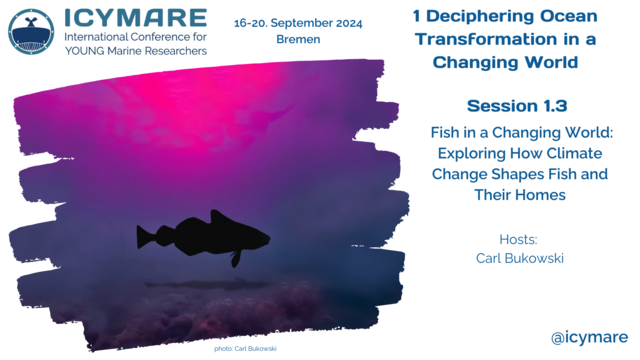
Session 1.3 “Fish in a Changing World: Exploring How Climate Change Shapes Fish and Their Homes” hosted by Carl Bukowski from the Thünen Institut of Baltic Sea Fisheries
Find the call for abstracts on our webite:
https://tinyurl.com/ICYcallforabstracts
#ICYMAREfamily #ICYMARE #ICYMARE2024 #earlycareerresearchers #callforabstracts #marinescience #fisheries #fisheriesscience #fisheriesresearch
CALL FOR ABSTRACTS - ICYMARE

You can attend with presenting a talk or a poster in one of the sessions listed here. All we need is your abstract and a short CV to [email protected]

ICYMARE
Do you have experience with incorporating social or economic considerations in fish stock assessments for #fisheriesmanagement advice? We want to know more! Submit your abstract to our #ICESASC24 theme session K "Incorporating human dimensions to improve fishing opportunities advice".👇
#fisheriesscience #socialscience
https://www.ices.dk/events/asc/2024/Pages/Call_for_Abstracts.aspx
Call for abstracts

Why both scientists and #fishers benefit from working together | It was a pleasure to be a guest in Jim Cowie's #seafoodmatterspodcast and discuss this and other important topics. Here is a short clip. Full episode on: https://rss.com/podcasts/seafoodmatterspodcast/ or Spotify:
https://open.spotify.com/episode/4emWvAyIOpqw1dhsvP1Y7g?si=TBw9vddIRs-lhnOAQGIOCA
#fisheries #fisheriesscience #socialscience #fisheriesmanagement
Seafood Matters Podcast

Providing a voice for the UK fishing industry Jim Cowie speaks with fishermen, fisheries scientists and seafood industry leaders.

RSS.com