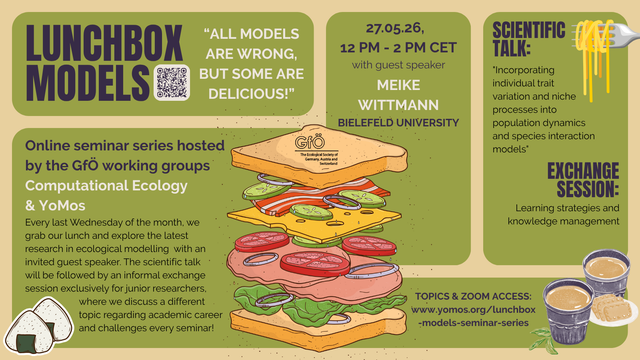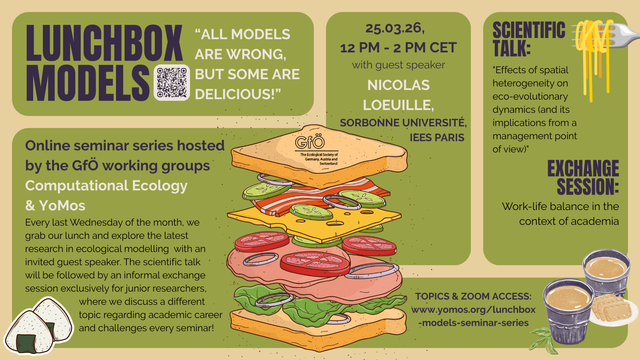
...your regular reminder that all models are wrong, but some are delicious! 😋

Our next #LunchBoxModels #seminar is scheduled for Wednesday (Feb 25) at 12 CET. Boris Schröder-Esselbach (TU Berlin) will talk about #EcologicalModelling and how it provides key contributions to coastal #EcosystemServices and the restoration of seagrass meadows. Don't think twice, join us! 😊

More info here:
https://www.yomos.org/lunchbox-models-seminar-series

#TheoreticalEcology, #ComputationalEcology

@YoMosEco @Louzula

🚨 Save the date! 🚨

The next @YoMosEco / #YoMos workshop for young modellers in ecology will be held from 25th-29th May at the AWI Guesthouse Möbius on the island Sylt. Are you a BSc/MSc/PhD student interested in #EcologicalModelling and/or #TheoreticalEcology? Then don't think twice, this is certainly THE meeting to atttend.

More info:
https://www.yomos.org/next-workshop

Next workshop | YoMos

YoMos

Nice study showing yet another effect of the ongoing temperature increase due to #ClimateChange : French oak populations were, over time, less exposed to late spring frost damage, in frequency as well as extent, which are largely driven by the temporal advance of both the last spring frost day and budburst dates.

https://doi.org/10.1016/j.agrformet.2025.110927

#Forest #EUForests #ForestEcology #ForestDynamics #Ecology #EcologicalModelling
#AcademicChatter

...and another quick reminder that all models are wrong, but some are delicious! 😋

Our next #LunchBoxModels #seminar is scheduled for Wednesday (Jan 28) at 12 CET. Elisa Thebault (Sorbonne Université de Paris) will talk about species diversity, food web structure and ecosystem stability. Don't think twice, join us! 😊

More info here:
https://www.yomos.org/lunchbox-models-seminar-series

#TheoreticalEcology, #ComputationalEcology, #EcologicalModelling, #ecology, #FoodWebs #EcologicalNetworks

@YoMosEco @Louzula

#seminar alert! ⏰

Next Tuesday, Frank Hilker from the University of Osnabrück will give a talk in our Ecology Colloquium entitled

"To connect or not connect isolated patches: Total population abundance and failed rescue effects in fragmented landscapes".

Everyone welcome, either in person or via Zoom, the more the merrier! 😀

#Theoretical Ecology #YoMos
#EcologicalModelling #ecoevo #metapopulation

🚨new paper published! 🚨

„Many weak and few strong links“ seems to be a common pattern in many ecological networks. 1st author Franziska Koch shows that this pattern can enable stabilising effects of network structure, using competitive hierarchies as a case study. We argue that skewed link strength distributions should hence receive more attention, especially in studies based on #RandomMatrixTheory.

https://link.springer.com/article/10.1007/s12080-025-00626-7

#TheoreticalEcology
#EcologicalModelling
#EcologicalNetworks

Many weak and few strong links: the importance of link strength distributions for stabilising patterns in competition networks - Theoretical Ecology

Ecological networks tend to contain many weak and only a few strong links. Furthermore, link strengths are often patterned within a network in ways that enhance system stability considerably, increasing the ability of the system to return to equilibrium after a perturbation. However, little attention has been given to the relation between the skewed “many weak and few strong links” distribution and the stabilising effect of patterning. Here, we focus on the stabilising effect of a hierarchical patterning in bryozoan competition networks and demonstrate that this stabilising effect critically depends on a skewed distribution of link strengths. We first show that, in line with many other ecological networks, the empirically derived link strengths in these competition networks were characterised by a high level of skewness, with many weak and few strong links. Then, we analysed the relationship between the link strength distributions, hierarchy and stability by comparing theoretical competition matrices with different distributions of link strengths. We found that the full stabilising effect of hierarchy only appeared when we used skewed link strengths produced by a gamma distribution, but not in matrices built with uniform or half-normal distributions. This has important methodological implications, since theoretical studies often assume normal or uniform distributions to investigate ecological stability, and therefore might overlook stabilising mechanisms. These implications are relevant for theory on the relation between structure and stability of ecological networks in general, since skewed link strengths are also a common feature of food webs and mutualistic systems.

SpringerLink

New publication in #EcologicalModelling! Benedikt Hartweg & his colleagues simulated tropical forests in #Brazil under disturbance scenarios and fitted allometries at different spatial scales. Super helpful insights for the new #BIOMASS mission by @esa

🔗 Learn more on our blog: https://www.geo.lmu.de/geographie/en/latest-news/news-overview/news/new-publication-in-ecological-modelling.html

#science #research #newpaper #ecologicalmodelling #forest #geography #remotesensing

...and here comes another reminder that all models are wrong, but some are delicious! 😋

The second #LunchboxModels #seminar will happen on Wednesday (Nov 26). Vasilis Dakos (CNRS, University of Montpellier) will talk about detecting #fisheries productivity trajectories at-risk to abrupt shifts. Don't think twice, join us!

More info here:
https://www.yomos.org/lunchbox-models-seminar-series

#TheoreticalEcology, #ComputationalEcology, #EcologicalModelling, #EcoModels, #ecology, #evolution, #ecoevo

@YoMosEco @Louzula @gfoe

Schöne Winterschule mit lauter coolen Leuten ;) #ecology #EcologicalModelling