Forest dieback, often related to #ClimateChange, is increasing in many parts of the world, and there is an urgent need to develop an efficient large-scale monitoring system of forest health, to improve forest management.
This study by Carletti et al 2025, based on a combination of satellite and ground level observations, will allow to improve detection of forest dieback, with a species specific calibration, and can therefore be used to produce high-resolution dieback maps at species levels and thus monitor dieback trends over time.

https://www.tandfonline.com/doi/full/10.1080/22797254.2025.2547386#d1e1030

#AcademicChatter #BioDiversity
#ForestManagement #Forests #Forestry
#ForestHealth #ForestDieback #ForestDynamics #ForestMonitoring

Nice study showing yet another effect of the ongoing temperature increase due to #ClimateChange : French oak populations were, over time, less exposed to late spring frost damage, in frequency as well as extent, which are largely driven by the temporal advance of both the last spring frost day and budburst dates.

https://doi.org/10.1016/j.agrformet.2025.110927

#Forest #EUForests #ForestEcology #ForestDynamics #Ecology #EcologicalModelling
#AcademicChatter

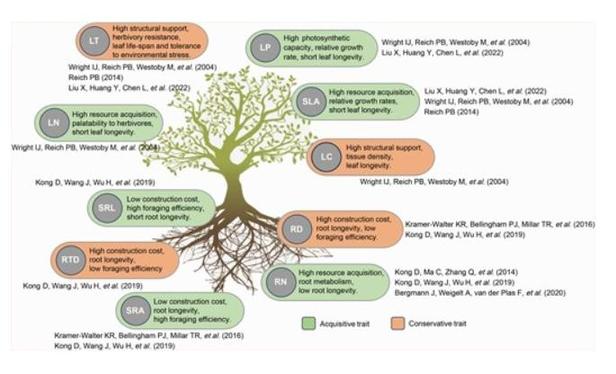
Zhen-Yu Wang et al. explored relationships between functional traits and survival mediated by tree size in subtropical forests. The results showed that leaf and root traits have inconsistent effects on tree survival.
#ForestDynamics #Multidimensionality
Details: https://doi.org/10.1093/jpe/rtae036
Participated yesterday in a very interesting PhD Viva, in which it has been show for common beech that adaptation to local environmental conditions can happen over very few generations (2-5) and small spatial scales (hundreds of meters). And that within population variation for an adaptive trait, such as leaf phenology, can respond to changes in temperature regimes, which is important news for #ForestDynamics under #ClimateChange
https://www.nature.com/articles/s41437-024-00696-z
#Forests
Rolling down that mountain: microgeographical adaptive divergence during a fast population expansion along a steep environmental gradient in European beech - Heredity

Forest tree populations harbour high genetic diversity thanks to large effective population sizes and strong gene flow, allowing them to diversify through adaptation to local environmental pressures within dispersal distance. Many tree populations also experienced historical demographic fluctuations, including spatial population contraction or expansions at various temporal scales, which may constrain their ability to adapt to environmental variations. Our aim is to investigate how recent contraction and expansion events interfere with local adaptation, by studying patterns of adaptive divergence between closely related stands undergoing environmentally contrasted conditions, and having or not recently expanded. To investigate genome-wide signatures of local adaptation while accounting for demography, we analysed divergence in a European beech population by testing pairwise differentiation among four tree stands at ~35k Single Nucleotide Polymorphisms from ~9k genomic regions. We applied three divergence outlier search methods resting on different assumptions and targeting either single SNPs or contiguous genomic regions, while accounting for the effect of population size variations on genetic divergence. We found 27 signals of selective signatures in 19 target regions. Putatively adaptive divergence involved all stand pairs. We retrieved signals both when comparing old-growth stands and recently colonised areas and when comparing stands within the old-growth area. Therefore, adaptive divergence processes have taken place both over short time spans, under strong environmental contrasts, and over short ecological gradients, in populations that have been stable in the long term. This suggests that standing genetic variation supports local, microgeographic divergence processes, which can maintain genetic diversity at the landscape level.

Nature

🌍 The findings point towards mixed forest plantations as a valuable strategy for enhancing ecosystem productivity and tackling climate change. A diverse mix of tree species offers significant benefits above and below ground. (8/8)

πŸ‘‰ https://botany.fyi/o8pzk9

#SustainableForestry #ClimateSolutions #ClimateAction #Biodiversity #ForestScience #ForestDynamics #RootEcology #SoilHealth #CarbonSequestration #PlantDiversity #ForestEcology

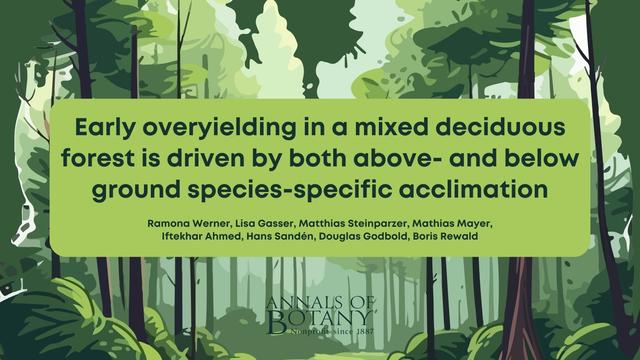
Early overyielding in a mixed deciduous forest is driven by both above- and below ground species-specific acclimation

AbstractBackground and Aims. Mixed forest plantations are increasingly recognised for their role in mitigating the impacts of climate change and enhancing

OUP Academic

🌿Join us to learn about the newly published paper β€˜Early overyielding in a mixed deciduous forest is driven by both above- and below ground species-specific acclimation’ in @AnnBot by Ramona Werner and co-authors. 🧡 (1/8)

πŸ‘‰ https://botany.fyi/o8pzk9

#AoBpapers #SustainableForestry #ClimateSolutions #ClimateAction #Biodiversity #ForestScience #ForestDynamics #RootEcology #SoilHealth #CarbonSequestration #PlantDiversity #ForestEcology

Early overyielding in a mixed deciduous forest is driven by both above- and below ground species-specific acclimation

AbstractBackground and Aims. Mixed forest plantations are increasingly recognised for their role in mitigating the impacts of climate change and enhancing

OUP Academic