 Slow Mover
Struck Blind, Led By Grace
A Sermon of Encounter on the Damascus Road (Acts 9:1–19a)
(Note: Sermons can be heard in audio format at https://millersburgmennonite.org/worship/sermon-audio/)
Introduction
Last Sunday Rachelle talked about the disciples trembling in fear behind locked doors, only to have a surprise encounter with the risen Christ. As you may remember, last week I shared during the children’s story about a fearful encounter with a tornado from my childhood. Since I left you hanging at the end, and since there have been some inquiries about how things turned out, I wanted to finish the story.
I left the story with the windows of the school wide open, the skies dark and roiling with clouds, and we students and teachers sitting with our heads between our knees in the hallway, as I heard a teacher running from the office and the squawking Bearcat weather radio announcing that a tornado was heading right for us.
Well, unless I have somehow been replaced by a clone, you of course know I survived.
I did some research, and it seems the tornado in question was an F4—one step below the worst rating—that occurred on March 29, 1976. It started in central Mississippi and traveled 127 miles to Meridian. I was in third grade. I was scared.
If my memory serves me correctly, the tornado jumped over the school and tore the roof off a car dealership down the road. I learned that the tornado did kill three people. But it could have been much, much worse if the twister had landed on top of a bunch of scared children in Mt. Barton Elementary School that warm afternoon in March.
If we live on this earth very long, most of us will encounter forces greater than ourselves. Moments of terror. Moments of mystery. Moments when we are left trying to understand why we encountered what we encountered, why we lived while others died, why we had to face the experience at all. There are things that overtake us in this life—storms in the sky, storms in history, storms in the soul—and in those moments we feel very small indeed.
That is part of what makes Acts 9 such a powerful text.
Because Acts 9 is not just about a road.
It is about a man under orders.
It is about a collision with a force far greater than himself.
Scripture portrays Saul as overwhelmed by the terrifying nearness of the risen Christ—fallen to the earth, blinded by glory, and reduced from a man of force to one who must be led by the hand.
Let us pray,
Que las palabras de mi boca y las meditaciones de nuestros corazones sean agradables a tus ojos, oh Dios, roca nuestra y redentor nuestro. Amén.
Homily
Saul begins the story as a man of certainty, a man of momentum, a man of religious fervor. He is not hesitant. He is not conflicted. He is “still breathing threats and murder against the disciples of the Lord.” Violence is in his lungs. Zeal is in his bones. He believes he knows exactly what he is doing.
And yet in one terrible and merciful moment, all of that certainty collapses.
Sometimes Christ meets us that way, by interrupting the life we thought we controlled. Sometimes grace arrives as disruption. Sometimes truth comes as collapse. A veces, Cristo resucitado nos encuentra no en nuestra fuerza, sino en nuestra debilidad. Sometimes the risen Christ meets us not in our strength, but in our weakness.
And so as we come to this story, we do not come merely to admire Saul’s conversion from a safe distance. We come as people who know what it is to be brought low, to have our certainties shaken, to ask what on earth just happened, and what do we do now.
Acts 9 is not only the story of Saul’s conversion. It is also the story of how Jesus interrupts violence, how blindness can become the beginning of true sight, and how the church is called to receive even the one it most fears.
“Meanwhile Saul, still breathing threats and murder against the disciples of the Lord, went to the high priest…”
That is how the story opens. Saul is not merely irritated. He is not simply mistaken. He is a man so certain of his cause, so convinced of his righteousness, that he believes persecution is holy work.
That is one of the most unsettling truths in all of scripture: it is possible to be zealous for God and yet resistant to God. It is possible to be religious and wrong. It is possible to think we are defending truth while we are actually wounding Christ.
Saul is fervent. Focused. Devoted. He has official backing. He has a mission. He is going to Damascus to bind disciples and drag them away.
And then, on the road, everything changes.
A light from heaven flashes around him. He falls to the ground. And he hears a voice saying, “Saul, Saul, why do you persecute me?”
That sentence is at the heart of the whole passage.
Jesus does not say, “Why do you persecute my people?”
He says, “Why do you persecute me?”
Christ so identifies with the church, with the suffering, hunted, trembling body of believers, that to strike them is to strike him. To wound them is to wound him. To terrorize them is to terrorize him.
This means the church is never merely a voluntary association or a club of like-minded people. The church is bound to Christ. The body belongs to the head. Jesús resucitado se toma como algo personal lo que se le hace a su pueblo. The risen Jesus takes personally what is done to his people.
And this also means something else. When anyone is trampled, degraded, humiliated, or brutalized, Christ is not distant from that suffering. The crucified and risen Jesus is the one who still says, in every age, “Why are you persecuting me?”
The voice of Christ echoes across history—across jail cells, lynching trees, prison camps, ghettos, slave ships, detention centers, ruined villages, and frightened homes. Christ is not neutral where human beings are crushed.
But notice: Jesus confronts Saul yet does not destroy him.
The first word Saul receives is judgment, yes—but judgment in the form of revelation. Saul is forced to see that the one he opposes is the Lord. The one he thought he was defending God against is, in fact, God’s Anointed One. The risen Christ unmasks Saul’s righteousness as rebellion.
But Jesus does not kill Saul on the road. He stops him.
The grace of God is often like that. It interrupts before it rebuilds. It knocks us down before it raises us up. It unmasks the disease before it heals.
And then comes the strange mercy of blindness.
Saul opens his eyes, but he can see nothing.
The man who thought he could see clearly turns out to be blind. The man who believed he had clarity, certainty, and theological precision is suddenly dependent on others to lead him by the hand.
He came to Damascus to take captives.
Instead, he enters Damascus a prisoner of his blindness.
He came with authority.
He arrives helpless.
He came breathing threats.
He arrives in silence.
For three days he neither eats nor drinks. Three days. A familiar length of time in the Christian story. It sounds like death, burial, waiting, undoing. Saul is in a kind of tomb. The old Saul—the self-assured, violent, self-justifying Saul—is being dismantled in darkness.
Sometimes we speak of conversion too lightly. As if it were merely changing one’s opinion or adjusting one’s beliefs. But in Acts, conversion is more like death and resurrection. It is not a tweak. It is a collapse of the old order. Saul’s world caves in on the Damascus road. As Paul later wrote to the church of Corinth, “Therefore, if anyone is in Christ, the new creation has come: ¡Lo viejo se ha ido, lo nuevo ha llegado! The old has gone, the new is here!”
Some of us know what it is to have a world we trusted come apart. We know what it is to discover that our certainties were too certain, our judgments too sharp, our righteousness too self-protective, our religion too aligned with our fear.
Some of us know what it is to be brought low enough that we must be led by the hand.
But that is not the end of the story. Acts 9 is not only about Saul. It is also about Ananias.
The Lord comes to a disciple in Damascus and says, “Go.”
And Ananias rsponds with the facts: “Lord, I have heard from many about this man…”
In other words:
Lord, do you know who this is?
Lord, do you know what he has done?
Lord, do you know what he came here for?
Ananias is not faithless. He is honest. He knows the danger. He knows the stories. He knows the trauma Saul has caused. He knows that “welcome” is not cheap for people who have been hunted.
Pero el Señor dice: «Ve, porque él es un instrumento que yo he escogido…»
Yet the Lord says, “Go, for he is an instrument whom I have chosen…”
This is astonishing. God chooses the persecutor. Not because the persecution did not matter. Not because the harm was unreal. Not because God waves away the suffering Saul caused. No—God chooses Saul because grace is stronger than Saul’s past. La gracia es más fuerte que el pasado.
That does not minimize sin. It magnifies mercy.
Ananias goes.
This may be the hardest part of the text, honestly. Saul’s conversion is dramatic and memorable, but Ananias’s obedience is perhaps even more difficult.
Ananias must walk into the house where his enemy is staying. He must cross the threshold of fear. He must trust that Christ is already at work in someone he would never have trusted on his own.
And when he enters, his first words are breathtaking:
“Brother Saul.”
Brother.
Not “former enemy,”
not “dangerous man,”
not “suspect,”
not “problem,”
not even “convert.”
Brother.
Before the scales fall, Ananias speaks kinship. Before Saul has preached a sermon, planted a church, or written a letter, Ananias names him as family.
That is what the church is called to do—not cheaply, not foolishly, not without truth—but with the deep, trembling courage that believes Christ can make a new creation where we may only see a threat.
Ananias lays hands on Saul. Saul’s sight is restored. He is filled with the Holy Spirit. He rises and is baptized.
Maybe today some of us need the Saul word.
We have been too certain.
Too quick to call our own fear “conviction.”
Too ready to wound in the name of righteousness.
And the risen Christ is merciful enough to stop us.
Some need the Ananias word.
We are being asked to go where we do not want to go.
To cross a threshold we did not choose.
To trust that Christ may already be at work in the person we fear, avoid, or resent.
And obedience feels dangerous.
Some need the church word.
We are not merely individuals with private spiritual lives. We belong to one another in Christ. What is done to one member is done to all of us. The wounds of others are not somebody else’s problem. Christ says, “Why do you persecute me?”
And some need the resurrection word.
Our blindness is not the end.
Our darkness is not the end.
Our undone place is not the end.
God knows how to use even the tomb-like places that fill our souls.
Again and again in Scripture, God meets fearful, overwhelmed, disoriented people and makes a way where there seemed to be none. Paul himself will later admit that he came “in weakness and in fear and in much trembling.” La Biblia no oculta el miedo humano. Revela a un Dios que se encuentra con las personas en medio de él. The Bible does not hide human fear. It reveals a God who keeps meeting people in the middle of it.
We often think faith should remove fear entirely. But scripture is more honest than that. Faith is not always the absence of trembling. Often it is what happens when trembling people keep going because God has met them where they shiver and shake.
This means grace is not merely about making nice people a little nicer. Grace is about new creation. Grace does not simply smooth over rough edges. It raises the dead and rips off the grave clothes. It takes enemies and makes them kin. It takes what is curved inward on itself and bends it toward love.
The church, then, is called to be the place where this strange and difficult miracle keeps happening. Not that we become naive about harm. Not that we forget wounds. Not that accountability disappears. But that we refuse to believe anyone lies outside the reach of the risen Christ. Nos negamos a creer que alguien esté fuera del alcance de Cristo resucitado.
So perhaps part of the sermon today is this: someone else’s healing may depend on your willingness to go.
Your willingness to knock on the door.
Your willingness to enter the room.
Your willingness to pray.
Your willingness to trust that Christ has gone ahead of you.
And perhaps part of the sermon is this too: your own healing may depend on letting someone come to you.
Letting yourself be seen in your blindness.
Letting yourself be led.
Letting yourself receive touch, prayer, kindness, and naming.
Letting the community do for you what you cannot do for yourself.
So this morning, wherever you find yourself in the story, hear the good news.
If you are frightened, Christ speaks peace to frightened people.
If you are blind, Christ can open your eyes.
If you are ashamed of what you have done, Christ can heal you.
If you are reluctant like Ananias, Christ can still send you.
If you are wounded by what others have done, Christ sees that wound as his own.
The voice that spoke on the Damascus road still speaks today.
Still interrupts. Still confronts. Still blinds false vision. Still opens true eyes. Still joins himself to the wounded. Still sends disciples into difficult places. Still makes apostles out of enemies and saints out of the shattered.
So may the Lord who met Saul meet us. May the Lord who sent Ananias send us. May the Lord who restored sight restore our own. And may the scales fall from our eyes—whatever they are, however long they have clung—so that we may finally see Christ, and in seeing Christ, also rise with him in power, witness, and glory.
Amen
#Acts9 #Ananias #ApostlePaul #BlindnessAndSight #ChristianConversion #ConversionOfSaul #DamascusRoad #Discipleship #DivineCalling #EncounterWithChrist #Grace #HolySpirit #JesusAppearsToSaul #Mercy #NewLifeInChrist #Obedience #PaulSConversion #Repentance #SaulOnTheRoadToDamascus #Transformation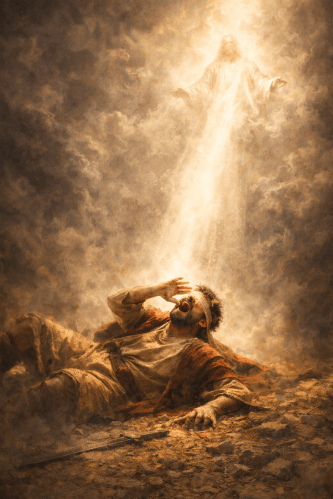
 Praise the Lord
 Intentional Faith
 VR LIVE CHANNEL
 Bryan King
 Steagus