Struck Blind, Led By Grace

A Sermon of Encounter on the Damascus Road (Acts 9:1–19a)

(Note: Sermons can be heard in audio format at https://millersburgmennonite.org/worship/sermon-audio/)

Introduction

Last Sunday Rachelle talked about the disciples trembling in fear behind locked doors, only to have a surprise encounter with the risen Christ. As you may remember, last week I shared during the children’s story about a fearful encounter with a tornado from my childhood. Since I left you hanging at the end, and since there have been some inquiries about how things turned out, I wanted to finish the story.

I left the story with the windows of the school wide open, the skies dark and roiling with clouds, and we students and teachers sitting with our heads between our knees in the hallway, as I heard a teacher running from the office and the squawking Bearcat weather radio announcing that a tornado was heading right for us.

Well, unless I have somehow been replaced by a clone, you of course know I survived.

I did some research, and it seems the tornado in question was an F4—one step below the worst rating—that occurred on March 29, 1976. It started in central Mississippi and traveled 127 miles to Meridian. I was in third grade. I was scared.

If my memory serves me correctly, the tornado jumped over the school and tore the roof off a car dealership down the road. I learned that the tornado did kill three people. But it could have been much, much worse if the twister had landed on top of a bunch of scared children in Mt. Barton Elementary School that warm afternoon in March.

If we live on this earth very long, most of us will encounter forces greater than ourselves. Moments of terror. Moments of mystery. Moments when we are left trying to understand why we encountered what we encountered, why we lived while others died, why we had to face the experience at all. There are things that overtake us in this life—storms in the sky, storms in history, storms in the soul—and in those moments we feel very small indeed.

That is part of what makes Acts 9 such a powerful text.

Because Acts 9 is not just about a road.
It is about a man under orders.
It is about a collision with a force far greater than himself.

Scripture portrays Saul as overwhelmed by the terrifying nearness of the risen Christ—fallen to the earth, blinded by glory, and reduced from a man of force to one who must be led by the hand.

Let us pray,

 Que las palabras de mi boca y las meditaciones de nuestros corazones sean agradables a tus ojos, oh Dios, roca nuestra y redentor nuestro. Amén.

Homily

Saul begins the story as a man of certainty, a man of momentum, a man of religious fervor. He is not hesitant. He is not conflicted. He is “still breathing threats and murder against the disciples of the Lord.” Violence is in his lungs. Zeal is in his bones. He believes he knows exactly what he is doing.

And yet in one terrible and merciful moment, all of that certainty collapses.

Sometimes Christ meets us that way, by interrupting the life we thought we controlled. Sometimes grace arrives as disruption. Sometimes truth comes as collapse. A veces, Cristo resucitado nos encuentra no en nuestra fuerza, sino en nuestra debilidad. Sometimes the risen Christ meets us not in our strength, but in our weakness.

And so as we come to this story, we do not come merely to admire Saul’s conversion from a safe distance. We come as people who know what it is to be brought low, to have our certainties shaken, to ask what on earth just happened, and what do we do now.

Acts 9 is not only the story of Saul’s conversion. It is also the story of how Jesus interrupts violence, how blindness can become the beginning of true sight, and how the church is called to receive even the one it most fears.

“Meanwhile Saul, still breathing threats and murder against the disciples of the Lord, went to the high priest…”

That is how the story opens. Saul is not merely irritated. He is not simply mistaken.  He is a man so certain of his cause, so convinced of his righteousness, that he believes persecution is holy work.

That is one of the most unsettling truths in all of scripture: it is possible to be zealous for God and yet resistant to God. It is possible to be religious and wrong. It is possible to think we are defending truth while we are actually wounding Christ.

Saul is fervent. Focused. Devoted. He has official backing. He has a mission. He is going to Damascus to bind disciples and drag them away.

And then, on the road, everything changes.

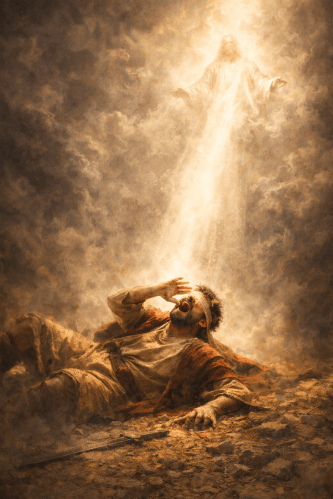
A light from heaven flashes around him. He falls to the ground. And he hears a voice saying, “Saul, Saul, why do you persecute me?”

That sentence is at the heart of the whole passage.

Jesus does not say, “Why do you persecute my people?”
He says, “Why do you persecute me?”

Christ so identifies with the church, with the suffering, hunted, trembling body of believers, that to strike them is to strike him. To wound them is to wound him. To terrorize them is to terrorize him.

This means the church is never merely a voluntary association or a club of like-minded people. The church is bound to Christ. The body belongs to the head. Jesús resucitado se toma como algo personal lo que se le hace a su pueblo. The risen Jesus takes personally what is done to his people.

And this also means something else. When anyone is trampled, degraded, humiliated, or brutalized, Christ is not distant from that suffering. The crucified and risen Jesus is the one who still says, in every age, “Why are you persecuting me?”

The voice of Christ echoes across history—across jail cells, lynching trees, prison camps, ghettos, slave ships, detention centers, ruined villages, and frightened homes. Christ is not neutral where human beings are crushed.

But notice: Jesus confronts Saul yet does not destroy him.

The first word Saul receives is judgment, yes—but judgment in the form of revelation. Saul is forced to see that the one he opposes is the Lord. The one he thought he was defending God against is, in fact, God’s Anointed One. The risen Christ unmasks Saul’s righteousness as rebellion.

But Jesus does not kill Saul on the road. He stops him.

The grace of God is often like that. It interrupts before it rebuilds. It knocks us down before it raises us up. It unmasks the disease before it heals.

And then comes the strange mercy of blindness.

Saul opens his eyes, but he can see nothing.

The man who thought he could see clearly turns out to be blind. The man who believed he had clarity, certainty, and theological precision is suddenly dependent on others to lead him by the hand.

He came to Damascus to take captives.
Instead, he enters Damascus a prisoner of his blindness.

He came with authority.
He arrives helpless.

He came breathing threats.
He arrives in silence.

For three days he neither eats nor drinks. Three days. A familiar length of time in the Christian story. It sounds like death, burial, waiting, undoing. Saul is in a kind of tomb. The old Saul—the self-assured, violent, self-justifying Saul—is being dismantled in darkness.

Sometimes we speak of conversion too lightly. As if it were merely changing one’s opinion or adjusting one’s beliefs. But in Acts, conversion is more like death and resurrection. It is not a tweak. It is a collapse of the old order. Saul’s world caves in on the Damascus road. As Paul later wrote to the church of Corinth, “Therefore, if anyone is in Christ, the new creation has come: ¡Lo viejo se ha ido, lo nuevo ha llegado! The old has gone, the new is here!”

Some of us know what it is to have a world we trusted come apart. We know what it is to discover that our certainties were too certain, our judgments too sharp, our righteousness too self-protective, our religion too aligned with our fear.

Some of us know what it is to be brought low enough that we must be led by the hand.

But that is not the end of the story. Acts 9 is not only about Saul. It is also about Ananias.

The Lord comes to a disciple in Damascus and says, “Go.”

And Ananias rsponds with the facts: “Lord, I have heard from many about this man…”

In other words:
Lord, do you know who this is?
Lord, do you know what he has done?
Lord, do you know what he came here for?

Ananias is not faithless. He is honest. He knows the danger. He knows the stories. He knows the trauma Saul has caused. He knows that “welcome” is not cheap for people who have been hunted.

Pero el Señor dice: «Ve, porque él es un instrumento que yo he escogido…»

Yet the Lord says, “Go, for he is an instrument whom I have chosen…”

This is astonishing. God chooses the persecutor. Not because the persecution did not matter. Not because the harm was unreal. Not because God waves away the suffering Saul caused. No—God chooses Saul because grace is stronger than Saul’s past. La gracia es más fuerte que el pasado.

That does not minimize sin. It magnifies mercy.

Ananias goes.

This may be the hardest part of the text, honestly. Saul’s conversion is dramatic and memorable, but Ananias’s obedience is perhaps even more difficult.

Ananias must walk into the house where his enemy is staying. He must cross the threshold of fear. He must trust that Christ is already at work in someone he would never have trusted on his own.

And when he enters, his first words are breathtaking:

“Brother Saul.”

Brother.

Not “former enemy,”
not “dangerous man,”
not “suspect,”
not “problem,”
not even “convert.”

Brother.

Before the scales fall, Ananias speaks kinship. Before Saul has preached a sermon, planted a church, or written a letter, Ananias names him as family.

That is what the church is called to do—not cheaply, not foolishly, not without truth—but with the deep, trembling courage that believes Christ can make a new creation where we may only see a threat.

Ananias lays hands on Saul. Saul’s sight is restored. He is filled with the Holy Spirit. He rises and is baptized.

Maybe today some of us need the Saul word.
We have been too certain.
Too quick to call our own fear “conviction.”
Too ready to wound in the name of righteousness.
And the risen Christ is merciful enough to stop us.

Some need the Ananias word.
We are being asked to go where we do not want to go.
To cross a threshold we did not choose.
To trust that Christ may already be at work in the person we fear, avoid, or resent.
And obedience feels dangerous.

Some need the church word.
We are not merely individuals with private spiritual lives. We belong to one another in Christ. What is done to one member is done to all of us. The wounds of others are not somebody else’s problem. Christ says, “Why do you persecute me?”

And some need the resurrection word.
Our blindness is not the end.
Our darkness is not the end.
Our undone place is not the end.
God knows how to use even the tomb-like places that fill our souls.

Again and again in Scripture, God meets fearful, overwhelmed, disoriented people and makes a way where there seemed to be none. Paul himself will later admit that he came “in weakness and in fear and in much trembling.” La Biblia no oculta el miedo humano. Revela a un Dios que se encuentra con las personas en medio de él. The Bible does not hide human fear. It reveals a God who keeps meeting people in the middle of it.

We often think faith should remove fear entirely. But scripture is more honest than that. Faith is not always the absence of trembling. Often it is what happens when trembling people keep going because God has met them where they shiver and shake.

This means grace is not merely about making nice people a little nicer. Grace is about new creation. Grace does not simply smooth over rough edges. It raises the dead and rips off the grave clothes. It takes enemies and makes them kin. It takes what is curved inward on itself and bends it toward love.

The church, then, is called to be the place where this strange and difficult miracle keeps happening. Not that we become naive about harm. Not that we forget wounds. Not that accountability disappears. But that we refuse to believe anyone lies outside the reach of the risen Christ. Nos negamos a creer que alguien esté fuera del alcance de Cristo resucitado.

So perhaps part of the sermon today is this: someone else’s healing may depend on your willingness to go.

Your willingness to knock on the door.
Your willingness to enter the room.
Your willingness to pray.
Your willingness to trust that Christ has gone ahead of you.

And perhaps part of the sermon is this too: your own healing may depend on letting someone come to you.

Letting yourself be seen in your blindness.
Letting yourself be led.
Letting yourself receive touch, prayer, kindness, and naming.
Letting the community do for you what you cannot do for yourself.

So this morning, wherever you find yourself in the story, hear the good news.

If you are frightened, Christ speaks peace to frightened people.
If you are blind, Christ can open your eyes.
If you are ashamed of what you have done, Christ can heal you.
If you are reluctant like Ananias, Christ can still send you.
If you are wounded by what others have done, Christ sees that wound as his own.

The voice that spoke on the Damascus road still speaks today.

Still interrupts. Still confronts. Still blinds false vision. Still opens true eyes. Still joins himself to the wounded. Still sends disciples into difficult places. Still makes apostles out of enemies and saints out of the shattered.

So may the Lord who met Saul meet us. May the Lord who sent Ananias send us. May the Lord who restored sight restore our own. And may the scales fall from our eyes—whatever they are, however long they have clung—so that we may finally see Christ, and in seeing Christ, also rise with him in power, witness, and glory.

Amen

#Acts9 #Ananias #ApostlePaul #BlindnessAndSight #ChristianConversion #ConversionOfSaul #DamascusRoad #Discipleship #DivineCalling #EncounterWithChrist #Grace #HolySpirit #JesusAppearsToSaul #Mercy #NewLifeInChrist #Obedience #PaulSConversion #Repentance #SaulOnTheRoadToDamascus #Transformation
YouTube

Enjoy the videos and music you love, upload original content, and share it all with friends, family, and the world on YouTube.

When God Chooses the Next Leader

The Bible in a Year

The Lord said unto Moses, Take thee Joshua the son of Nun, a man in whom is the spirit, and lay thine hand upon him” (Numbers 27:18). As we continue our journey through Scripture, we arrive at a sacred transition. Moses, the towering figure of the Exodus, is nearing the end of his earthly assignment. Rather than clinging to position or influence, he does something deeply instructive—he asks God to appoint a successor. Leadership in Israel was never meant to revolve around personality; it was anchored in divine calling.

The first thing we notice is designation. “Take thee Joshua the son of Nun.” God makes the choice. Moses does not conduct a poll, and Joshua does not campaign. The initiative begins with the Lord. Throughout Scripture, calling originates in God’s sovereign will. Abraham was summoned from Ur. David was chosen from the sheepfold. The apostles were called from fishing nets and tax booths. Service in God’s kingdom is not self-assigned ambition; it is divine commission. As Oswald Sanders wrote in Spiritual Leadership, “True leadership is not attained by self-assertion but by divine appointment.” That principle confronts our modern assumptions. We are often tempted to tell God what we will do for Him. Yet biblical service begins when we ask, “Lord, what would You have me to do?”

For most of us, the calling may not involve public prominence like Joshua’s. It may involve unseen acts of faithfulness—teaching children, visiting the sick, supporting ministry quietly. Yet the dignity of the task does not depend on its visibility. It depends on the One who assigns it. When God calls, obedience is the only faithful response.

Second, we observe qualification. Joshua is described as “a man in whom is the spirit.” The Hebrew term ruach can mean breath, wind, or spirit. Here it points to the enabling presence of God. Joshua was not chosen because of charisma alone, nor because of military résumé. His defining characteristic was spiritual condition. Earlier, we saw Joshua lingering in the tent of meeting (Exodus 33:11) and standing with Caleb in courageous faith (Numbers 14). He had already demonstrated reliance on God before he was elevated by God.

This speaks directly to the church today. Appointments in ministry are often influenced by worldly markers—business success, education, popularity. Yet Scripture places priority on inner life. When Paul outlined qualifications for elders in 1 Timothy 3, the emphasis fell on character more than capability. A spiritually healthy heart is the primary credential. John Stott once observed, “The church’s greatest need is not more machinery or better organization, but men and women filled with the Spirit.” That remains true in every generation.

Joshua’s qualification also reminds us that God never calls without enabling. The Spirit’s presence signifies empowerment. In our New Testament context, the Holy Spirit equips believers to fulfill their assignments (Acts 1:8). If God has placed you in a role—whether in church, family, or workplace—He supplies the strength required. The question is not whether we feel adequate; it is whether we depend upon the Spirit’s sufficiency.

Finally, we see installation. “Lay thine hand upon him.” This public act symbolized recognition, affirmation, and transfer of responsibility. Leadership transitions were not private affairs; they were communal moments. The congregation needed to see and understand that Joshua’s authority came from God’s direction. Public installation also honored the office itself. The people were called to respect not merely the individual but the role ordained by God.

In our reading plan this year, moments like this remind us that God’s work moves forward through generations. Moses’ departure did not halt God’s purposes. The covenant promises remained intact. Leadership changes, but the Lord’s faithfulness endures. If we are reading this passage during a season approaching Lent or reflecting on Christ’s redemptive mission, we might see a deeper parallel. Just as Joshua would lead the people into the Promised Land, Jesus—whose Hebrew name Yehoshua means “The Lord saves”—leads us into ultimate rest. The shadow in Numbers anticipates the substance fulfilled in Christ.

As we walk through the Bible in this year-long journey, this passage invites personal reflection. What assignment has God given me? Am I more concerned with recognition or with spiritual condition? Do I honor God-ordained roles in my church and community? Leadership in God’s economy is never self-created; it is Spirit-enabled and publicly affirmed.

For further study on Joshua’s leadership and its theological significance, you may find this article helpful from Bible.org:
https://bible.org/seriespage/lesson-19-god-commissions-joshua-joshua-11-9

Let us continue reading faithfully. The Scriptures consistently reveal a God who calls, equips, and commissions. As we trace His story from Genesis to Revelation, we discover that He remains the same—sovereign in designation, generous in qualification, and orderly in installation. And in every season, He invites us to trust His wisdom in the roles He assigns.

FEEL FREE TO COMMENT, SUBSCRIBE, AND REPOST, SO OTHERS MAY KNOW


#BibleInAYearDevotion #biblicalLeadership #divineCalling #HolySpiritEmpowerment #JoshuaSuccessorOfMoses #Numbers2718

सुबह 3 से 5 बजे के बीच नींद खुलना: मामूली बात नहीं, यह है ईश्वरीय शक्तियों का संकेत और दैवीय बुलावा! Early morning waking spiritual meaning #MorningRituals #Spirituality #Positivity #BrahmaMuhurta #SpiritualAwakening #DivinePower #BrahmaMuhurta #SpiritualSigns #DivineCalling #Hinduism #Meditation #PositiveEnergy #AncientWisdom #MorningPrayer #InnerPeace #GodGifts #WakeUpCall

https://vrnewslive.com/early-morning-waking-spiritual-meaning-3-to-5/

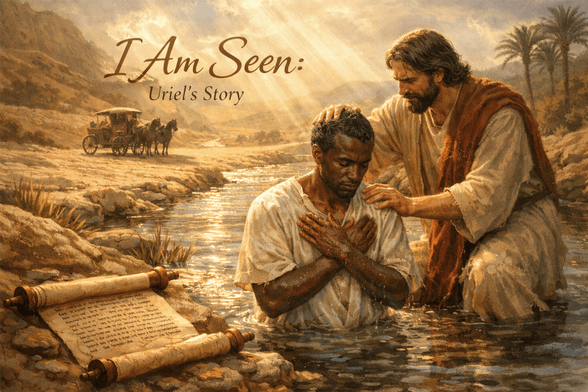
I Am Seen: Uriel’s Story

1,680 words, 9 minutes read time.

I am Uriel. I have been many things in my life — a servant of the queen, her treasurer, a man entrusted with her wealth, her correspondence, her secrets. Respected, feared, admired. Yet in the quiet of my heart, I have often felt… unseen. Not just overlooked by men, but unseen by God.

For years, I had believed that my position, my intelligence, my loyalty, and my ability to navigate the intrigues of court life could define me. That I could earn respect, perhaps even God’s favor, through accomplishment. But the truth I carried in my heart told a different story. I was a eunuch, a man marked by society as incomplete, and no title, no honor, no treasure could hide the ache of exclusion.

That day, I rode south on the desert road from Jerusalem to Gaza. My chariot rattled over stones that seemed to mock the rhythm of my heartbeat, the sun pressing down with a relentless weight. In my hands was a scroll — Isaiah 53 — the words of the suffering servant, pierced for our transgressions, led like a lamb to the slaughter. I had read these words many times before, but today they burned differently.

As I read, I reflected on Isaiah 56:3-5 — the promise to eunuchs and the marginalized. I felt a warmth in my chest as if God were speaking directly to me: “Some are born that way, some are made that way, some choose devotion for the kingdom of heaven. God sees you. You are not lesser. You are not overlooked.”

Could it really be true? Could a man like me — excluded from family, from the society I served, defined by usefulness rather than worth — truly belong? Could I be accepted by God?

I thought of the queen’s court. Every day, I managed treasures, counseled ministers, carried the queen’s correspondence. I was trusted with her wealth, her secrets, her reputation. Men came to me for advice, for judgment, for strategy. Yet I walked among them as a man seen only for what he could do, not who he was. Every glance reminded me: I was different — useful, yes, but incomplete.

I reflected on my own pride. I had relied on titles and intellect, on influence and cunning, to craft my identity. I had learned to hide my loneliness behind a mask of competence. But in the heat of the desert and the stillness of my soul, I realized that all of it was hollow. Who truly saw me? Who truly knew me?

Then he appeared. Philip. Walking steadily toward me, eyes focused, yet gentle. Later I learned he had been sent by an angel of the Lord — divinely orchestrated, guided to this road at exactly this moment. My breath caught. There was authority in him, yes, but also a kindness I had rarely encountered. Something in his presence radiated God’s intent.

Philip spoke simply: “Do you understand what you are reading?”

I hesitated, pride rising as it always did. I knew the scriptures. I could recite them, interpret them, debate them with scholars. But he did not speak to test my knowledge. His question invited honesty. I spoke of Isaiah 53, of the suffering servant who bore our pain, pierced for our transgressions. I confessed my confusion, my longing, my sense of unworthiness. “How can a man like me,” I asked, “find a place in God’s kingdom? I am a eunuch. I have no sons, no family legacy. I am… incomplete.”

Philip nodded, his expression steady, patient. “The Spirit opens hearts to see what is true,” he said. “God looks at the heart, not at status or appearance. He sees you, Uriel. He calls you.”

I felt again the echo of Jesus’ words about eunuchs — self-denial, surrender, devotion beyond societal expectations. This was the path God offered: not pride, not titles, not the approval of men, but humility and obedience. My walls began to crumble. The pride that had insulated me for years, the fear of exposure, the ache of exclusion — all were being unmasked in the light of God’s acceptance.

I thought back to my days in the palace: the careful calculations, the whispered secrets, the constant weighing of trust and betrayal. I had been a man of influence, yes, but never a man free. Always performing, always measured. Always hiding the parts of myself that the world deemed “incomplete.” I realized then that God’s kingdom did not measure me by what society demanded, but by what He saw — a heart capable of faith, a soul capable of surrender.

I looked down at the water in the desert ravine, a narrow pool glimmering under the sun. My chest tightened. “See,” I said to Philip, pointing, “here is water! What prevents me from being baptized?”

We left the chariot together. I stepped into the cool water, the desert air contrasting sharply against the stream’s embrace. As I lowered myself beneath the surface, I felt more than water surrounding me — I felt the weight of years of shame and fear, pride and secrecy, lifting. When I rose again, I gasped, tasting freedom for the first time in my life.

Philip smiled. We sat for a while on the bank, the scroll still in my hands. He asked quietly about my life, my fears, my doubts. I spoke of the isolation I had felt as a eunuch in a society that prizes legacy and masculinity, of the times I wondered if God could ever use someone like me. He listened. And I understood, in a way I never had before, that God’s acceptance is not earned through achievement or conformity, but received through honesty, humility, and surrender.

I mounted my chariot once more, the scroll of Isaiah 53 still in my hands, but now a new understanding in my heart. I was not merely a treasurer, not merely a eunuch, not merely a man defined by society. I was seen. Fully. By God. And in that sight, I was made whole.

As I rode down the road, I thought of men I knew — proud, successful, burdened by secrecy or shame, afraid to be seen as they truly are. I thought of the armor we wear, the masks we craft, the chains of pride we carry. I wanted to tell them: true strength is not measured by titles, wealth, or control. True strength is courage, humility, and surrender. To be seen by God is freedom beyond any earthly measure.

I am Uriel. I am seen. I am known. And I will never be the same.

Author’s Note – Inclusion and God’s Promise

There are times in life when we feel invisible — when the world notices what we do but never who we truly are. Perhaps you’ve carried the weight of pride, fear, or isolation, wondering if anyone really sees you.

We don’t know the name of the eunuch that day on the desert road, but God does. History preserves his title, his position, his nationality — but not the man’s name. Yet in God’s eyes, he is known. He has a new name, one that is written on a memorial, within the walls of God’s temple. He new name is etched in eternity. Isaiah 56:4–8 promises:

To the eunuchs who keep my Sabbaths,
who choose what pleases me and hold fast to my covenant—
to them I will give within my temple and its walls a memorial and a name better than sons and daughters; I will give them an everlasting name that will endure forever.

And foreigners who bind themselves to the Lord to minister to him,
to love the name of the Lord, and to be his servants,
all who keep the Sabbath without desecrating it
and who hold fast to my covenant—these I will bring to my holy mountain and give them joy in my house of prayer. Their burnt offerings and sacrifices will be accepted on my altar; for my house will be called a house of prayer for all nations.”

Notice that Isaiah specifically promises that “their burnt offerings and sacrifices will be accepted…for all nations.” God intended the temple to be a place where those excluded by society — eunuchs, foreigners, outsiders — could encounter Him fully.

Yet centuries later, Jesus braided a whip and overturned the tables of the money changers in the temple. Why? Because the vendors were in the Court of the Gentiles, the only place where non-Jews could approach God. They had turned God’s house — God’s house of prayer for all nations — into a marketplace that excluded and exploited outsiders.

This act reveals God’s heart: He calls the marginalized to worship freely, and He opposes systems that keep them out. The eunuch’s story on the desert road echoes this truth: even if society excludes or overlooks you, God sees you, welcomes you, and your devotion is honored in His eternal house.

May this promise speak to anyone who has ever felt unseen or excluded. You are seen. You are known. And your name is written on the walls of God’s eternal temple.

Call to Action

If this story struck a chord, don’t just scroll on. Join the brotherhood—men learning to build, not borrow, their strength. Subscribe for more stories like this, drop a comment about where you’re growing, or reach out and tell me what you’re working toward. Let’s grow together.

D. Bryan King

Sources

Disclaimer:

The views and opinions expressed in this post are solely those of the author. The information provided is based on personal research, experience, and understanding of the subject matter at the time of writing. Readers should consult relevant experts or authorities for specific guidance related to their unique situations.

#Acts8Story #authenticFaith #baptismStory #BibleStoryForMen #BibleTeaching #biblicalCharacterStudy #biblicalDevotion #biblicalInspiration #biblicalMeditation #BiblicalReflection #biblicalShortStory #ChristianDevotion #ChristianEncouragement #ChristianEncouragementForMen #ChristianInspiration #ChristianNarrative #ChristianShortStory #ChristianStorytelling #ChristianStorytellingForMen #ChristianTestimony #divineCalling #EthiopianEunuch #eunuchAndGod #eunuchCourage #eunuchFaith #eunuchIdentity #eunuchInBible #eunuchObedience #eunuchReflection #eunuchSalvation #faithAndHumility #faithAndSurrender #faithInGod #faithJourney #faithLesson #GodKnowsYourName #GodSeesYou #GodSAcceptance #GodSEternalPromise #GodSHouse #GodSPromise #inclusionInGodSKingdom #inclusionInScripture #Isaiah56 #lifeTransformation #marginalizedInBible #menAndFaith #newBeginnings #PhilipAndTheEunuch #prayerForAllNations #scriptureStory #spiritualAwakening #SpiritualGrowth #spiritualMetaphor #surrenderToGod #trustGodStory #UrielStory

Oethus - Theurgy (TTRPG)
You didn't cast a miracle. You asked for one. It said yes. This time.
Your power is waiting. Join the free playtest at steagus.com
#OethusFaith #DivineCalling #OethusPlaytest
Running Towards Grace (Christian Music)

YouTube
Oethus - Theurgy (TTRPG)
You weren't chosen for your virtue. You were chosen for your use.
Your power is waiting. Join the free playtest at https://steagus.com
#OethusFaith #DivineCalling #OethusPlaytest #TestTheCalling
Steagus Games is looking for playtesters.

We are looking for playtesters for the Oethus TTRPG system.

Steagus Games is looking for playtesters. - We are looking for playtesters for the Oethus TTRPG system.
Oethus - Theurgy (TTRPG)
Your Calling doesn't come with a handbook. It comes with a voice.
Your power is waiting. Join the free playtest at steagus.com
#OethusFaith #DivineCalling #OethusPlaytest #TestTheCalling
Oethus - Theurgy (TTRPG)
You don't need to believe. You just need to be believable.
Your power is waiting. Join the free playtest at steagus.com
#OethusFaith #DivineCalling #OethusPlaytest #TestTheCalling