 Unofficial PetaPixel Bot
Nikon is Developing a 120-300mm f/2.8 S with a 1.4x Teleconverter https://petapixel.com/2026/05/06/nikon-is-developing-a-120-300mm-f-2-8-s-with-a-1-4x-teleconverter/ #developmentannouncement #nikkorz120300mmf28tcvrs #nikon120300mmf28 #teleconverter #nikonzmount #Equipment #zoomlens #NIKKOR #nikonz #zmount #nikon #News
Nikon’s First-Ever Full-Frame Video Lens Is the Nikkor Z 28-135mm f/4 Power Zoom https://petapixel.com/2024/10/29/nikons-first-ever-full-frame-video-lens-is-the-nikkor-z-28-135mm-f-4-power-zoom/ #developmentannouncement #nikkorz28135mmf4pz #powerzoomlens #development #nikonzmount #Equipment #powerzoom #videolens #NIKKOR #zmount #nikon #News

Canon Announces Development of the EOS R1: The R System’s First Flagship https://petapixel.com/2024/05/14/canon-announces-development-of-the-eos-r1-the-r-systems-first-flagship/ #canondevelopmentannouncement #developmentannouncement #canoneosr1 #mirrorless #Equipment #flagship #action #sports #Canon #eosr1 #News #r1

 petapixel (unofficial)
Nikon is Developing Z-Mount 400mm f/2.8 with Built-In 1.4x Teleconverter
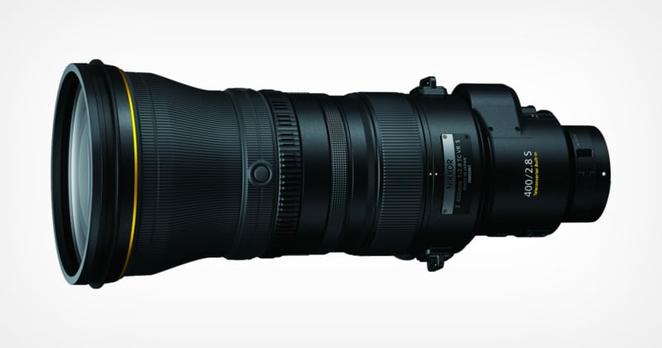
Nikon has announced that it is developing a new 400mm f/2.8 TC VR S prime lens with a built-in 1.4x teleconverter for Nikon Z-mount, which will be the first super-telephoto lens made for Nikon's mirrorless system.
The new Nikkor Z 400mm f/2.8 TC VR S prime lens will belong to the S-Line of Nikon Z Lenses that the company states "pursues the ultimate in optical performance." The super-zoom prime lens will feature a built-in 1.4x teleconverter and a new coating that Nikon promises will deliver the highest quality anti-reflection performance in Nikkor lens history.
The company says the lens will have the ability render incredibly realistic and high-resolution color while also providing what Nikon describes as a beautiful and smooth bokeh pattern. The company also says this lens will be very useful for action, sports, and wildlife photographers, as well as being quite useful for videographers who aim to capture footage of the same genres. At the time of publication, PetaPixel was not provided specific details on this new coating, the expected price, nor when the lens is expected to come to market.
In fact, other than the included image and the few notes above, Nikon provided scant little information about the lens.
If the amount of time it took Nikon to go from announcing the development of the Z9 to actually fully unveiling the camera is any indication of wait time, however, it will likely be several months before more is revealed. On that note, the current parts shortage and global supply chain disruptions are likely to delay any new product even further, so it's safe to assume the lens won't be available until 2022.
The most recent 400mm f/2.8 that Nikon has produced would be the AF-S Nikkor 400mm f/2.8E FL ED VR Lens which was originally released in 2014. It doesn't include a built-in teleconverter and the exterior of the lens looks substantially different from the image provided of the new mirrorless 400mm f/2.8, so it's likely safe to assume that Nikon has redesigned or changed the optical formula.
If so, that would be a departure from Canon's choice to simply build in an EF to RF mount adapter into its latest 400mm lens. there isn't really any indication that Canon's choice made an inferior lens, but the choice did add a bit of length to the lens that could have probably been avoided if Canon had chosen to change the optical formula. In Canon's defense, its choice did allow it to release the optic much faster than it appears it will take Nikon to produce its new one.
#equipment #news #14x #400mm #announcement #development #developmentannouncement #ftz2 #ftzii #mirrorless #mountadapter #nikkor400mmf28tcvrs #nikon #nikonz #nikonzmount #supertelephoto #teleconverter #zmount



OM Digital Developing 20mm f/1.4 and 40-150mm f/4 Lenses for M43
OM Digital has released a new lens roadmap as well as announced the development of two new lenses for Micro Four Thirds (M43), the M.Zuiko Digital ED 20mm f/1.4 Pro and M.Zuiko Digital ED 40-150mm f/4.0 Pro.
OM Digital, which still releases products under the Olympus name but is doing business separately from its parent company after it was purchased by Japan Industrial Partners (JIP) last year, has revealed very little information about the two lenses other than their names.
Both the M.Zuiko Digital ED 20mm f/1.4 Pro and M.Zuiko Digital ED 40-150mm f/4.0 Pro lenses will join the M.Zuiko Pro series which OM Digital says features compact and lightweight lenses that offer excellent resolution and "make the most of the unrivaled portability and image quality that is the hallmark of the Micro Four Thirds System."
As part of this development announcement, OM Digital has also updated its lens roadmap as part of its goal to "leverage the strengths of the Micro Four Thirds System to enhance its lineup of lenses and broaden opportunities for photographic expression."
The two lenses that have been added to the roadmap are the only updates, and the company still promises that an additional macro lens and two telephoto zooms will come to the system in the future, but did not provide any expected timeline or additional information on the expected focal lengths or aperture speeds.
The full updated roadmap can be seen below:
OM Digital has been largely quiet since its acquisition by JIP completed in January. In fact, since Olympus concluded negotiations for the sale of the photo division, OM Digital has only released three products in total and one firmware update. It launched the 150-400mm f/4.5 Pro (which quickly sold out) and also added Bird Detection autofocus and RAW video support to the E-M1X via a firmware update in November of last year, and the PEN E-P7 (which was not designated to come to North America) and the 8-25mm f/4 Pro lens were announced seven months later in June. Throughout that period, OM Digital executives made multiple press appearances to assure consumers that new products would be coming.
While it has been a slow process for OM Digital, this announcement may be an indication that the company is starting to hit a stride, and it is possible that by this time next year OM Digital will be releasing new products and technologies at a stable and steady clip.
#equipment #news #development #developmentannouncement #lensroadmap #mzuikodigitaled20mmf14pro #mzuikodigitaled40150mmf40pro #olympus #omdigital #prime #roadmap #telephoto




Fujifilm’s First Stacked, Back-Illuminated, X-Trans Sensor Coming in 2022
Fujifilm has announced that it is currently developing a new flagship camera that will feature the company's first back-illuminated, stacked layer X-trans CMOS sensor.
The company has said that to celebrate the tenth anniversary of the X-system, it plans to bring out not only new lenses (which were announced as part of a lens roadmap) but will also launch a new flagship camera that features the company's first combination stacked layer and backside-illuminated X-trans CMOS sensor.
While Fujifilm's current fourth-generation 26.1-megapixel image sensor that is featured in the X-T30, for example, is already backside-illuminated, the company has never used a stacked structure before.
Back-illuminated, also referred interchangeably as backside-illuminated or BSI, sensors are a type of image sensor that uses an arrangement of imaging elements that increase the amount of light captured and therefore improve low light performance. Typical front-side illuminated sensors are constructed similarly to how a human eye works with a lens in front and the photodetectors in the back. While easier and simpler to manufacture, the way the parts that make up the sensor are arranged will actually cause some of the light that hits it to reflect back outwards and reduce the amount of light signal that it is capable of actually recording to make an image.
Image by Cmglee, CC BY-SA 4.0
In contrast, back illumination rearranges the same elements behind the photocathode layer so that the wiring no longer is in front, which improves the light-gathering capabilities from about 60% efficiency to over 90%.
A stacked CMOS is considered a next-generation backside-illuminated sensor and was first developed by Sony in 2012. In this design, the supporting circuitry that was moved behind the photodiodes in a standard backside-illuminated sensor are further moved below the active pixel section and adds an additional 30% improvement to light gathering capability. Because parts have been rearranged on a stacked CMOS sensor, designers can do more with the space. Sony, for example, has built RAM directly into the sensor which has resulted in dramatically improved readout speeds, a system that has allowed the Alpha 7R IV, Alpha 9 II, and Alpha 1 cameras to perform extremely fast frames per second bursts at ever-increasing resolutions.
Generally speaking, this sensor design doesn't improve image quality but instead focuses the benefits at pure speed of data transfer.
In the case of Fujifilm, the company hasn't indicated how much resolution should be expected out of what is likely to be the fifth-generation X-trans sensor, but even if the company chooses to stick around the mid-20-megapixel range, the performance gains from adding that stacked design will very likely be considerable when compared to the fourth-generation sensor currently available.
#equipment #news #backsideilluminated #bsi #cameradevelopment #developmentannouncement #fifthgeneration #flagship #fujifilm #newflagship #stackedcmos #xtrans


Fujifilm’s Roadmap Promises Five New Lenses, Including a GF Tilt-Shift
Fujifilm has revealed an updated lens roadmap for both the medium format GFX system and its X Series mirrorless cameras.
Fujifilm promises that 17 lenses are currently on the development roadmap for its medium format system.
While not all 17 lenses were revealed, the company did note three lenses that are coming to the GFX system in the future. The first lens is will be the large aperture prime GF55mm f1.7, which is equivalent to a 44mm on the 35mm film format. The company says that the wide aperture combined with the large sensor size will produce an extremely shallow depth of field that will render the backgrounds of photos out of focus. It will join the GF80mmF1.7 R WR to expand the company's lineup of f/1.7 lenses.
The second lens that was noted as coming to the GFX system will be the first G-mount ultra-wide-angle zoom GF20-35mm lens, which will be equivalent to a 16-28mm lens on the 35mm film format.
Finally, the third lens that is currently in development is a tilt-shift lens designed with professional photographers in mind. Fujifilm says that it will be able to shift the focal plane to correct image distortion and produce distortion-free photos for the purposes of, for example, architecture. Fujifilm did not state specifically what focal length for the tilt-shift lens can be expected.
The X Series will also be getting two new lenses which have been added to the company's development roadmap. The first lens is the XF18-120mm zoom lens (equivalent to 27-183mm in the 35mm film format), designed for video creators. It will be the first XF lens that provides a function that would allow a single person to shoot a video production alone. Fujifilm did not elaborate on what that function would be or what to expect from it.
Finally, the company is also developing the XF150-600mm (equivalent to 229-914mm in the 35mm film format). This ultra-telephoto zoom extends the X Series’ longest focal distance among zoom lenses. The company says that this lens is a perfect choice for both wildlife photography and sports photography.
With these additional lenses, the X Series system will increase to 40 total first-party optics.
Image credits: Header photo licensed via Depositphotos.
#equipment #news #development #developmentannouncement #developmentroadmap #fujifilm #fujifilmgfxsystem #fujifilmlenses #fujifilmxsystem #lenses #lensroadmap #roadmap #tiltshift


 diyphotography (unofficial)
Tamron claims "world's first" f/2 max aperture mirrorless zoom with the new 35-150mm f/2-2.8 - DIY Photography
It looks like Tamron is taking a leaf out of Sony’s book, claiming records with hidden caveats. First, we had Sony claiming that the A7c was the world’s “smallest and lightest full-frame camera” – which it objectively wasn’t – and then Sony started adding caveats to the claim. Now, Tamron’s doing it with, perhaps not […]
Tamron Developing 35-150mm f/2-2.8 and 28-75mm f/2.8 for E-Mount
Tamron has published development announcements for a duo of upcoming lenses. The first is the 28-75mm f/2.8 Di III VXD G2, and the second is the 35-150mm f/2-2.8 Di III VXD. Both will be released for Sony E-mount cameras.
Tamron 28-75mm f/2.8 Di III VXD G2
The 28-75mm f/2.8 G2 is Tamron's successor to the original 28-75mm f/2.8 DI III RXD and the company says the new model will retain the compact size found in its predecessor. Speaking of the design, it has been updated to be more comfortable to operate and has a more "ergonomic texture." While it will still be compact, it will also feature a new optical construction that Tamron says has been revamped to enhance its imaging performance and to make it compatible with the latest digital cameras that offer higher resolution.
The autofocus system is Tamron's VXD (Voice-coil eXtreme-torque Drive) linear motor mechanism and was chosen for its high speed and accuracy. The lens will have a minimum focusing distance of 7.1-inches at the wide and and a maximum magnification ratio of 1:2.7.
Tamron expects the 28-75mm f/2.8 G2 lens to launch sometime in 2021, but was not more specific on the timing. Tamron also did not provide an expected price for the lens.
Tamron 35-150mm f/2-2.8 Di III VXD
Tamron says that the 35-150mm f/2-2.8 Di III VX will be the world's first mirrorless zoom lens with a maximum wide-open aperture of f/2. The company believes that the wide range of focal lengths offered in this lens will make it ideal for travel photography. Like the 28-75mm f/2.8 G2, the 35-150mm f/2-2.8 will feature Tamron's VXD autofocus motor and will likewise also feature a new design that has been made to enhance operability and ergonomic texture.
Tamron expects the 35-150mm f/2-2.8 lens to launch sometime in 2021, but was not more specific on the timing. Tamron also did not provide an expected price for the lens.
Both of Tamron's new lenses will be compatible with the Tamron Lens Utility software that connects lenses to computers via the connector port on the bodies of the lenses. This allows users to update firmware and customize shooting functions such as focus set buttons and focus ring settings.
#equipment #news #development #developmentannouncement #emount #lens #newlens #sonyemount #sonylens #tamron #tamron2875f28diiiivdxg2 #tamron35150f228diiiivxd


Tamron’s new 18-300mm is the first 3rd party autofocus zoom lens for Fuji X systems
#gear #18300mm #18300mmf3565 #developmentannouncement #gearannouncement #lensannouncement #tamron

Tamron's new 18-300mm is the first 3rd party autofocus zoom lens for Fuji X systems - DIY Photography
Since Fuji decided they were opening up their X mount to 3rd party lens manufacturers to be able to make autofocus lenses, we’ve seen a few new releases trickle out from manufacturers like Tokina, Viltrox, Pergear and even Zeiss. But so far (unless I’m mistaken – and I’m sure all the Fuji shooters will correct […]