LYRICS:
I bought a ticket to the end of the rainbow #BoughtATicket
I watched the stars crash into the sea #StarsCrash
If I could ask God just one question #AskGodJustOne

Celebrity Stars Crash Into The Sea...

Someday we'll know ... #WeThePeopleKnow #SomedayWeWill #FWakeSomedayWeWill

#WeForgotTheGreatSealUSA ! #Deism #FWakeDeism

https://www.youtube.com/watch?v=bDmA8qQKhMY

New Radicals - Someday We'll Know

Music video by New Radicals performing Someday We'll Know. (C) 1998 Geffen Records#NewRadicals #SomedayWellKnow #Vevo

YouTube

The Man without Superstition: John Toland and China


“None are found today in the whole mortal world, who are either as refined in their manners and more honourable, or in all the burdens and responsibilities of the good civic offices less in error than the sect of the Chinese called the literati. Their commission and mandate from the king is a civil administration which excludes religious cults. Although they believe in an eternal and incorruptible world, they do not believe in a Spirit which is distinguished from the structure of matter; and they completely reject as stories and political contrivances the doctrine of the future existence of souls”

John Toland,
Adeisidaemon sive Titus Livius a Superstitione Vindicatus,(Amsterdam,1709)

The Chinese literati were the mandarins, trained in Confucianism, who rose by a series of examinations to fill the official positions as judges and administrators in imperial China. John Toland (167-1722) had a positive opinion of Chinese society and culture, and particularly Confucianism. His views stand in stark contrast to the hostile attitudes that became common among Europeans in the course of the 19th century. For Toland, China was a model, an example to follow. Europeans had much to learn from it. When did the change take place and why?

The transitional point may come with Montesquieu, who made critical remarks about China in De l’esprit des loix (1748). It may be that attitudes to China changed as anti-absolutist and republican views gained traction in Europe. The change may be due to the very negative account of China that George Anson published after his piratical voyage around the world. But there were plenty of earlier critics of China such as Daniel Defoe. Defoe was a sinophobe if ever there was one. Nor is the equation between radical political views and hostility to China entirely satisfactory. Toland was a radical Whig, an anti- absolutist and a republican but found much in China to admire.

What impressed Toland about China was that the government seemed to operate on largely secular principles. It was unlike any European state in that respect. All European states were confessional states. They might tolerate religious minorities to some degree but this was by no means common. The Dutch Republic and England were exceptions but even there toleration was limited and always under threat. The Chinese form of government seemed to Toland to have produced an exemplary system which was superior to that found in European states because it was entirely civil in character.

It could be argued that the Chinese literati had a state religion no less than the ruling elites of Europe. They were Confucians and practiced rituals which were intended to ensure the welfare of the empire. But Toland did not regard Confucianism as a religion since the Chinese literati did not recognise spirits that were separate from the structure of matter and nor did they believe in punishments and rewards for an immortal soul after death. Such beliefs were no more than “stories and political contrivances” as far as he was concerned. They were a feature of the “priestcraft” which the clergy used to instill superstition and fear into the minds of the faithful, as far as Toland was concerned.

Toland dedicated Adeisidaemon to “carissime Antoni,” my dearest Anthony, that is to say Anthony Collins the freethinker at whose house he often stayed. Collins was associated with a group of radical Whigs that emerged in the growing coffee house culture of London. They often gathered at the Grecian coffee house. It was to the Grecian that George Berkeley went as a young ecclesiastic intent on confronting deists and afterwards claimed he had heard Anthony Collins argue for the non-existence of God. Among this group were John Trenchard and Thomas Gordon who produced the Independent Whig a journal to which Collins contributed as did Toland’s patron Robert Molesworth. China figured in Trenchard and Gordon’s writings as an example of a state in which religious diversity was tolerated, producing a happy and prosperous society.

The problem that confronted the radical Whigs after 1688 was how to develop an effective state that preserved the liberties they valued, including freedom of thought, in a period of rapid social and economic change that seemed to favour powerful, well-armed, well-resourced centralised states. John Locke had drawn on the earlier concepts of natural rights to develop a theory which included the right of resistance but the post-1688 Whigs were not in the business of overthrowing the state. Whatever its shortcomings might be they wished to defend the British state against internal and external threats. The plea for toleration was rooted in their religious thinking but there was a political aspect to it as well and it became an integral part of their theory of the state. Toleration became central to their political writings and China was an integral to their arguments for toleration.

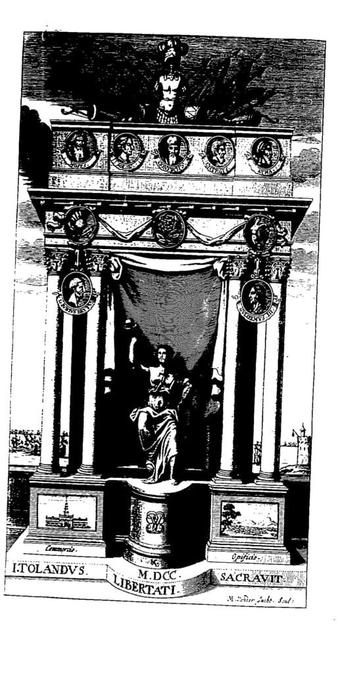
Toland can be identified with the “Country” ideology associated with Harringtonian republicanism. But if we take his use of China as a model form of state seriously then the court versus country dichotomy looks a little strained. China was not a republic in a traditional sense. Already in 1700 Toland’s edition of Oceana by James Harrington had referenced Confucius. The frontispiece shows Confucius alongside Moses, Solon, Lycurgus, and Numa Pompilius, Brutus the defender of Roman republican virtues and William III who had come to the defence of the English constitution against what the Whigs believed to be the tyranny of James II. Here was a strange amalgam fusing the Biblical concept of law, with the classical republics of ancient Greece and Rome, added to the contemporary political experiences of 1688, which were now combined with the relatively recently discovered figure of Confucius.

This odd assembly of notables represents a visual summary of the political conceptions that ran through the ideology with which the Whigs sought to underpin their developing vision of the state. James II’s attempt to create a centralised, efficient, bureaucratic state on the lines of those that were emerging across Europe had offended his subjects, both Whig and Tory, and led to his overthrow. Even with James gone the same fundamental problem remained. Could such an effective state exist without being absolutist in character and being based on the principle of divine right?

Toland’s comments on China in Adeisidaemon were an attempt to suggest how that could be done. They reflect a radical Whig approach to articulating a concept of a non-absolutist state which did not rely on superstition to maintain the loyalty of its citizens. From different sources, political traditions and periods of history Toland assembled a unitary vision of an ideal state. It was a republic but not in the modern sense of a state without a king. This utopian republic had a king who respected the law and appointed magistrates who governed without partiality for any religious sect. This was a state founded on law which could be tolerant of diversity among its citizens. Toland was doing rather more than preserving the Whig tradition. He was expanding it in significant ways.

The makeshift character of Toland’s concept of the state underlines how recent the British state was. Created by the Act of Union of 1707 Great Britain had come into existence only two years before Toland published Adeisidaemon. Historian J.H. Plumb argued that Britain had achieved a unique stability under a kind of Venetian oligarchy of super-rich Whigs after three generations of rebellion, treason and plot. Plumb’s view was not one which Toland and his contemporaries would have recognised. They feared that the gains of the 1688 Revolution would be overthrown by an external threat at any moment or undermined from within by corruption and financial speculation. From their point of view, Great Britain was a kingdom beset with economic and political problems at home and powerful enemies abroad. It was vulnerable and insecure, a precarious newcomer on the world scene. As the Whig oligarchy eventually consolidated its hold on power Toland’s writings began to look outmoded. By the end of the century Burke could dismiss the revolution of 1688 as “a small and a temporary deviation from the strict order of a regular hereditary succession”. But in Toland’s lifetime the British state was not, as Plumb argued, “legitimised by achievement and buttressed by massive economic and political power.” That was still to come.

Britain was a state with shallow historical roots that seemed illegitimate to wide sections of society. Toland and his contemporaries still saw themselves as engaged in a life and death struggle against absolutism. They can look like conspiracy theorists but their paranoia had some foundation. Toland’s political world was shaped by conspiracies. The Whigs had good grounds to fear a popular counter-revolution urged on from High Church pulpits and backed by foreign armies and subsidies. Support for the exiled Stuart monarchs and the mystique of kingship remained strong.

The very newness of the British state made it difficult to characterise in terms of the traditional political vocabulary derived from either ancient and renaissance city states or the dynastic states of Europe. There was a theoretical lag in comprehending what the complex upheavals of the late seventeenth century had brought into being in Britain. Toland’s Adeisidaemon is a long way from being a work of systematic political theory. He never presented such a theoretical account of the state. What he did, in an allusive and imaginative way, in Adeisidaemon was to sketch the outline of a state by stretching the established republican tradition into a new form.

At the centre of Adeisidaemon was the Roman historian Titus Livius, better known as Livy, who wrote a history of Rome from its foundation to his own lifetime in the reign of Augustus. In the course of Livy’s narrative Rome was repeatedly faced with outbreaks of superstitious mass hysteria from the population in times of danger. The role of the political elite in Livy’s view was to exercise a restraining and moderating influence and bring the citizens back to correct religious rites rather than displays of emotion. Livy’s account of Rome had a resonance in early eighteenth century Britain, when London remained the centre of militant Tory, High Church, or Jacobite popular protest. In the Sacheverell riots of 1710 High Church clergymen egged on the crowds than burned dissenting meeting houses and threatened the Bank of England. The Hanoverian dynasty was far from popular. Effigies of George I were burned and Jacobite mementoes imported to meet popular demand. The writer Anna Laetitia Barbauld later recalled the terror that the Jacobite rising of 1745 caused in her Dissenting Leicestershire home. Livy’s admonitions offered a contemporary political lesson which retained its relevance for Whigs long after Toland’s death.

If Livy’s history of Rome offered a case study in the dangers of superstition, China offered an apparently exemplary model of how a state could restrain superstition by good governance. The Qing dynasty seemed to have overcome the turbulence of the mid-seventeenth century when the previous dynasty had been overthrown. In the course of the eighteenth century its population and economy were growing strongly. It held together a large and diverse empire which seemed impregnable to external attack. China provided a glimpse of the way in which republican virtues could be preserved in an era of large, territorial states with powerful executives. The philosophy of Confucius seemed to be the ideological underpinning of this state and to offer an alternative to divine right absolutism.

Toland’s death in 1722 followed the collapse of the South Sea Bubble. He lost all the money he had invested in the speculative venture and died in poverty as a result. It was more than a personal tragedy. He was one among thousands ruined by the crash. The scale of the crisis comes into focus when it is remembered that the British government was still paying the debt it incurred in 2008. The financial crisis coincided with the exposure of the Atterbury Plot. Francis Atterbury, the Bishop of Rochester was found to have conspired to oust George I and restore the Stuart line. Here was ample confirmation of the vulnerability of the Hanoverian regime and the danger of High Church conspiracies whipping up popular emotions. Toland’s appeal to Livy and the Chinese literati as men without superstition seemed to be justified by events.


J. H. Plumb, The Growth of Political Stability in England, 1675–1725 (London: Macmillan, 1967).

Diego Lucci, “Deism, Freethinking and Toleration in Enlightenment England,” History of European Ideas, 43 (2017): 345-358

J.G.A. Pocock, The Machiavellian Moment: Florentine Political Thought and the Atlantic Republican Tradition (Princeton: Princeton University Press, 1985).

George F.E Rudé, Ideology and Popular Protest, London: Lawrence and Wishart, 1980).

#Confucius #deism #Toland

The #FrenchRevolution's first replacement for #RomanCatholicism as state church was the #CultOfReason, an #Enlightenment #atheism. It was in turn replaced on #ThisDayInHistory in 1794 with a #CultOfTheSupremeBeing, a form of #Deism. It fell with #Robespierre & was banned in 1802.

“Here’s the church, here’s the steeple, open the doors, and see all the people”*…

It’s Sunday, and war is raging (again) in the Middle East. This time around, the strains of fundamentalist Christian thought are hard to miss in the justifications of the role of the U.S. in the conflict. The widely-circulated reports of troops being briefed that the war in Iran is meant to hasten the Biblical End Times may or may not be true. But it seems clear that the millennial contingent in Trump’s movement is all in on an apocalypse. (And here.) As the right-wing site Media Matters reports, “Christian media figures have claimed that the Iran war could signal ‘the second coming’ or the ‘End Times’ and said ‘we are watching incredible prophecy in this time come to pass’.”

Tal Lavin has reached back to the work he did for his book Wild Faith to help us understand…

As chaos and violence break out across the Middle East in a war led by the US with Israel as junior partner, I wanted to revisit my research on Christian apocalyptic prophecy… about the evangelical Christians eagerly looking forward to the end of the world—and influencing foreign policy to bring it closer. It’s difficult to conceive of willful courting of disaster for religious reasons, but decades of modern Christian prophecy eagerly foresee mass bloodshed in the Middle East as a prelude to Christ’s triumphant return. Evangelicals of this stripe form a crucial part of Trump’s base and governing coalition…

Eminently worth reading in full: “Yearning for the Apocalypse,” from @swordsjew.bsky.social.

And lest we think that this inveighling is in any way unprecedented, Matthew Avery Sutton, reminds us that there’s a long history of politics using religion (and vice versa). In an excerpt from his new book, Chosen Land: How Christianity Made America and Americans Remade Christianity, he tells the story of Reconstuction, during which churches were mobilized on both sides of the divide-that-never-went-away…

… In the aftermath of the Civil War, federal leaders sought help from Christian groups… as they sought to reassert their power across the entire United States. The US Army had won on the battlefields, and now governing authorities and their protestant collaborators sought to secure the peace. They aimed to reconstruct the nation, to rebuild Americans’ shattered sense of their nation’s exceptional history and manifest destiny, and to reinvigorate their commitment to the United States’ Christian mission. But to succeed, policymakers knew they needed to limit dissent—including religious dissent.

Christian activists played key roles in every part of postwar reconstruction. In the South, Black ministers and White missionaries welcomed the formerly enslaved into the faith and worked with them to establish independent social and political lives. Defeated Southern Whites launched a multi-generation effort to defend their treason by reimagining the causes of the Civil War and God’s role in it. In the West, a series of Indian wars led to the US government’s creation of a comprehensive reservation system, where government-sponsored missionaries sought to Christianize tribes and “civilize” their children. In Utah Territory the US government cracked down on the Church of Jesus Christ of Latter-day Saints and its impressive theocracy, seeking to quell religious dissent.

Across the nation, Reconstruction policies provided new opportunities for church leaders in collaboration with the government to impose their ideas and values on the land and its peoples. Protestant activists believed that they alone had the tools and expertise to integrate Black and Native peoples, former Confederates, and religious dissenters into the body politic, while bringing healing and reconciliation to all Americans on their terms. Rocked by the split over slavery and then the war, they worked to build unity by identifying common threats and enemies and organizing Christians against them. Their actions demonstrated that after the conflict, just as before, the free exercise clause did not apply to all equally. But minority groups constantly challenged the power of mainstream Christian leaders…

… Only about one-third of enslaved Americans considered themselves Christian at the start of the Civil War. But in the Reconstruction era Black church going skyrocketed. And just about all of those who converted chose to attend Black-led churches. The days of Southern Black Christians submitting to second-class treatment in the house of the Lord had ended. In urban areas, African Americans could usually join churches that Black activists had founded before the war. In rural areas, they had fewer options. They sometimes had to settle for makeshift meetings in vacant buildings or arrange outdoor services until they could build rudimentary houses of worship.

Black clergy became some of the strongest advocates for full equality and rights in the postwar South. Seeing Jesus as a liberator, they aimed to make the egalitarianism of the gospel and the Declaration’s line that “all men are created equal” the reality in the United States. Many engaged directly in politics, understanding that while slavery might have ended, securing political equality required vigilance…

… Black ministers’ political engagement made them targets of violence. Members of the Ku Klux Klan, a [Protestant-led] terrorist organization founded by Southern Whites shortly after the war, burned down churches and threatened Black activists. A journalist testified to the US Senate about his interview with a minister. While “he had been preaching on the circuit,” Klansmen dragged the preacher from bed in the middle of the night and “beat him severely.” They “told him that if he returned to the county he would suffer for it.” This was one example of many. As racial violence escalated in the South, serving as a minister proved dangerous…

… Historian, sociologist, and Black activist W.E.B. Du Bois summarized in 1903 the role that churches played in Black life, especially in the postwar South. “The Negro church of today is the social centre of Negro life in the United States,” he wrote, “and the most characteristic expression of African character.” Postwar Black churches, as Du Bois understood, represented the heart of Black efforts to secure social, political, and religious equality. Church leaders had engineered the Christian faith into a tool of liberation, which made them a threat to the White Christians of the South and much of the rest of the United States.

In addition to working to suppress Black political and religious power, many Southern Whites launched a quasi-religious campaign to reshape the memory of the Civil War. Rather than acknowledge their deep investment in slavery, they recast the conflict as a tragic clash between two honorable forces—the North fighting to preserve the Union, and the South struggling to defend local autonomy and states’ rights. The authors of this revisionist account reduced slavery to a secondary issue, incidental to the “real” causes of the war. As a result, by war’s end, many White Southerners felt they had no reason to repent, no moral reckoning to face, and no obligation to embrace Black equality or suffrage. For them, the war had simply preserved the Union and, almost as an afterthought, ended slavery. Nothing more.

Christianity became central to this new Southern narrative. In defeat, White Southerners cast themselves in the role of Christ, imagining their suffering as redemptive. They claimed they had sacrificed for the greater good of the nation, their values—chivalric protection of White women, paternalistic care for those they enslaved, and Christian devotion—positioned them as the rightful moral leaders of the country. In their view, God had chosen them to guide the nation toward righteousness, but first he had humbled and purified them through the bloodshed of war…

Also eminently worth reading in full: How Christianity Was Used By the Powerful and the Marginalized to Shape Post-Civil War America,” from @literaryhub.bsky.social.

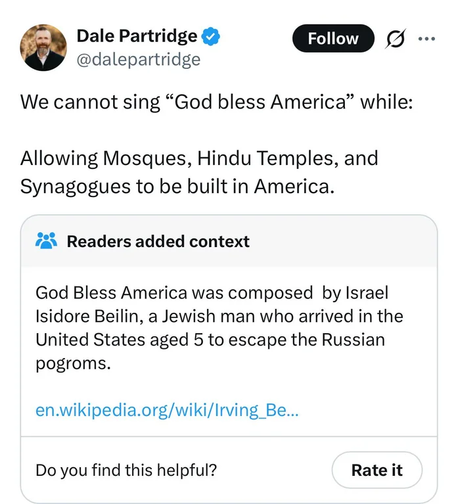
We are reminded why our founding fathers– so many of them, Deists— so wisely insisted on freedom of religion and separation of church and state.

Apposite: “The ‘Straight White American Jesus’ podcast covers the history, philosophy, theology, and politics of Christian nationalism” (from Boing Boing)

Also, (under the general heading “things aren’t always what they seem”): “The Iran War’s Most Precious Commodity Isn’t Oil,” (gift article from Bloomberg)

And finally: only vaguely related, but fascinating: “Preached Whales“– (landlocked) Central European pulpits shaped like fish, whales, and boats.

classic children’s fingerplay rhyme

###

As we celebrate separation, we might recall that it was on this date in 1965 that “Subterranean Homesick Blues” by Bob Dylan was released.

Johnny’s in the basement, mixin’ up the medicine / I’m on the pavement, thinkin’ about the government…

https://youtu.be/MGxjIBEZvx0?si=YBG68RAAPgdVvRIb

The opening sequence of D. A. Pennebaker‘s Dont Look Back (the apostrophe is absent in the title… and yes, that’s Allen Ginsberg in the background)

#apocalypse #BobDylan #Christianity #church #culture #deism #endTimes #fundamentalism #history #politics #religion #religiousFreedom #seperationOfChurchAndState #society #state #SubterraneanHomesickBlues

Cult of the Supreme Being

Also known as (in French): Culte de l’Etre supreme. This cult was a form of Deism established by Maximilien Robespierre during the French Revolution.

This was supposed to be the intended state religion of France & a replacement for its rival, the Cult of Reason & also a replacement for Roman Catholicism. It went unsupported after the fall of Robespierre. This cult, along with the Cult of Reason, was officially banned by First Consul Napoleon Bonaparte in 1802.

The French Revolution led to many radical changes in France. One of the most fundamental changes was the official rejection of religion.

The 1st new major organized school of thought came out under the umbrella term: the Cult of Reason. The Cult of Reason purified a mix of mainly atheistic views into an anthropocentric philosophy. Anthropocentric is another word for Human Supremacy or Human Exceptionism. No gods were worshipped, at all, in the Cult of Reason.

The straight-up rejection of any or all godhead horrified Robespierre. He wasn’t a fan of Catholicism, but he had a special distain for atheism. He thought that a belief in a supreme being was important for social order. He’d quote Voltaire: “If God didn’t exist, it would be necessary to invent Him.”

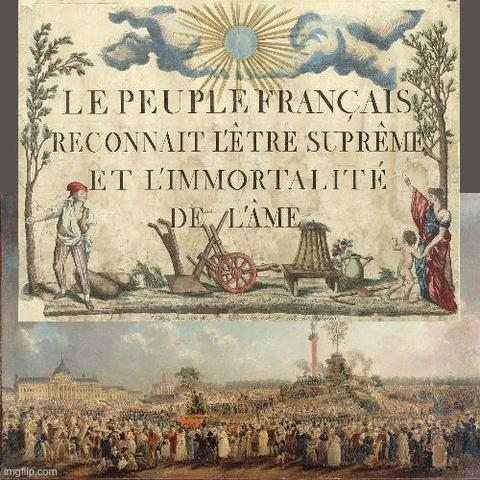
In late 1793, Robespierre gave a fiery denunciation of the Cult of Reason & its advocates. He then gave his own vision for a proper Revolutionary religion. As 1 does. Devised entirely, almost, by Robespierre, the Cult of the Supreme Being was authorized by the National Convention on May 7, 1794 as the civic religion of France.

France, as of 2025, doesn’t have an official state religion. This was established by a 1905 law that bans the state government from funding, or recognizing any religion.

On May 7, 1794, the National Convention established the Worship of the Supreme Being. The opening articles of the Decree Establishing the Worship of the Supreme Being of the 18th Floreal of the Year II (Floreal was the 8th month of the French Republic calendar.) declared: 1) The French People recognize the existence of the Supreme Being & the Immortality of the Soul. 2) They declare that the best service of the Supreme Being is the practice of man’s duties. 3) They set among the most important of these duties the detestation of bad faith & traitors by caring for the unfortunate, respecting the weak, defending the oppressed, doing unto others all the good one can, & not being unjust towards anyone.

Robespierre dedicated festivals to the Supreme Being, to Truth, Justice, (& the American way…we’ll show ourselves out…), Modesty, Friendship, Frugality, Fidelity, Immortality, Misfortune, etc. The Cult of the Supreme Being was based on the creed of the Savoy chaplain that Jean-Jacques Rousseau had outlined in Book IV of Emile. Emile (or On Education) is a treatise on the nature of education & on the nature of man, written by Jean-Jacques Rousseau, who considered it to be the “best & most important” of all his writings.

To start off the new state religion, Robespierre declared that 20 Prairial Year II (June 8, 1797, also the Christian holiday of Pentecost.) would be a national celebration of the Supreme Being & future republican holidays were to be held every 10th day – the days of rest (decadi) in the new French Republican Calendar.

The Cult of the Supreme Being & its festival may have contributed to the Thermidorian Reaction & the downfall of Robespierre. With Robespierre’s death at the guillotine on July 28, 1794, the cult lost all official sanctions & disappeared from public view. It was officially banned by Napoleon on April 8, 1802 with his Law on Cults of 18 Germinal, Year X.

One-Time Monthly Yearly

Make a one-time donation

Make a monthly donation

Make a yearly donation

Choose an amount

$1.00 $5.00 $10.00 $1.00 $5.00 $10.00 $5.00 $10.00 $15.00

Or enter a custom amount

$

Your contribution is appreciated.

Your contribution is appreciated.

Your contribution is appreciated.

DonateDonate monthlyDonate yearly

#1802 #18thFlorealOfTheYearIi #1905 #20PrairialYearIi #28July1794 #7May1794 #8April1802 #8June1794 #anthropocentricPhiloshsophy #atheist #catholicism #cultOfReason #cultOfTheSupremeBeing #culteDeLetreSupreme #decadi #decreeEstablishingTheWorshipOfTheSupremeBeing #deism #emile #firstConsulNapoleonBonaparte #france #french #frenchRevolution #godhead #guillotine #humanExceptionism #humanSupremacy #jeanJacquesRousseau #late1793 #lawOnCultsOf18GerminalYearX #maximilienRobespierre #napoleonBonaparte #nationalConvention #onEducation #pentecost #romanCatholicism #thermidorianReaction #voltaire

How I know there is no God (or at least one that gives a crap): Trump is still alive and kicking and president.

#crueluniverse #atheism #deism #DonaldTrump

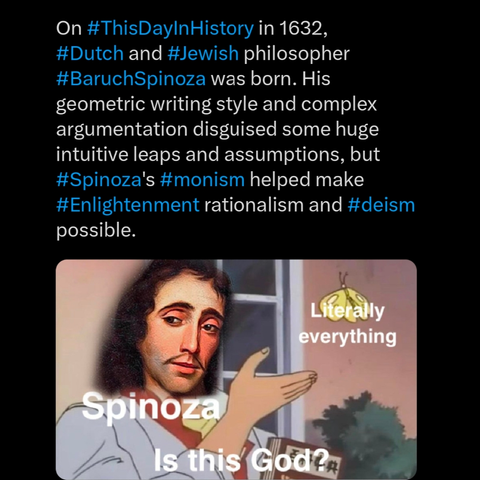
On #ThisDayInHistory in 1632, #Dutch and #Jewish philosopher #BaruchSpinoza was born. His geometric writing style and complex argumentation disguised some huge intuitive leaps and assumptions, but #Spinoza's #monism helped make #Enlightenment rationalism and #deism possible.
Secret History #10: The Conspiracy of Evil

YouTube
If God Exists, Why Can't We Find Him?

YouTube