Snowball Earth wasn’t fully frozen: ice-free oases sheltered early life | The-14

New research reveals Snowball Earth wasn’t fully frozen, with ice-free tropical oases possibly sheltering early complex life during extreme glaciation.

The-14 Pictures

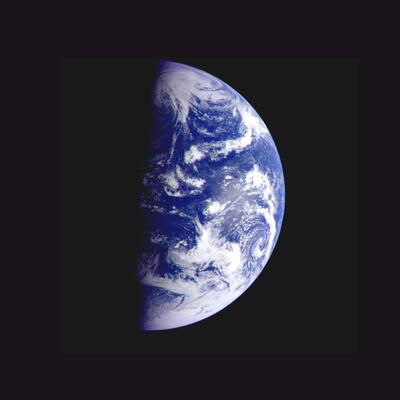
Some 700 million years ago, #Earth would have looked like a blinding white #snowball.

During the #Cryogenian period, from 720 million to 635 million years ago, the Earth was buried by massive ice sheets that marched from the poles to the tropics.

Surface temperatures were as low as -50°C.

Because the bright, white surface of the #planet reflected the Sun’s energy – a phenomenon known as the albedo effect – the Earth remained locked in this extreme climate state for tens of millions of years.

This seems an unlikely cradle for #life, yet new evidence suggests the frozen #ocean featured restricted ice-free oases that provided a lifeline for our earliest complex ancestors.

#astrobiology #planets
https://theconversation.com/snowball-earth-wasnt-fully-frozen-ice-free-oases-sheltered-early-life-275240

Snowball Earth wasn’t fully frozen: ice-free oases sheltered early life

New research reveals that Earth may not have been completely covered in ice.

The Conversation

Cryogenian (Geological periods 🌍)

The Cryogenian is a geologic period that lasted from 720 to 635 million years ago. It is the second of the three periods of the Neoproterozoic era, preceded by the Tonian and followed by the Ediacaran. The Cryogenian was a time of drastic climate changes. After the long environmental stability/stagnation during the Boring Billi...

https://en.wikipedia.org/wiki/Cryogenian

#Cryogenian #IceAges #Glaciology #Neoproterozoic #GeologicalPeriods #GeologyControversies

Cryogenian - Wikipedia

Longer #SnowballEarth deglaciation could have driven multiple phases of #SeaLevelRise and fall https://phys.org/news/2024-12-longer-snowball-earth-deglaciation-driven.html

Melting the #Marinoan Snowball Earth: The impact of #deglaciation duration on the sea-level history of continental margins. By Freya Morris et al. https://www.sciencedirect.com/science/article/pii/S0012821X24005648

"The #Cryogenian period is believed to have played a significant role in the emergence of complex, multicellular life, with animal and algal-based ecosystems beginning to appear once the ice sheets retreated"

Longer Snowball Earth deglaciation could have driven multiple phases of sea level rise and fall

Snowball Earth defines periods of our planet's history when ice spanned the globe, even reaching the equator. The planetary-scale freeze is thought to have been driven by ice sheet expansion triggering a climatic tipping point that led to runaway ice-albedo feedbacks: the ice sheets reflected incoming solar radiation back to space, causing climate cooling and continued ice sheet formation.

Phys.org

Cryogenian (Geological periods 🌍)

The Cryogenian is a geologic period that lasted from 720 to 635 million years ago. It is the second of the three periods of the Neoproterozoic era, preceded by the Tonian and followed by the Ediacaran. The Cryogenian was a time of drastic climate changes. After the long environmental stability/stagnation during the Boring Billi...

https://en.wikipedia.org/wiki/Cryogenian

#Cryogenian #IceAges #Glaciology #Neoproterozoic #GeologicalPeriods #GeologyControversies

Cryogenian - Wikipedia

The Garvellach islands, just south of Mull, have fabulous rocks preserving detailed records of repeated Neoproterozoic "snowball Earth" glaciations. But the exact age, and correlation with similar rocks elsewhere, has been controversial. New #OpenAccess paper shows that the sequence seems entirely Sturtian (older than 662 million years) + may be the most complete Sturtian section preserved on Earth.🤓😊🏆https://www.lyellcollection.org/doi/full/10.1144/jgs2024-029 #Cryogenian #SnowballEarth #Geology @Ruth_Mottram @TatianaIlyina
Snowball Earth’s Environmental Conditions Gave Multicellular Organisms Evolutionary Advantage
https://www.sci.news/paleontology/snowball-earth-multicellularity-13063.html #geology #biology #Cryogenian #SnowballEarth #multicellularity
Snowball Earth’s Environmental Conditions Gave Multicellular Organisms Evolutionary Advantage | Sci.News

New research suggests that Snowball Earth was an environmental trigger for the proliferation of complex multicellularity across several groups of eukaryotes.

Sci.News: Breaking Science News

I have now done #paleoart for every single period of the Phanerozoic, plus the Ediacaran and Cryogenian! So with that milestone, I thought it'd be fun to go through those periods in order and show off one paleoart of mine for each!

#Cryogenian

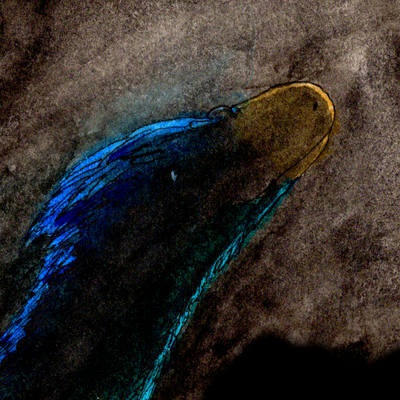
In the Cryogenian, the Earth froze over. Twice! Life wasn't much to look at yet, but I enjoyed drawing what our planet might have looked like at the time. The girdle of lakes at the left is the equator, which may have had ice-free patches.

(1/14)

A frozen world heaves through the void,its bright surface reflecting the light and heat of the Sun back into space.Is this one of the moons of the gas giants?No, it's our own Earth during the Cryogenian period,640 million years ago. These Snowball Earth events caused the entire planet to freeze over for millions of years. Life held on by the skin of its teeth, whether under the ice or in equatorial lakes.

#Cryogenian #SnowballEarth #Paleoart #SpaceArt #MyArt

The Earth was twice frozen over from 720 million to 635 million years ago during the Cryogenian Period.

#science #sciencefacts #earth #cryogenian #cryogenianperiod #sorryforthetypo🤭