 se;sm
se;sm Confoederatio Ludens
#2yearjubilee #chludens #throwback Our #TeamLausanne organised our first ever CH-Ludens workshop at the Swiss Museum of Games, focusing on interview methodologies. It was a truly wonderful and educational day! You can find an overview of the day and what we did here: https://chludens.hypotheses.org/2922

First CH Ludens workshop: Focus on interview methodologies
by Sophie Bémelmans As the inaugural host, we prioritized interview methodology due to widespread interest among project members in conducting oral history. We collaborated with the Swiss Museum of Games, under the direction of Selim Krichane, who graciously hosted this workshop. Recap of our inaugural workshop The workshop kicked off with an introduction by Eugen … Continue reading First CH Ludens workshop: Focus on interview methodologies
#2yearjubilee #chludens #throwback
A project like CH-Ludens requires regular attendance at conferences. In 2023, the annual Digital Games Research Association (DiGRA) conference took place in Seville, Spain.
A project like CH-Ludens requires regular attendance at conferences. In 2023, the annual Digital Games Research Association (DiGRA) conference took place in Seville, Spain.
#2yearjubilee #chludens #throwback On the 2nd of February 2023, the CH-Ludens team (20 people!) met for the first time at the HKB in Bern. An unforgettable #kickoff of to the project! ➡️ Read more on our blog: https://chludens.hypotheses.org/260


CH-Ludens Kick off. How the Sinergia came into being.
by Eugen Pfister How it all began Our SNSF-Sinergia project unites a dynamic team of 20 researchers across four university locations in Switzerland: The Bern Academy Of the Arts, the University of Bern, the University of Lausanne and the Zurich University of the Arts. We come from different cantons and countries as well as from … Continue reading CH-Ludens Kick off. How the Sinergia came into being.
(More than) two years of CH-Ludens 🎉 To celebrate our anniversary and the half-time of the project, we'll be doing a series of posts looking back on our achievements and best moments. ➡️ Stay tuned for more! #2yearjubilee #chludens #throwback

 BlackICE BBS / BBSindex.de
Die Vorträge des Vintage Computer Festival in Zürich aus dem Stream haben nun Timestamps. Mehr Infos gibt es in der Videobeschreibung.
Ab März werden die Vorträge in optimierter Qualität auch einzeln nach und nach zur Verfügung stehen.
Samstag: https://www.youtube.com/watch?v=eqKkViPzEDc
Sonntag: https://www.youtube.com/watch?v=yRu9bIxe7YM
#retrocomputing #vcfzh25 #zurich #zürich #apollo #gameboy #CHludens #demoscene #mountainbytes #pacman #FPGA #girlgaming #amiberry #amiga

Vintage Computer Festival Zürich 2025 Samstag - Vorträge #VCFZH25
 Adrian
I’m at the same time excited and insecure to share the publication of my first article. This is a new experience for me and I want to thank @thist and @Eugen_pfister for their guidance along the way.
“Observing the Coming of Age of Video Game Graphics” is an attempt to dig the complex history of video games through their visuality.
https://openhumanitiesdata.metajnl.com/articles/10.5334/johd.251
Observing the Coming of Age of Video Game Graphics: Exploring the historical development of video game graphics through distant viewing, hermeneutics and image clustering | Journal of Open Humanities Data
The Journal of Open Humanities Data (JOHD) aims to be a key part of a thriving community of scholars sharing humanities data. The journal features peer reviewed publications describing humanities research objects or techniques with high potential for reuse. Humanities subjects of interest to JOHD include, but are not limited to Art History, Classics, History, Library Science, Linguistics, Literature, Media Studies, Modern Languages, Music and musicology, Philosophy, Religious Studies, etc. Submissions that cross one or more of these traditional disciplines are particularly encouraged.
Ich habe zusammen mit @loise_b und @Eugen_pfister eine kleine aber feine Ausstellung zur Geschichte des Videospielens kuratiert - mit Fokus aufs Videospiel als etwas soziales. Ihr könnt diese in den nächsten zwei Wochen in der Stadtbibliothek Biel/Bienne besuchen und bespielen.
Avec Loïse et Eugen, j'ai organisé une petite mais belle exposition sur l'histoire du jeu vidéo, en mettant l'accent sur le jeu vidéo en tant qu'élément social. Vous pourrez la visiter et y jouer pendant les deux prochaines semaines à la bibliothèque de la ville de Biel/Bienne.
https://www.hkb.bfh.ch/de/aktuell/fachveranstaltungen/digital-days-nov-2024-lets-play

I had the absolute pleasure of talking about parts of my ongoing research at Digital History Switzerland. I presented my approach on how to analyze video game images, in which FAVR plays a crucial role. Nervous as always, but the hosts and present community did a wonderful job of being warm and welcoming. Although my topic was a bit besides what many others presented, I got some valuable feedback and discussions out of the event. 10/10 would do again.
- https://digihistch24.github.io/book-of-abstracts/submissions/438/
- https://www.ludov.ca/en/observation/graphical-technologies/game-favr
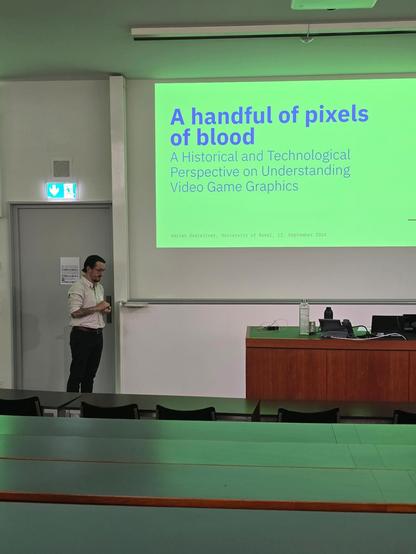
A handful of pixels of blood – DigiHistCH24 Book of Abstracts
What is the purpose of blood splattering onto the screen in a video game? Does it serve functional value, or is it mere intended to shock the user? Up to this day, little advance has been made in studying video game graphics’ material and structural conditions. They are not only narrative and aesthetic devices comparable to films but also hold functional information for players and are of an interactive nature (Fizek 2022; Gerling, Möring, and Mutiis 2023). Classical visual analysis struggles to encompass video game images because they focus on analogue or time-based visual media (Arsenault, Côté, and Larochelle 2015). How can blood spurting from a virtual body be analyzed? This research applies and extends the Framework for the Analysis of Visual Representation in Video Games (FAVR) to conduct and further adequate research on video game images.
 Michael Gisiger
A mention of #CHLudens in a recent #RetroGaming site Time Extension article:
