DALLAS
I thought I’d seen enough pictures of a total solar eclipse to guess what it might feel like to see one with my own eyes. But then I got out of bed at 5:30 a.m. Monday to fly to DFW and witness that afternoon’s eclipse with a friend who lives northwest of the city—and that revealed how awestruck I could be left watching celestial mechanics play out in a sky like none above me before.
The show started with a progression of the moon across the sun that I’d seen from our front yard during 2017’s partial solar eclipse. As the sun condensed into a crescent, the clouds began clearing—the weather development I wanted to see after a week of checking forecasts with an obsessiveness I’d last exhibited in the run-up to a space shuttle launch.
Two clouds passed between us and a now-shriveled slice of the sun (allowing me to get pictures of it without the exposure getting blown out) before giving way to an open expanse of blue, set up like a stage for totality.
The light got weirdly dim in a way that made me think of a photo with the white balance out of whack, nearby streetlights turned on, and it cooled off on that cul-de-sac, as if the clock had spun six hours forward into dusk.
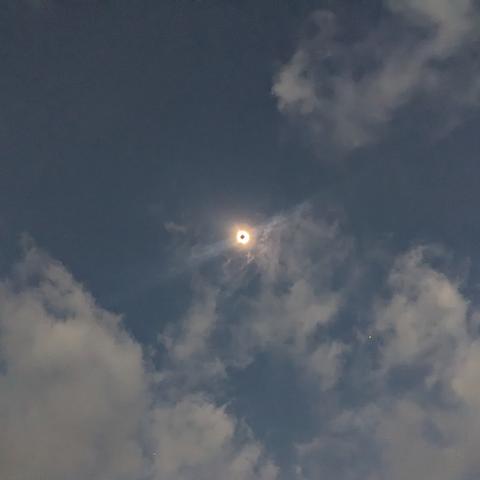
Then the sun blinked out–transformed into a black spot, wreathed by a delicate ring of shimmering light and surrounded by the glow of its corona radiating outward into a dark-blue sky. Two bright dots appeared: Jupiter to the left of our star, Venus below and to its right. I realized that I had never before experienced that perspective on our solar system.
I took pictures but mostly stared, trying to store this profoundly eerie sight in my memory for the rest of my life. After a few minutes that felt like more time, I could spot beads of light over the trailing edge of the moon–the sun shining through valleys some 239,000 miles away. Moments later, sunlight snapped back into existence.
I wrote this to my wife in an e-mail later that afternoon, trying to find words for what I’d seen:
“It’s just not anything my entire life of looking up at the sky had prepared me for. The sun isn’t supposed to look like that! It’s not supposed to be the darkest thing in the sky!”
None of the photos that I took quite captured what the eclipse looked like, mainly because that delicate ring of light appears in them as a thick glowing collar. I’m glad I didn’t take too many pictures, as Washington Post meteorologist Matthew Cappucci had advised in a March 8 essay.
Another part of Cappucci’s piece that now checks out is his assessment of traveling, even much farther than I did, to see a total eclipse: “more than worth it.”
https://robpegoraro.com/2024/04/08/darkness-at-141-p-m/
#2024Eclipse #astronomy #celestialMechanics #corona #Dallas #eclipse #solarEclipse #solarSystem #totality
 Jeremy Mallin
 3i/Atlas
 Oraldo Perales 🇺🇲 🇲🇽
 Ian Robinson
 MathiasTCK.bsky.social
 ƧƿѦςɛ♏ѦਹѤʞ
 Daniel Pomarède
 Michael Porter
 Rob Pegoraro