A new study connects recent regionally confined warming in China 2010ff to their strive for healthy air by scrubbing SO2 from their coal chimneys. *

In other news, India is lambasted by a politician for excluding most of their coal chimneys from SO2 scrubbing regulation. **

And here's a curious side effect of acid rain from SO2:
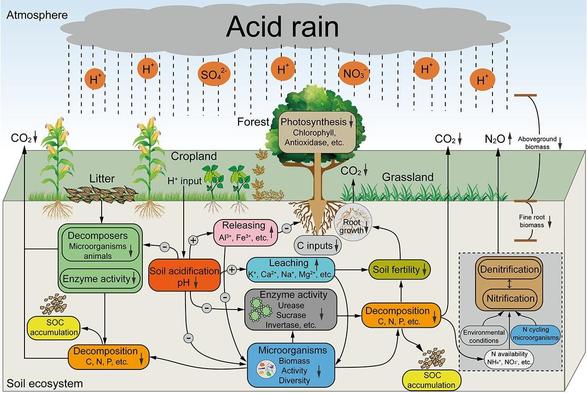
it reduces CO2 emissions from soil 💡
https://www.sciencedirect.com/science/article/abs/pii/S0341816221005725 "Acid rain reduces soil CO2 emission and promotes soil organic carbon accumulation in association with decreasing the biomass and biological activity of ecosystems: A meta-analysis" by Ziqiang Liu et al 2022

So when large areas simultaneously get rid of SO2 pollution
, CO2 emissions start to rise noticeably? Europe's SO2 reduction was fastest, USA is her typical laggard, and China began 2010ff and is now already on par with a mid-1990s Europe, much faster than USA.

My musings:
I guess, it means, once the soil removes the acid, CO2 emissions start to rise.
AFAIK, acid removal is no automatism in forest soil but I can imagine, removal from agricultural land happens automatically bit by bit during subsequent harvests? (Yum!)

Germany distributed chalk or something to her forest soils to counter the acidification and to rescue dying forests.

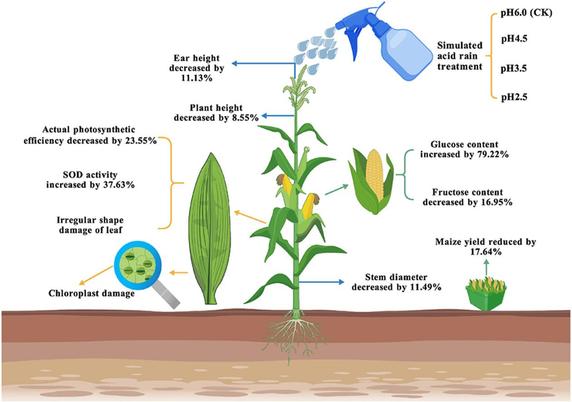
But. Plants and other beings suffer during acidification. And when forests recover they raise their carbon uptake. Crop yields also recover when the soil does, I reckon. (Indeed! see *** and pic 2, and also ****. Now I wonder whether the elsewhere celebrated yield gains are more due to cleaner air than genetical engineering and pesticides!)

Maybe, CO2 emissions from soil are balanced out by increased carbon uptake from healthier beings.
Does the paper say anything about all these musings?

"Overall, the responses of soil GHGs emissions to acid rain vary across different ecosystems, climates, soil types and experimental duration, and thus no consensus has emerged yet" 😁

* "East Asian aerosol cleanup has likely contributed to the recent acceleration in global warming" by Samset et al https://www.nature.com/articles/s43247-025-02527-3
A Conversation piece by the authors: https://theconversation.com/cleaner-air-in-east-asia-may-have-driven-recent-acceleration-in-global-warming-our-new-study-indicates-260601

** "‘Faulty premises’: Jairam Ramesh slams govt after it eases SO2 emission norms" https://theprint.in/india/faulty-premises-jairam-ramesh-slams-govt-after-it-eases-so2-emission-norms/2688855/

*** "The negative effects of simulated acid rain on maize physiology, grain quality and yield in a field trial" by Jidong Liao et al, 2025 https://www.sciencedirect.com/science/article/abs/pii/S1309104224003477

**** "More Power Generation, More Wheat Losses? Evidence from Wheat Productivity in North China" by Fujin Yi et al 2024 .
https://link.springer.com/article/10.1007/s10640-024-00841-6

#SO2 #AcidRain #SoilBiodiversity #soil #carbonUptake #CO2 #greenhousegases #agriculture #forest #cropyield #ClimateChange
Three particular responses of the #EarthSystem are critically important for our understanding of #ClimateChange, but remain highly uncertain:

(I) The change in #GlobalMeanSurfaceTemperature for a doubling of atmospheric #CO2, which determines the long-term warming of the Earth.
(II) The rate at which excess heat is sequestered into the deep ocean.
(III) The fraction of #carbonemissions that remains in the atmosphere, which is controlled by the efficacy of ocean and terrestrial #CarbonUptake.

🌱💚 New Study Shakes Up Climate Models: Plants Absorb More CO2 Than Thought 🌟💡 Read how radiocarbon analysis reveals the importance of accurate climate modeling for a sustainable future 🌎 #ClimateModels #CarbonUptake #Sustainability #ClimateAction #ScienceMatters https://scitechdaily.com/new-study-shakes-up-climate-models-plants-absorb-more-co2-than-thought/
New Study Shakes Up Climate Models: Plants Absorb More CO2 Than Thought

Radiocarbon analysis reveals that Earth system models underestimate the carbon uptake in terrestrial ecosystems and suggest quicker carbon turnover, highlighting the need for more accurate climate modeling. Radiocarbon analysis from nuclear bomb tests in the 1960s indicates that existing Earth sy

SciTechDaily
#Plants can’t be expected to do all the heavy lifting - Using realistic #ecological #modeling scientists found globe’s #vegetation could actually b taking on about 20% more of #CO2 humans have pumped into #atmosphere & will continue to do so through to the end of century. “What we found is that a well-established #climatemodel used to feed into #global #climateassessments predicts stronger sustained #carbonuptake until the end of #21stcentury https://newatlas.com/biology/plants-absorb-more-co2/
Plants may be absorbing 20% more CO2 than we thought, new models find

There’s little good news to report in the field of research surrounding climate change and its far-reaching impacts on the planet, yet an international team of scientists may have found a small victory to celebrate.

New Atlas
Increase in number of severe wildfires is slowing recovery of forests in California, reducing carbon uptake

A combined team of environmental scientists from Stanford University and the University of California, Irvine, has found that increases in the frequency of severe wildfires in California has been reducing the ability of forests to recover, resulting in a reduction in carbon uptake. In their study, reported in Proceedings of the National Academy of Sciences, the group used ground observations and satellite imagery to measure gross primary production (GPP) in forests in California over the last century.

Phys.org

We are starting to hear about carbon dioxide removal from the atmosphere - the “net” in net zero. But it’s pointless until we have almost completely decarbonised. This essay from @davidho sets out why: https://www.nature.com/articles/d41586-023-00953-x

"Meanwhile, if everyone on Earth planted a tree — 8 billion trees — it would take us back in time by about 43 hours every year, once the trees had matured.

The time-machine analogy reveals just how futile CDR currently is."

#CDR #climate #CarbonUptake

Carbon dioxide removal is not a current climate solution — we need to change the narrative

Drastically reduce emissions first, or carbon dioxide removal will be next to useless.

#CarbonUptake in the Amazon rainforest limited by phosphorus availability 🌿

"About 60% of the Amazon basin is on old soils with low phosphorus content, but the role of phosphorus in controlling productivity was unclear because most fertilization experiments in other parts of the world have been in more phosphorus-rich systems".
–Fernanda Cunha (lead author)

https://phys.org/news/2022-08-amazon-rainforest-growth-limited-lack.html

 https://dx.doi.org/10.1038/s41586-022-05085-2

#Ecology #ClimateEmergency

Amazon rainforest growth limited by lack of phosphorus

Growth of the Amazon rainforest in our increasingly carbon-rich atmosphere could be limited by a lack of phosphorus in the soil, new research shows.

Phys.org