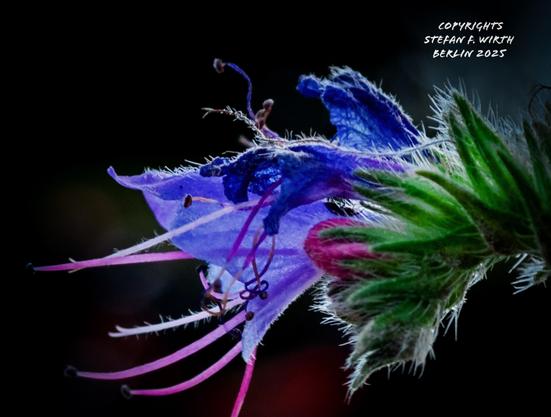
#Blueweed #Echium #vulgare (#Boraginaceae) is naturally distributed from #Europe to Central Asia and occurs as a neophyte e.g. in North America and Australia. It is highly #adapted to #drought and nutrient-poor soils. According to K. A. Leiss et al. (2004), the amount of #nectar #produced is genetically determined, although #environmentalfactors also play a role. #biodiversity
© #StefanFWirth #Berlin 2025
Ref
K. A. Leiss et al. (2004)
https://doi.org/10.1038/sj.hdy.6800439
#Photos
S.F. Wirth Bln 2025
I love love love this
#flower! Sometimes it pops up in our garden, but never as tall as this beauty
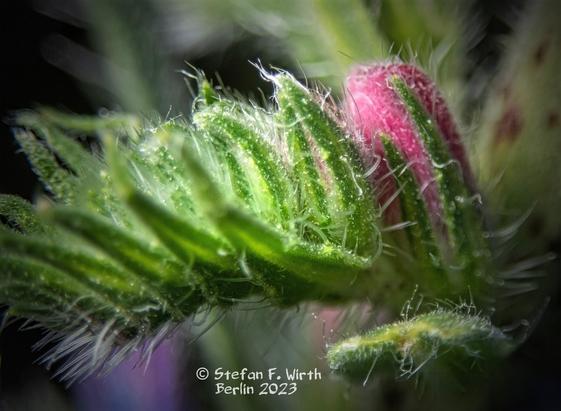
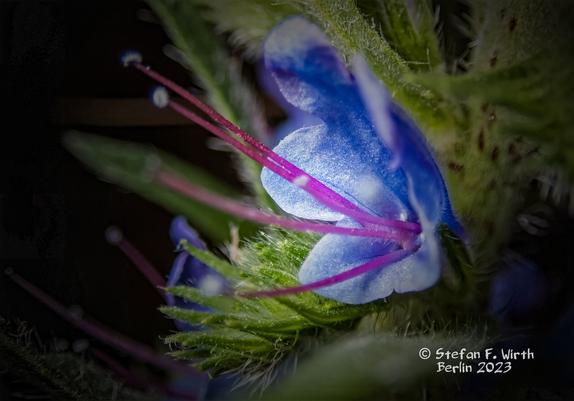
#BloomScrolling #Natternkopf #VipersBugloss #blueweed #Blume#Blueweed #meadows fascinate me. The #flowers of blueweed rise from red bulbs into blue #blossoms (attached photos), and they ripen in two steps, first the male parts become fertile, only then the female parts, a phenomenon that is called #proterandric. The species is used for #greenroofs, important in #globalwarming times, see paper of authors A. Latini et al. (2022).
© #StefanFWirth Berlin
Urban roofs (2022):
https://doi.org/10.3390/su14159581

Echium vulgare and Echium plantagineum: A Comparative Study to Evaluate Their Inclusion in Mediterranean Urban Green Roofs
Green roofs (GRs) are proposed to offset against numerous environmental and socio-economic concerns associated with climate change and urban sprawl. In Mediterranean urban areas, to protect and conserve biodiversity through GRs, the use of native plant species from arid environments and with shallow roots is generally recommended. In north Europe, Echium vulgare L. is widely used on GRs for its tolerance to abiotic stresses and its attractiveness for bees; unfortunately, since this species requires cold winters to induce flowering and warm wet summers for vegetative growths, its adaptability to Mediterranean GRs has been questioned. The current study is based on the hypothesis that Echium plantagineum L. can adapt better to the Mediterranean environment than E. vulgare and offer blooms to pollinators, thus providing the important urban ecosystem service (UES) of protecting entomofauna biodiversity. To compare the adaptability of E. plantagineum vs. E. vulgare, both Echium species were grown and studied on the extensive GR installed at ENEA Casaccia Research Center, in the north of Rome, Lazio, Italy. The comparative analysis of the GR performance of the two species was based on several plant-related traits, including seed morphology, rosette stage, inflorescence, flower and root-related traits, and their biological life cycle, most of them showing significant differences (for example, rosette area was 1.42-fold major in E. plantagineum than in E. vulgare). The information provided in this manuscript will be useful to update the herbarium records for conservation biology. A dramatic water stress was purposely applied in the GR before the end of the hot summer season, and while E. plantagineum faced with success the imposed dehydration (88.4% vegetation cover), E. vulgare did not (7.5% vegetation cover), presumably because of its biennial life cycle which did not allow it to complete seed maturation (only 46.9% percentage mature seeds in E. vulgare respect to 89.5% in E. plantagineum). In summary, as the main result, this work shows that in Mediterranean areas, the inclusion of E. plantagineum in seed mixes for flower meadow GRs could represent a valuable alternative to E. vulgare in temperate areas, providing a safeguard for pollinators and allowing water and energy saving.
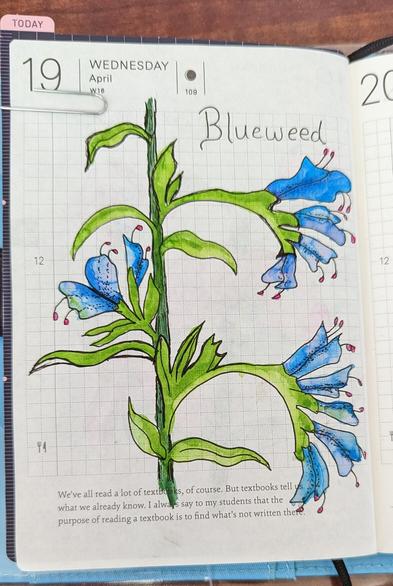
Blueweed or viper's-bugloss is both poisonous and a medicinal plant. I guess it all depends on the dose. So don't play with it. It's also considered invasive in a lot of areas. they could all be noxious weeds but it's a fun plant to draw. It gets 1 to 3 feet tall.
#hobonichitecho #hobonichi #ink #micron #doodle #bugloss #blueweed #garden #medicinalplants #blue #wildflower #flowers #watercolor #drawing #sketchoftheday #sotd #botanicalillustration #waterbrush #noxiousweeds
 Der Rheinländer
 Stefan F. Wirth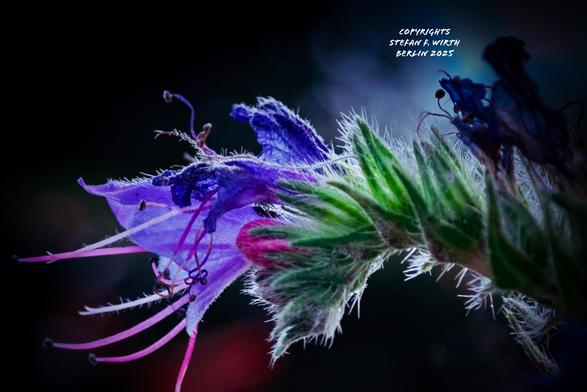
 ~meoralis~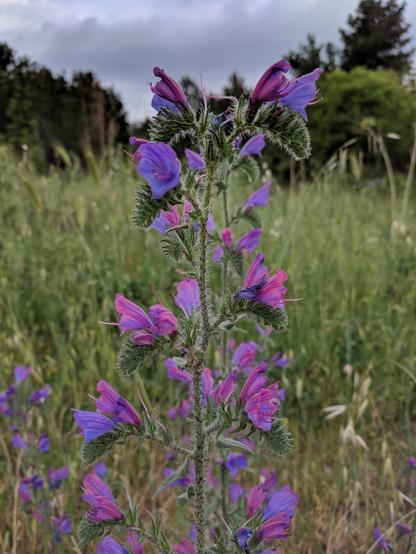
 caffination