 elbuhocurioso✨🔭🌳🚴🏼♀️🧙🏼♂️✍🏼💩
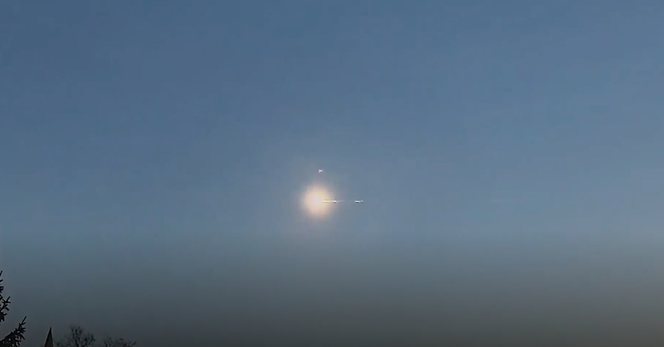
A bright #fireball crossed the evening sky over north-western Europe on Sunday and was widely observed across Belgium, France, Luxembourg, the Netherlands, and Germany. The object was detected by the #AllSky7 network, a system of automated sky cameras used to track #meteors and recover #meteorites. Using multiple recordings, researchers reconstructed the #trajectory of the incoming #meteoroid.
The object was first detected at an altitude of about 85 km, where atmospheric entry produced intense heating and light emission. During its approximately six-second passage, several flashes occurred as the body fragmented. Each fragmentation event likely produced between 10 and 100 #meteorites, meaning the original body broke into many pieces during #atmosphericEntry.
Based on brightness and duration, astronomers estimate the original #meteoroid had a diameter of roughly 1–3 meters. Objects of this size impact Earth relatively frequently, approximately once every two weeks, although most fall into oceans or sparsely populated regions.
Fragments slowed rapidly due to #atmosphericDrag, reducing their velocity from initial ~61,000 km/h in space to roughly ≤700 km/h before reaching the ground. Despite this deceleration, surviving #meteorites can still cause structural damage.
In this case, at least one fragment struck a house in Koblenz (Germany), penetrating the roof and landing inside a bedroom that was fortunately unoccupied. No injuries were reported. The unusual aspect of the event is therefore the impact occurring in a populated urban area, whereas most meteorite falls occur unnoticed in remote regions.
The calculated fall zone is now being searched by meteorite hunters and scientists, as recovered fragments may provide #cosmochemistry evidence about the early #SolarSystem and the composition of #asteroids.
 Adamas Nemesis
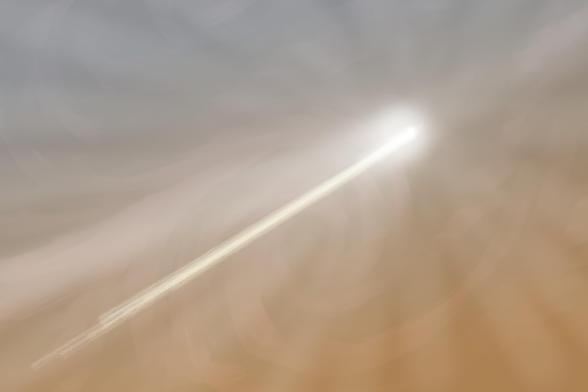
When the crack of an incoming spaceship comes in, the desert must *really* come alive, especially to those who look up at those crystal-clear skies and dream of touching those little points of light...
My own artwork, "Hot entry over the desert".
#art #digitalart #digitalpainting #painting #spaceart #entry #atmosphericentry #reentry #spaceflight
 AlcorNews
Un avion de papier lâché depuis l’ISS pourrait planer 3,5 jours avant de se désintégrer en rentrée atmosphérique 🔥
https://www.science-et-vie.com/ciel-et-espace/lancer-un-avion-en-papier-depuis-liss-lexperience-insolite-dune-equipe-de-chercheurs-ouvre-a-une-nouvelle-maniere-daborder-lespace-204727.html
#espace #science #curiosité
#ISS #origami #atmosphericentry
#paperplane #ActaAstronautica #LEO
#spaceSustainability
https://www.science-et-vie.com/ciel-et-espace/lancer-un-avion-en-papier-depuis-liss-lexperience-insolite-dune-equipe-de-chercheurs-ouvre-a-une-nouvelle-maniere-daborder-lespace-204727.html
#espace #science #curiosité
#ISS #origami #atmosphericentry
#paperplane #ActaAstronautica #LEO
#spaceSustainability

 Spaceflight 🚀
🇩🇪 #ATMOS has few competitors, of which #VardaSpace and #InversionSpace both apply parachutes 🪂 for the final descent of their return capsules. #Phoenix doesn’t require parachutes due to its large surface area and low mass, allowing its shape to essentially act as a parachute. The ballistic coefficient is lower than #NASA’s #LOFTID demonstrator. The next Phoenix to launch will carry "green #propulsion; ethane and nitrous oxide” https://www.nasaspaceflight.com/2025/06/atmos-space-cargo

Splashdowns are cool and everything, but you just can't beat the vibe of a spacecraft coming in like wings of fire over the dunefields. My spacey (and, for once, not entirely science-fictional!) vision "Hot entry over the desert".
#art #digitalart #digitalpainting #spaceart #painting #spacecraft #reentry #atmosphericentry #atmosphere

For a trip to #Mars 🔴, decreasing travel time by 10% necessitates twice as much fuel, while cutting travel time in half requires ten times as much. May prove worthwhile when considering factors such as decreased exposure time to #radiation ☢️ for crewed 👩🚀 missions. Extra speed must be lost at Mars. Many Mars missions do this, taking about 6 6️⃣ to 7 months for transit to the Red Planet. https://marspedia.org/Hohmann_transfer#Type-I_and_Type-II_Trajectories
#AMAT allows the user to simulate #atmospheric entry trajectories, compute deceleration and heating🌡️loads, compute aerocapture entry corridors and simulate aerocapture trajectories. AMAT supports analysis for all #atmosphere-bearing destinations in the #SolarSystem: #Venus, #Earth, #Mars, #Jupiter, #Saturn, #Titan, #Uranus, and #Neptune https://amat.readthedocs.io/en/master
Parachute 🪂 is not the only means for descent, as high-mass class vehicles are emerging for human 👩🚀 missions. Shallow entry flight-path angles are preferred in order to achieve a lower terminal velocity to ensure a safe descent phase. Retro-propulsion could be activated at Mach 2 and above https://www.intechopen.com/chapters/72944#

Aerocapture, Aerobraking, and Entry for Robotic and Human Mars Missions
This chapter provides an overview of the aeroassist technologies and performances for Mars missions. We review the current state-of-the-art aeroassist technologies for Mars explorations, including aerocapture, aerobraking, and entry. Then we present a parametric analysis considering key design parameters such as interplanetary trajectory and vehicle design parameters (lift-to-drag ratio, ballistic coefficient, peak g-load, peak heat rate, and total heat load) for aerocapture, aerobraking, and entry. A new perspective on a rapid aerobraking concept will be provided. The analysis will include first-order estimates for thermal loading, thermal protection systems material selection, and vehicle design. Results and discussion focus on both robotic missions and human missions as landed assets and orbiters.
 #prfm Booster on Twitter
[ireniqs]
Yasutaka Nakata podczas tworzenia swojej magii. 😌 Wielka szkoda, że ten kawałek nie został użyty w żadnym albumie Perfume. Uwielbiam tego słuchać. Mogę nawet non stop. 🥹🫶 #prfm #中田ヤスタカ #YasutakaNakata #AtmosphericEntry https://t.co/xy2YAvGr1N
https://twitter.com/ireniqs/status/1887053717515423999
Yasutaka Nakata podczas tworzenia swojej magii. 😌 Wielka szkoda, że ten kawałek nie został użyty w żadnym albumie Perfume. Uwielbiam tego słuchać. Mogę nawet non stop. 🥹🫶 #prfm #中田ヤスタカ #YasutakaNakata #AtmosphericEntry https://t.co/xy2YAvGr1N
https://twitter.com/ireniqs/status/1887053717515423999

[markn_kayakko]
ユニクロCMといえば、Perfumeです*
#UNIQLO #HEATTECH
#prfm #AtmosphericEntry
*個人の感想です
https://t.co/qu1BiCDNlA https://t.co/DBhlrCpuwz
https://twitter.com/markn_kayakko/status/1878034160897683806
ユニクロCMといえば、Perfumeです*
#UNIQLO #HEATTECH
#prfm #AtmosphericEntry
*個人の感想です
https://t.co/qu1BiCDNlA https://t.co/DBhlrCpuwz
https://twitter.com/markn_kayakko/status/1878034160897683806