Hello  !

If you're into #bacterial #antiphage system, either expert in the field or just curious about biology in general, you might find useful this resource.

🔗 https://defensefinder.mdmlab.fr

You'll find a webservice for #defensefinder, a collaborative wiki and databases of precomputed results and predicted protein structures.
You can find more in this blog post (that you can follow here : @mdmlab)

https://mdmlab.fr/preprint-a-comprehensive-resource-for-exploring-antiphage-defense-defensefinder-web-service-wiki-and-databases/

Work in colab with @audeber and @Gemma_Atkinson

Webservice

👋DefenseFinder news !

Thinking of how we can better help the community, we provide a new website that includes a wiki on defense systems, a structure database and precomputed DefenseFinder results on >22k genomes.

https://defensefinder.mdmlab.fr

Here is the preprint : https://www.biorxiv.org/content/10.1101/2024.01.25.577194v1

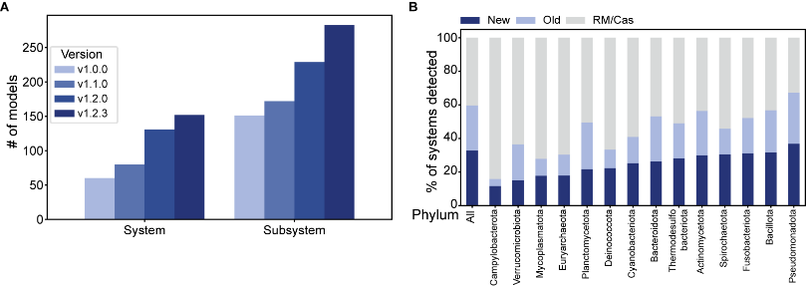
In the ever evolving antiphage defense landscape, we’ve added 92 new systems, now detecting a total of 152. These additions account for more than 33% of the systems detected. Please keep telling us if we are missing some. Full list here: https://defensefinder.mdmlab.fr/wiki/defense-systems

The new web service interface allows anyone to detect defense systems in their preferred genomes and to save previous analysis (without any registration). We also provide genomic visualization and the ability to easily download everything.

One major feedback we had, was the difficulty to understand the hits identified by DefenseFinder and put it in context.

We created a wiki (https://defensefinder.mdmlab.fr/wiki/) where each defense system has its page. Systems found by DefenseFinder are now linked to those wiki-like pages.

The Wiki is usable on its own, allowing research through the diversity of system mechanisms and domains through a searchable table. We added general concepts often used in the field.

It’s a collaborative and participative website, so create missing pages or tell us about them ✍️!

You can find, on the help page of the website, how to contribute. Don’t hesitate to ask us in case of problem.

To allow direct search of the presence of systems in public genomes, we ran DefenseFinder on RefSeq complete genomes database. We provide visualization through interactive tables and graphs that are easily downloadable. 

We now live in a world of structure predictions, so we teamed up with Gemma Atkinson’s lab and precomputed all monomers as well as dimers for all known representatives of defense systems. Foldseek results on the AlphaFoldDB and PDB were also precomputed. All these results can be visualized with Mol*, a powerful tool-kit for web-based visualization of protein structures.

Congrats to Florian Tesson, lead author and Rémi Planel for the website development as well as the IT Department of the Institut Pasteur for the technical part.

We organized a hackathon day, internal to the lab, to fill the 152 defense systems’ pages. We also ask expert in the field to write the page on their favorite system. So : huge thanks to everyone who participated in the project, of course MDM Lab members but also wiki contributors : Adi Millman, François Rousset, Daan C. Swarts, Avigail Stokar-Avihail, Nathalie Béchon, Alex L. Gao

We really hope this web service will allow everyone to dive into antiphage defense biology by having easy access to bioinformatics resources.

Don’t hesitate to let us know what you would like to see next and join the fun of creating improving wiki pages!

https://mdmlab.fr/preprint-a-comprehensive-resource-for-exploring-antiphage-defense-defensefinder-web-service-wiki-and-databases/

#alphafold #antiphage #defensefinder #defensesystems #genomics #microbiology #phage #wiki

Webservice

New preprint from our lab. We report that genomic islands containing Gamma-Mobile-Trio proteins are bacterial armories stockpiled with antibacterial, anti-phage, and anti-eukaryotic weapons.
This one has something for everybody: #antiphage #T6SS #Vibrio #MGE
https://www.biorxiv.org/content/10.1101/2023.03.28.534373v2

An E1–E2 fusion protein primes #antiviral immune signalling in bacteria | Nature

#phage #antiphage

https://www.nature.com/articles/s41586-022-05647-4

An E1–E2 fusion protein primes antiviral immune signalling in bacteria - Nature

This study demonstrates that bacteria use a ubiquitin transferase-like enzyme to prime cGAS/DncV-like nucleotidyltransferase activation and use a deubiquitinase-like enzyme to decrease activity. 

Nature
#Bacteriophages inhibit and evade cGAS-like immune function in bacteria: Cell
#phage #antiphage #signaling
https://www.cell.com/cell/fulltext/S0092-8674(22)01584-7

A conserved family of immune effectors cleaves cellular ATP upon #viral infection |

#phage #antiphage

https://www.biorxiv.org/content/10.1101/2023.01.24.525353v1

Synergy and regulation of #antiphage systems: toward the existence of a bacterial immune system? -
#phage #phages

https://www.sciencedirect.com/science/article/abs/pii/S1369527422001229

Aude Bernheim (@[email protected])

In a new #preprint we report that recently discovered anti-phages systems (Mokosh, Eleos, Lamassu…) have eukaryotic homologs. We harnessed this conservation to discover novel defense mechanisms in humans. @jeanrjc @[email protected] https://www.biorxiv.org/content/10.1101/2022.12.12.520048v1

mstdn.science
Antiviral signaling by a cyclic nucleotide activated CRISPR protease
https://www.nature.com/articles/s41586-022-05571-7
#phage #bacteria #immunesystem #antiphage #crispr
Antiviral signaling by a cyclic nucleotide activated CRISPR protease - Nature

CRISPR defense systems such as the well-known DNA-targeting Cas9 and the RNA-targeting type III systems are widespread in prokaryotes1,2. The latter can orchestrate a complex antiviral response that is initiated by the synthesis of cyclic oligoadenylates (cOAs) upon foreign RNA recognition3–5. Among a large set of proteins that were linked to type III systems and predicted to bind cOAs6,7, a CRISPR associated Lon protease (CalpL) stood out to us. The protein contains a sensor domain of the SAVED (SMODS-associated and fused to various effector domains) family7, fused to a Lon protease effector domain. However, the mode of action of this effector was unknown. Here, we report the structure and function of CalpL and show that the soluble protein forms a stable tripartite complex with two further proteins, CalpT and CalpS, that are encoded in the same operon. Upon activation by cA4, CalpL oligomerizes and specifically cleaves the MazF-homolog CalpT, releasing the extracytoplasmic function (ECF) sigma factor CalpS from the complex. This provides a direct connection between CRISPR-based foreign nucleic acid detection and transcriptional regulation. Furthermore, the presence of a cA4-binding SAVED domain in a CRISPR effector reveals an unexpected link to the cyclic oligonucleotide-based antiphage signaling system (CBASS).

Nature