 Paul Healey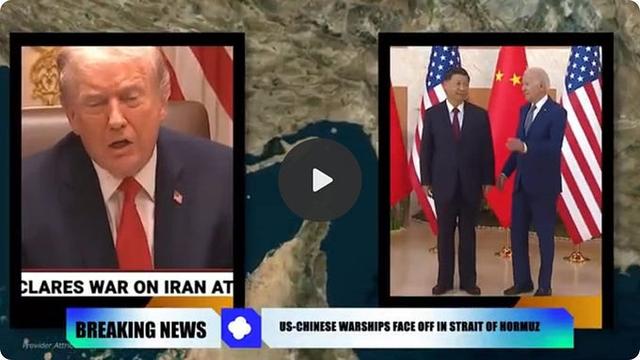
Tee Ashby (@teeashby)
A tense naval standoff is underway just outside the Strait of Hormuz after China deployed a Type 052DL guided-missile destroyer, the Tangshan, to protect Iranian oil tankers from a newly announced U.S. maritime blockade. The 7,500-ton vessel, which carries 64 vertical launch cells for long-range air defense, anti-ship, and land-attack cruise missiles, took up an aggressive stationary posture at the strategic exit of the strait hours before the U.S. Central Command’s 10:00 a.m. Eastern deadline to begin enforcing what Washington calls a blockade of all Iranian ports. Beijing has made clear it will not allow U.S. warships to intercept Chinese-flagged or Chinese-owned tankers in international waters, with a reinforced contingent of 50 to 70 PLA Marine special forces personnel aboard the destroyer for boarding actions and rapid response. The *Tangshan* raced to its position alongside a supporting intelligence vessel, the 30,000-ton *Liaowang 1*, after a high-speed transit from Hainan through the Strait of Malacca. In response, Centcom issued a new directive ordering the stopping and searching of all commercial traffic in the Persian Gulf and Gulf of Oman, a move critics describe as an admission of weakness that turns the waterway into a congested zone under U.S. guns while Chinese warships observe. Russia has also moved naval assets into the theater, with a flotilla including the guided-missile cruiser *Variag*, the frigate *Marshall Shaposhnikov*, and several corvettes operating in the northern Indian Ocean. At least one Russian frigate has entered the Gulf of Oman to conduct joint live-fire drills with the Iranian Navy. With Chinese intelligence feeding U.S. carrier group movements to Moscow and Tehran, and Russian sailors watching through fire control radars, the risk of a miscalculation is extremely high. Iranian officials have warned that with Chinese and Russian support, Iran can shift into a more aggressive asymmetrical posture, threatening to use sea mines and hypersonic missiles against U.S. Fifth Fleet assets. The standoff echoes the 2025 Venezuelan blockade, when U.S. forces seized a China-bound oil tanker in the Caribbean, but this time China and Russia have forward-deployed naval muscle to prevent a repeat. Oil prices have already spiked above $120 a barrel, and analysts warn that a single radio warning from the Chinese destroyer could push crude to $200 before the weekend. The blockade, which began on April 13, is widely considered exposing the limits of American power, with China effectively running a counter-blockade that dares the U.S. to make the first move against a Chinese warship—an act that would trigger a far more dangerous conflict.
 Hublai (charismatic megafauna)
 Ham on Wry
 Sue Cohen
 Victoria Stuart 🇨🇦 🏳️⚧️
 RonSupportsYou
 Dr Susi Arnott
 Dorean Paxorales
 j43147 :pentagram: