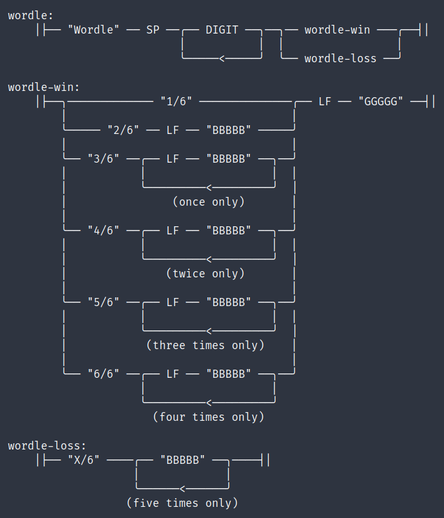
@sethmlarson It seems to fail on most ABNF files. Could you share what ABNF input you provided to get the railroad diagrams you had in the post?
I tried running it on the `examples/abnf.abnf` it ships with and that produced nothing:
kgt -l abnf -e rrtext < examples/abnf.abnf
There is not a single tool on the entire Internet to convert ABNF grammar to railroad diagrams. 🙄
PS: https://github.com/katef/kgt is the only one that claims to do this, but fails on its own example ABNF files.
Does anyone know what “flavor” of #ABNF / #EBNF this is written in? The table heading says “EBNF,” while the paragraph above references “ABNF,” but it appears to use a format that’s different from what’s defined in RFC 5234 or ISO/IEC 14977:1996.
https://www.unicode.org/reports/tr35/#unicode-locale-identifier
I could make assumptions about some of these characters, but I’d rather be as explicit as possible.
As a frequent consumer (and dare I say... enjoyer!) of #ABNF I can't believe I hadn't stumbled across this delightful little tool yet:
Makes cute little UTF-8 diagrams right in your terminal 
Added spec and interactive railroad diagrams to jevko.org:
https://jevko.org/spec.html
https://jevko.org/diagram.xhtml
#jevko #specification #diagrams #interactive #syntax #minimal #grammar #ebnf #abnf #bnf
#EBNF is a #publicdomain EBNF #parser generator for #Ruby.
EBNF parses EBNF (Extended Backus-Naur Form) and BNF grammars that can be then translated into other forms, like S-Expressions, #ABNF, #HTML, and Ruby code. EBNF supports #PEG/#Packrat operation as well as LL(1) operation.
Website 🔗️: https://github.com/dryruby/ebnf