#Web3Wednesday

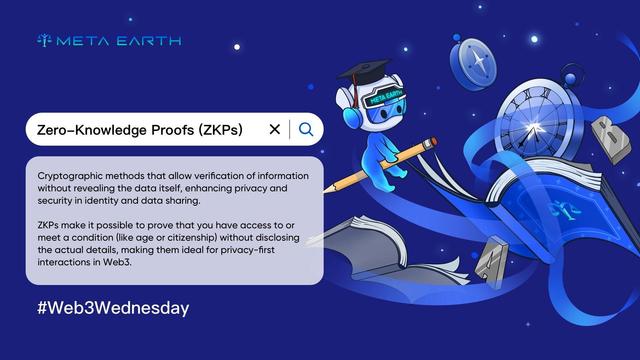
#ZKPs = Proving you're 18+ without revealing your birthdate.

That’s the magic of Zero-Knowledge Proofs — you prove what’s needed, nothing more.

Your info stays private. Your trust stays intact.

Meta Earth’s #MEID uses ZKPs to bring privacy-first identity to #Web3. Be an early user: https://invite.mec.me/?type=download&code=zebt0svb…
#MetaEarth

4/N

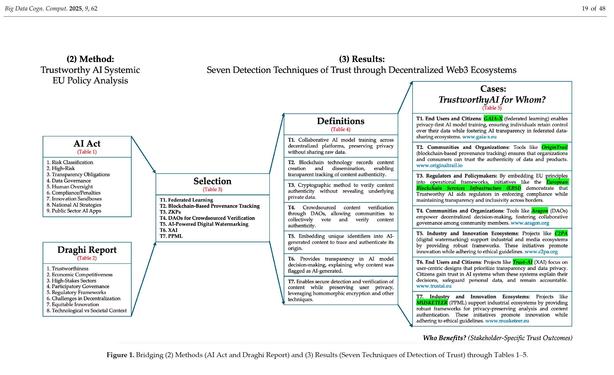
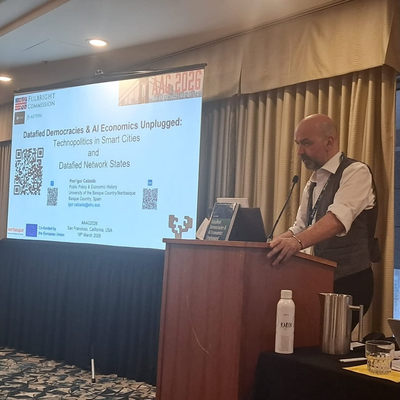
🔎#TrustworthyAI for Whom?
Exploring #Web3 & #Decentralization for #AI #Trust

✅ 7 detection techniques:

1. Federated Learning
2. #Blockchain
3. #ZKPs
4. #DAOs
5. #Watermarking
6. #XAI
7. #PPML

#EU #AIAct & #Draghi Report

🔗 https://doi.org/10.3390/bdcc9030062 #OpenAccess

Trustworthy AI for Whom? GenAI Detection Techniques of Trust Through Decentralized Web3 Ecosystems

As generative AI (GenAI) technologies proliferate, ensuring trust and transparency in digital ecosystems becomes increasingly critical, particularly within democratic frameworks. This article examines decentralized Web3 mechanisms—blockchain, decentralized autonomous organizations (DAOs), and data cooperatives—as foundational tools for enhancing trust in GenAI. These mechanisms are analyzed within the framework of the EU’s AI Act and the Draghi Report, focusing on their potential to support content authenticity, community-driven verification, and data sovereignty. Based on a systematic policy analysis, this article proposes a multi-layered framework to mitigate the risks of AI-generated misinformation. Specifically, as a result of this analysis, it identifies and evaluates seven detection techniques of trust stemming from the action research conducted in the Horizon Europe Lighthouse project called ENFIELD: (i) federated learning for decentralized AI detection, (ii) blockchain-based provenance tracking, (iii) zero-knowledge proofs for content authentication, (iv) DAOs for crowdsourced verification, (v) AI-powered digital watermarking, (vi) explainable AI (XAI) for content detection, and (vii) privacy-preserving machine learning (PPML). By leveraging these approaches, the framework strengthens AI governance through peer-to-peer (P2P) structures while addressing the socio-political challenges of AI-driven misinformation. Ultimately, this research contributes to the development of resilient democratic systems in an era of increasing technopolitical polarization.

MDPI

> We present LatticeFold+, a very different lattice-based folding protocol that improves on LatticeFold in every respect: the prover is five to ten times faster, the verification circuit is simpler, and the folding proofs are shorter

https://eprint.iacr.org/2025/247

#PQC #ZeroKnowledgeProofs #ZKPs #Cryptography

LatticeFold+: Faster, Simpler, Shorter Lattice-Based Folding for Succinct Proof Systems

Folding is a technique for building efficient succinct proof systems. Many existing folding protocols rely on the discrete-log based Pedersen commitment scheme, and are therefore not post-quantum secure and require a large (256-bit) field. Recently, Boneh and Chen constructed LatticeFold, a folding protocol using lattice-based commitments which is plausibly post-quantum secure and can operate with small (64-bit) fields. For knowledge soundness, LatticeFold requires the prover to provide a range proof on all the input witnesses using bit-decomposition, and this slows down the prover. In this work we present LatticeFold+, a very different lattice-based folding protocol that improves on LatticeFold in every respect: the prover is five to ten times faster, the verification circuit is simpler, and the folding proofs are shorter. To do so we develop two novel lattice techniques. First, we develop a new purely algebraic range proof which is much more efficient than the one in LatticeFold, and may be of independent interest. We further shrink the proof using double commitments (commitments of commitments). Second, we show how to fold statements about double commitments using a new sumcheck-based transformation.

IACR Cryptology ePrint Archive

🔒 What if you could verify data without revealing it? Zero-Knowledge Proofs (ZKPs) are transforming Decentralized Physical Infrastructure Networks (DePINs) by enhancing privacy and security. 🚀 Learn more in our latest article! 🌐

👉 https://shorturl.at/6imUO

#ZKPs #DePIN

The Power of Zero-Knowledge Proofs in DePIN | MapMetrics

Zero-Knowledge Proofs are a cryptographic protocol that allows for the verification of information without revealing the underlying data.

MapMetrics

🔒 Unlock the secrets of zero-knowledge proofs (#ZKPs) and #zkKYC with this beginner-friendly guide! Discover how ZKPs protect your #Blockchain #Privacy while unleashing its potential. #Crypto🛡️💡

🔗 Link to the full article
https://buff.ly/3wMAU0L

Heard of Zero-Knowledge Proofs But Confused? This Beginner’s Guide Makes it Easy!

Confused by zero-knowledge proofs and zkKYC? Worried about privacy in blockchain? Dive into this easy-to-understand guide and discover how zkKYC protects your data while unlocking the potential of…

Coinmonks

Recursive SNARKs go post-quantum:
“we present LatticeFold, the first lattice-based folding protocol based on the Module SIS problem. This folding protocol naturally leads to an efficient recursive lattice-based SNARK.”

LatticeFold supports low-degree relations (R1CS) as well as high-degree relations (CCS) and is considered as performant as Hypernova but with post-quantum security.

https://eprint.iacr.org/2024/257

#PQC #ZeroKnowledgeProofs #ZKPs #Cryptography

LatticeFold: A Lattice-based Folding Scheme and its Applications to Succinct Proof Systems

Folding is a recent technique for building efficient recursive SNARKs. Several elegant folding protocols have been proposed, such as Nova, Supernova, Hypernova, Protostar, and others. However, all of them rely on an additively homomorphic commitment scheme based on discrete log, and are therefore not post-quantum secure and require a large (256-bit) field. In this work we present LatticeFold, the first lattice-based folding protocol based on the Module SIS problem. This folding protocol naturally leads to an efficient recursive lattice-based SNARK and an efficient PCD scheme. LatticeFold supports folding low-degree relations, such as R1CS, as well as high-degree relations, such as CCS. The key challenge is to construct a secure folding protocol that works with the Ajtai commitment scheme. The difficulty is ensuring that extracted witnesses are low norm through many rounds of folding. We present a novel technique using the sumcheck protocol to ensure that extracted witnesses are always low norm no matter how many rounds of folding are used. Since LatticeFold can operate over a small (64-bit) field, our evaluation of the final proof system suggests that it is as performant as Hypernova, while providing plausible post-quantum security. Moreover, LatticeFold operates over the same module structure used by fully homomorphic encryption (FHE) and lattice signatures schemes, and can therefore benefit from software optimizations and custom hardware designed to accelerate these lattice schemes.

IACR Cryptology ePrint Archive

Interesting research by Orrù, Tessaro, Zaverucha and Zhu on creating oblivious zero-knowledge proofs.

With interesting applications to making a Publicly Verifiable OPRF and upgrading Keyed-Verification Anonymous Credentials to be concurrently secure blind signatures.

https://eprint.iacr.org/2023/1635

#ZK #ZKPs #Cryptography

Oblivious issuance of proofs

Since 2015, we've delved into zero-knowledge proofs to enhance privacy, bolster security, and promote ZKPs in Web3 tech and beyond. Our latest blog shares our journey and contributions in this exciting realm. #ZKPs https://leastauthority.com/blog/pioneering-zero-knowledge-proofs/
Pioneering Zero-Knowledge Proofs: Eight Years of Security, Implementation, and Education - Least Authority

Since 2015, Least Authority has been working with zero-knowledge proofs (ZKPs) to further enable privacy, improve security, and encourage the implementation of zero-knowledge proofs in Web3 technologies and beyond. Although Zcash spun out of Least Authority with the Electric Coin Company in 2016, we continued to work on zero-knowledge proofs by performing security audits for ... Read more

Least Authority

In this day and age of increased government control, institutional intrusion, and rampant corporate greed, protecting personal data is more important than ever.

Let’s explore #ZKPs/ Zero Knowledge Proofs

https://www.takeitbackcollective.com/empower-users-leverage-zero-knowledge-technologies

Empower users: Leverage Zero-Knowledge Technologies

Zero Knowledge Proofs or ZKPs improve security while facilitating easy interactions in the Web3 and cryptocurrency realms. In this blog we explore what they are, how they work and explore some of the different applications of this cutting edge technology. Protecting your personal data now is more important than ever.