
What do animals actually see? @VeraVasas @HanleyColorLab &co present a camera system & video processing pipeline that record animal-perceived colors in motion, allowing us to study color signals in their full complexity #VisualEcology #PLOSBiology https://plos.io/3U79so1
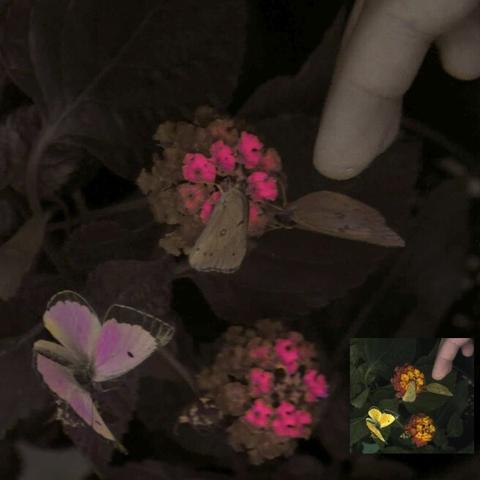
Recording animal-view videos of the natural world using a novel camera system and software package

Many animals use colors in dynamic displays performed in spatially complex environments, but what do the animals actually see? This study presents a newly developed camera system and video processing pipeline that accurately records animal-perceived colors in motion and in natural settings, allowing researchers to study color signals in their full complexity.

Travis Longcore (UCLA Institute of the Environment and Sustainability) has compiled large databases that characterize the spectral sensitivity of terrestrial wildlife species. He digitized or otherwise acquired 177 different spectral response curves that help investigate whether spectral tuning to avoid impacts from light pollution would have potential.

Open access: https://www.sciencedirect.com/science/article/pii/S1439179123000506

#Biology #Vision #VisualEcology #LightPollution

๐˜ˆ๐˜ฑ๐˜ช๐˜ด ๐˜ฅ๐˜ฐ๐˜ณ๐˜ด๐˜ข๐˜ต๐˜ข is a honeybee that can forage at night when the moon is at least half-full. But can they see colour at night? We explored this in our paper, out now in @RSocPublishing
https://doi.org/10.1098/rspb.2023.1267
Here is a short explainer of what we found ๐Ÿงต 1/8

#Honeybees #ColourVision #VisualEcology #Ecology #AnimalBehaviour #Foraging

#Introduction #AcademicMastodon

MSc #MarineBiology
BSc Animal Biology
BDes Industrial Design

Iโ€™ve spent most of my adult life working towards being able to specialize in the #VisualEcology of marine organisms.

My hopes for the future of marine biology are for marine scientists to be able to study the lives of seemingly inaccessible organisms at a similar resolution to those that are familiar. I believe that this advancement will be achieved largely through the development of new #techniques.

Out now: Using colour pattern edge contrast statistics to predict detection speed and success in triggerfish (Rhinecanthus aculeatus).
https://journals.biologists.com/jeb/article/225/23/jeb244677/285905/Using-colour-pattern-edge-contrast-statistics-to

#behaviour #colsci #visualecology #visualmodelling #PredatorPreyDynamics

Using colour pattern edge contrast statistics to predict detection speed and success in triggerfish (Rhinecanthus aculeatus)

Summary: The speed with which triggerfish detect patterned stimuli cannot be explained by a single image statistic. The relationship between pattern statistics and animal behaviour is complex, and is likely to be distance dependent.

The Company of Biologists