 Hackaday [Unofficial]
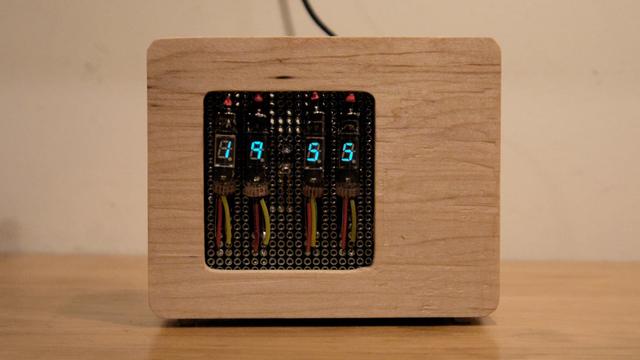
Salvaged VFDs in Nixie-Like Clock
https://fed.brid.gy/r/https://hackaday.com/2026/05/16/salvaged-vfds-in-nixie-like-clock/
Salvaged VFDs in Nixie-Like Clock
https://fed.brid.gy/r/https://hackaday.com/2026/05/16/salvaged-vfds-in-nixie-like-clock/
Death Clock -- The New Old Clock That Says When You Die

Don’t Look Up, or You’ll See the Time from This VFD Projection Clock
#clockhacks #ceiling #clock #jsonrpc #lenses #projection #stm32 #vacuumfluorescentdisplay #vfd #hackaday
-- Delivered by RssEverything service
VFD Character Display Turned Into Audio VU Meter
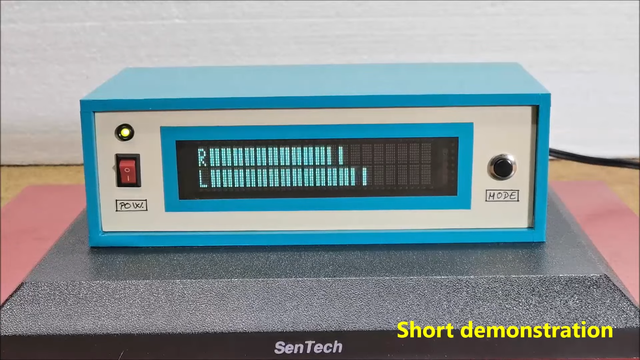
Humans love visualising music, whether it's in the form of an inscrutable equation drawing squiggles in Winamp, or a simple VU meter pulsing with the beat. This build from [mircemk] is of the latter variety, repurposing a VFD display to do the job.
The project is built around a VFM202MDA vacuum fluorescent display, which provides that lovely green-blue glow we all know and love, driven by a PT6314 driver chip. This has the benefit that it can be readily driven by a microcontroller in much the same way as the familiar HD44780 character LCD driver chip. With some minor tweaks, the character set can be modified to allow the display to become a surprisingly-responsive VU meter.
An Arduino Nano runs the show, with an envelope follower circuit feeding a signal for the left and right channels into the analog inputs of the microcontroller. The Arduino then measures the voltage on those inputs and feeds the necessary commands to the PT6314 driver to update the display.
The resulting VU meter has 38 bars per channel, and is highly responsive. The fast flickering of the meter bars in response to the music make it compelling to watch, and the era-appropriate enclosure the project is built in adds plenty to the aesthetic.
We've seen other VU meter builds before too, like this one that uses a little physics knowledge to create a more realistic analog-like needle meter. Video after the break.
#musicalhacks #arduino #vacuumfluorescentdisplay #vfd #vumeter
Using Arduinos To Drive Undocumented Displays
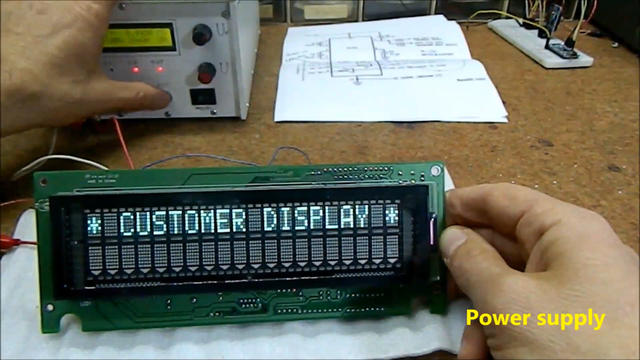
For those of us old enough to remember the VCR (and the difficulty of programming one), the ubiquitous vacuum fluorescent display, or VFD, is burned into our memories, mostly because of their brightness and contrast when compared to the superficially-similar LCD. These displays are incredibly common even apart from VCRs, though, and it's easy to find them for next to no cost, but figuring out how to drive one if you just pulled it out of a 30-year-old VCR is going to take some effort. In this build, [mircemk] shows us how he drives unknown VFD displays using an Arduino in order to build his own weather forecasting station.
For this demonstration [mircemk] decided to turn a VFD into a weather forecasting station. First of all, though, he had to get the VFD up and running. For this unit, which came from a point-of-sale (POS) terminal, simply connecting power to the device turned on a demo mode for the display which let him know some information about it. From there, and with the knowledge that most POS terminals use RS232 to communicate, he was able to zero in on the Rx and Tx pins on the on-board microcontroller and interface them with an Arduino. From there it's a short step to being able to output whatever he wanted to this display.
For this project, [mircemk] wanted the display to output information about weather, but rather than simply pull data from some weather API he is actually using a sensor suite connected to the Arduino to measure things like barometric pressure in order to make a 12-hour forecast. The design is inspired by old Zambretti weather forecasters which used analog wheels to input local weather data. It's an interesting build not only for the VFD implementation but also for attempting to forecast the weather directly with just a tiny sensor set instead of downloading a forecast to display. To do any better with your own forecasts, you'd likely need your own weather station.
#arduinohacks #arduino #barometer #forecasting #sensor #vacuumfluorescentdisplay #vfd #weather #zambretti
 sebastian
 emilysoddities
 R. L. Dane

 Andro Abhi
 Nausiyan
 hackaday unofficial