Part 27, drug discovery on an “Undruggable” Target.
K‑Ras is a small intracellular GTPase that functions as a molecular switch, activating mitogenic signaling pathways in response to growth… | Stan Van Boeckel
Part 27, drug discovery on an “Undruggable” Target.
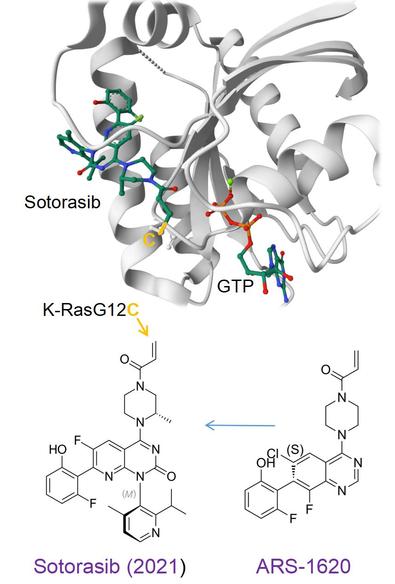
K‑Ras is a small intracellular GTPase that functions as a molecular switch, activating mitogenic signaling pathways in response to growth factors. Direct attempts to inhibit this oncogene with competitive drugs at its GTP‑binding site failed because of its picomolar affinity for GTP and the high intracellular GTP concentration. Mutations in the K‑Ras pathway, such as K‑RasG12C, render the protein constitutively active, driving uncontrolled proliferation and e.g. contributing to ~40% of K‑Ras–driven lung cancers. Until 2013, K‑Ras was considered non‑druggable, but this view shifted when the Shokat lab revealed a hidden allosteric regulatory pocket in K‑RasG12C that becomes accessible when small electrophilic molecules covalently bind the mutant cysteine. This covalent engagement displaces key “protein switches,” biases the protein toward GDP over GTP conformation and prevents Raf binding, thereby shutting down MAPK signaling.
Following this breakthrough, Amgen optimized the Shokat group’s early acrylamide fragments into an in‑vivo‑suitable tool compound, ARS‑1620. Extensive crystallography and docking guided the medicinal chemistry cycles that ultimately produced the highly decorated drug sotorasib (approved in 2021). In phase 3 trials in K‑RasG12C‑mutant lung cancer, sotorasib improved progression‑free survival compared with docetaxel, although overall survival was unchanged. That outcome is somewhat disappointing, but there is hope that real‑world drug combination strategies may yet deliver meaningful gains in overall survival.
Part 27, drug discovery on an “Undruggable” Target.
K‑Ras is a small intracellular GTPase that functions as a molecular switch, activating mitogenic signaling pathways in response to growth… | Stan Van Boeckel
Part 27, drug discovery on an “Undruggable” Target.
K‑Ras is a small intracellular GTPase that functions as a molecular switch, activating mitogenic signaling pathways in response to growth factors. Direct attempts to inhibit this oncogene with competitive drugs at its GTP‑binding site failed because of its picomolar affinity for GTP and the high intracellular GTP concentration. Mutations in the K‑Ras pathway, such as K‑RasG12C, render the protein constitutively active, driving uncontrolled proliferation and e.g. contributing to ~40% of K‑Ras–driven lung cancers. Until 2013, K‑Ras was considered non‑druggable, but this view shifted when the Shokat lab revealed a hidden allosteric regulatory pocket in K‑RasG12C that becomes accessible when small electrophilic molecules covalently bind the mutant cysteine. This covalent engagement displaces key “protein switches,” biases the protein toward GDP over GTP conformation and prevents Raf binding, thereby shutting down MAPK signaling.
Following this breakthrough, Amgen optimized the Shokat group’s early acrylamide fragments into an in‑vivo‑suitable tool compound, ARS‑1620. Extensive crystallography and docking guided the medicinal chemistry cycles that ultimately produced the highly decorated drug sotorasib (approved in 2021). In phase 3 trials in K‑RasG12C‑mutant lung cancer, sotorasib improved progression‑free survival compared with docetaxel, although overall survival was unchanged. That outcome is somewhat disappointing, but there is hope that real‑world drug combination strategies may yet deliver meaningful gains in overall survival.
We explored the question, from which different areas of chemistry, including glycochemistry, peptide chemistry, materials chemistry and synthetic method development new electrophiles for covalent inhibitors can originate in order to keep expanding the druggable space. (2/2)
#Chemistry #ChemBio #ChemicalProteomics #ChemPro #ProteoProbes #DrugDiscovery #Glycotime #Peptides #Materials #Synthesis #Undruggable #CovalentInhibitors
 Stephan Hacker
 Stephan Hacker