 Janine
Steve is bad at this
#Uncoupling
#Uncoupling
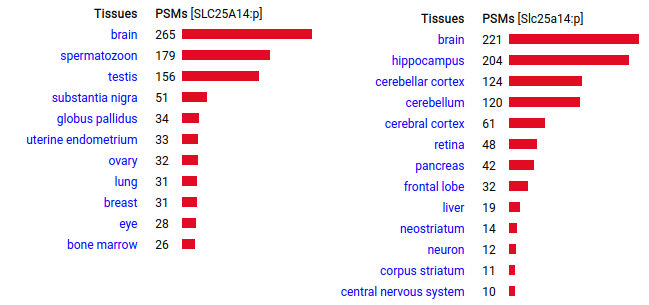
UCP5 is also found in the central nervous system of both species, with a surprise appearance in sperm/testis in humans. The role of the protein has been as a hypothetical regulator of reactive oxygen species (Ramsden 2012 https://www.ncbi.nlm.nih.gov/pmc/articles/PMC3432969) & more recently as an anion transporter (Gorgolione 2019 https://www.sciencedirect.com/science/article/pii/S0005272819300945)
Human & mouse uncoupling protein 5 (#UCP5:p | #SLC25A14:p)―GPMDB tissue tabbulations #proteomics #uncoupling

Uncoupling proteins (UCPs) belong to a large family of mitochondrial solute carriers 25 (SLC25s) localized at the inner mitochondrial membrane. UCPs transport protons directly from the intermembrane space to the matrix. Of five structural homologues (UCP1 ...
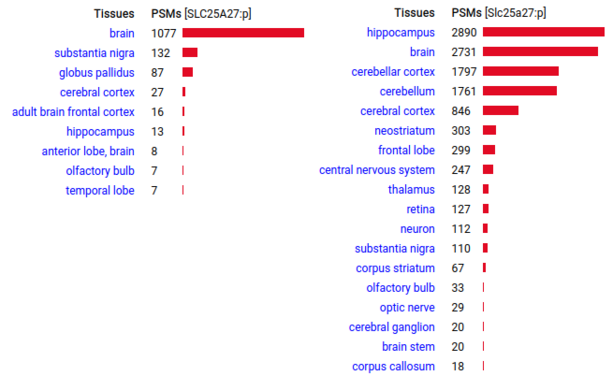
The next one in the series is located in the central nervous system of both species, probably in modulating glutamate controlled proton gradients in neuron mitochondrial inner membranes. It does not appear to have any role in thermogenisis.
Human & mouse uncoupling protein 4 (#UCP4:p | #SLC25A27:p)―GPMDB tissue tabbulations #proteomics #uncoupling
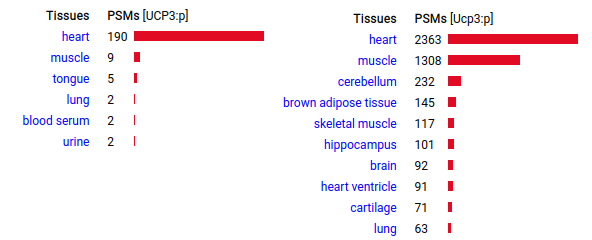
UCP3:p is also a mitochondrial inner membrane transport molecule, but it is most frequently observed in striated muscle. The idea that this sequence is used to "uncouple" ATP production to produce heat has been challenged & alternate functions proposed, e.g. Di Marchi, 2011 (https://pubmed.ncbi.nlm.nih.gov/21775425/)
Human & mouse uncoupling protein 3 (#UCP3:p | #SLC25A9:p)―GPMDB tissue tabbulations #proteomics #uncoupling

The uncoupling proteins UCP2 and UCP3 have been postulated to catalyze Ca(2+) entry across the inner membrane of mitochondria, but this proposal is disputed, and other, unrelated proteins have since been identified as the mitochondrial Ca(2+) uniporter. To clarify the role of UCPs in mitochondrial C …
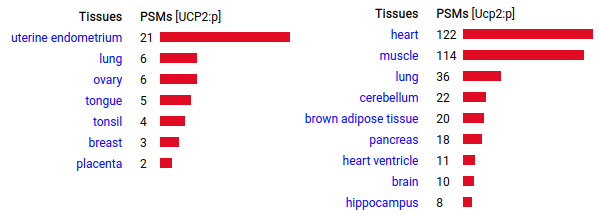
Like UCP1:p, this protein seems to be utilized more frequently by mice compared to humans, although its tissue distribution is different. The case for its role in non-shivering thermogenisis is less established than that of UCP1:p.
Human & mouse uncoupling protein 2 (#UCP2:p | #SLC25A8:p)―GPMDB tissue tabbulations #proteomics #uncoupling
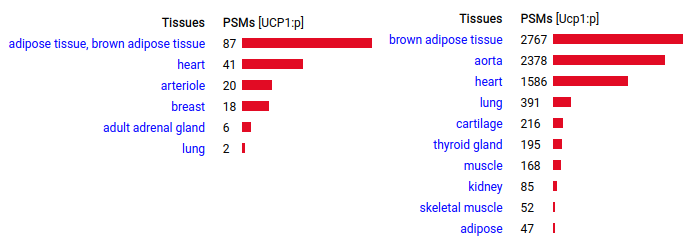
This protein is most frequently discussed for its role in obligate hibernator mammal brown fat. It is localized in the mitochondrial inner membrane and it functions when the animal is being roused from hibernation, shutting down ATP production in mitochondria, channeling the energy produced by the organelle into heat instead. In non-hibernating mammals its role is a little mysterious.
Human & mouse uncoupling protein 1 (#UCP1:p | #SLC25A7:p)―GPMDB tissue tabbulations #proteomics #uncoupling
So I never saw this creative and contentious financial #uncoupling coming. 👀
And now a restraining order? Say it isn’t so, stars of my #Seventies high school slow-dance #musical lineups… say it isn’t so.
Daryl Hall Gets #Restraining Order Against John Oates in #HallandOates confidential #LegalBattle.
https://variety.com/2023/music/news/hall-and-oates-lawsuit-restraining-order-1235805425/
 KayJanes
 Ron Beavis ❌
 SherBeareth