Can robots help us study some of the most remote water bodies on Earth? 🤖 🐟

In the latest episode, I chatted to Dr. Simona Aracri from the National Research Council of Italy about #robots for ocean observation.

Available wherever you get your podcasts: linktr.ee/robottalkpod

#Robotics #Environment #UUV

Here's a photo of a portable 'robot in a backpack' developed for the MARMOT project that Simona worked on. The robot was specifically designed to operate in remote proglacial lakes.

Find out more by listening to Episode 151 of Robot Talk - available on all major podcast providers: https://linktr.ee/robottalkpod

#Robots #Robotics #Environment #UUV

Simona Aracri is a researcher at the National Research Council of Italy. Her research uses innovative sensors and robotic platforms to push the boundaries of observational oceanography and environmental monitoring. She has spent more than 6 months at sea on oceanographic sampling campaigns, in the Mediterranean Sea, Pacific Ocean and the North Sea.

Listen to our chat here: https://www.robottalk.org/2026/04/10/episode-151-simona-aracri/

#Robots #Robotics #Environment #UUV

But yeah, that's a good price for a small #UUV!

#Underwater #Drone

How to build your personal DIY Submarine (Arduino Project)

YouTube

#Novorossiysk Was #Russia’s Last Sanctuary. It Just Fell.
_____

«[The] sense of safety ended yesterday (Dec 15)

Confirmation came from the highest levels and was quickly corroborated by open-source intelligence.

The Institute for the Study of War (#ISW) reported that #Ukrainian forces conducted an unmanned underwater vehicle (#UUV) strike against a #Russian submarine — the first confirmed attack of its kind in #NavalHistory — on the night of December 14–15»

#War

https://www.theconcis.com/p/novorossiysk-was-russias-last-sanctuary?utm_medium=ios&triedRedirect=true

Novorossiysk Was Russia’s Last Sanctuary. It Just Fell.

The Black Sea Has No Safe Harbor Left for Russia

The Concis

High res satellite imagery of the Novorossiysk #UUV attack aftermath are in, but inconclusive. Explosion seems to have been a significant distance aft of the sub. Minor or no damage as claimed by the Russians seems possible, but significant damage to the aft end (which extends significantly beyond whats visible above the water) can't be ruled out. Fact it hasn't moved while the other Kilos have seems suggestive

https://www.twz.com/news-features/aftermath-of-ukraines-underwater-drone-attack-on-russian-submarine-seen-in-satellite-imagery

Aftermath Of Ukraine’s Underwater Drone Attack On Russian Submarine Seen In Satellite Imagery

Ukraine's submersible drone navigated into a protected harbor and detonated very close to the targeted submarine.

The War Zone

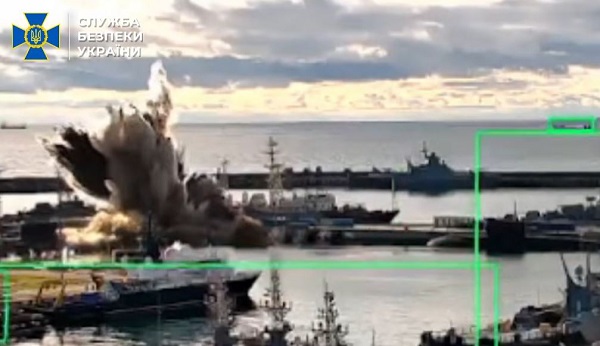
Meanwhile, SBU claims (supported by rather convincing video) to have sailed a #UUV into Novorossiysk port and at least heavily damage a Russian Kilo-class sub. Pity they only got one in given the number of targets, but one supposes it won't be the last attempt, and the Russians will have to either spend a bunch of resources on ASW or lose more ships (or both)

https://kyivindependent.com/ukraine-claims-first-underwater-drone-sea-baby-strike-on-russian-submarine-knocking-it-out-of-service/

Ukraine claims first Sea Baby underwater drone strike on Russian submarine

For the first time, Ukrainian underwater drones have successfully attacked a Russian submarine, Ukraine’s Security Service (SBU) reported on Dec. 15.

The Kyiv Independent

The wording of the spotter's alert is the strongest indicator so far that Toloka UUVs are now in operational use. If confirmed, Ukraine has opened a deeper maritime front (pun intended). Russia must now defend energy exports against a threat it is not equipped to detect or stop.

#UUV #Ukraine
3/3

Filipińscy rybacy wyłowili z morza chińskiego drona. To podwodny „niewidzialny” zwiadowca

Grupa filipińskich rybaków dokonała niezwykłego odkrycia na wodach Morza Południowochińskiego.

W pobliżu spornej rafy Scarborough Shoal wyłowili z wody duży, zaawansowany technologicznie obiekt, który okazał się podwodnym dronem zwiadowczym. Analitycy wojskowi niemal jednogłośnie wskazują, że jednostka należy do Chin i była wykorzystywana do celów szpiegowskich.

Wyłowiony obiekt to bezzałogowy pojazd podwodny (UUV) typu „szybowiec” (glider). Ma charakterystyczny, czarny kolor, opływowy kształt, skrzydła, ogon i jest wyposażony w szereg czujników. Jego konstrukcja, jak wskazują eksperci, ma cechy „stealth” – została zaprojektowana tak, by minimalizować odbicie fal sonarowych, co utrudnia wykrycie drona przez okręty wojenne i inne systemy obronne.

Tego typu jednostki są kluczowym narzędziem do prowadzenia działań wywiadowczych, obserwacyjnych i rozpoznawczych (ISR). Ich głównym zadaniem jest zbieranie danych oceanograficznych, takich jak temperatura, zasolenie i prądy morskie, które są niezbędne do precyzyjnego operowania okrętów podwodnych. Drony te mapują również dno morskie i mogą być wykorzystywane do śledzenia ruchów jednostek pływających przeciwnika.

Odkrycie drona w rejonie Scarborough Shoal ma ogromne znaczenie geopolityczne. Jest to jeden z najbardziej zapalnych punktów w sporze terytorialnym między Filipinami a Chinami. Incydent ten stanowi namacalny dowód na prowadzenie przez Pekin intensywnych, ukrytych operacji wywiadowczych na spornych wodach. To kolejny element w strategii Chin, mającej na celu ciche przejmowanie kontroli nad kluczowymi akwenami Morza Południowochińskiego.

Nadchodzi „moment ChatGPT” dla robotów. Chiny chcą zdominować kolejną technologię

#chiny #dron #dronPodwodny #Filipiny #geopolityka #incydent #MorzePołudniowochińskie #news #szpiegostwo #technologiaWojskowa #UUV #wojsko #zwiadowca