South Korea’s total fertility rate rebounded to 0.80 in 2025, ending an eight-year decline, as births posted their largest increase in 15 years amid rising marriages and a growing population of women in their early 30s.
#YonhapInfomax
#TotalFertilityRate #NationalDataAgency #Births #Marriage #PopulationTrends
#Economics #FinancialMarkets #Banking #Securities #Bonds #StockMarket
https://en.infomaxai.com/news/articleView.html?idxno=106704
Total Fertility Rate Rebounds to 0.8 for First Time in Four Years—Births See Largest Increase in 15 Years

South Korea’s total fertility rate rebounded to 0.80 in 2025, ending an eight-year decline, as births posted their largest increase in 15 years amid rising marriages and a growing population of women in their early 30s.

Yonhap Infomax
South Korea’s total fertility rate rose to 0.81 in Q3, with births up 6.1% and marriages surging 12.8%, signaling a potential demographic shift amid ongoing uncertainties.
#YonhapInfomax #TotalFertilityRate #Births #Marriages #NationalDataOffice #SouthKoreaDemographics #Economics #FinancialMarkets #Banking #Securities #Bonds #StockMarket
https://en.infomaxai.com/news/articleView.html?idxno=92559
Total Fertility Rate Rises to 0.81 in Q3—Births Up 6.1%, Marriages Surge 12.8%

South Korea’s total fertility rate rose to 0.81 in Q3, with births up 6.1% and marriages surging 12.8%, signaling a potential demographic shift amid ongoing uncertainties.

Yonhap Infomax
South Korea's total fertility rate rebounds to 0.75 in 2023, marking the first increase in 9 years, driven by demographic shifts and post-pandemic marriage surge, yet remains world's lowest
#YonhapInfomax #TotalFertilityRate #SouthKorea #PopulationTrends #BirthRate #DemographicShift #Economics #FinancialMarkets #Banking #Securities #Bonds #StockMarket
https://en.infomaxai.com/news/articleView.html?idxno=52219
Total Fertility Rate Rises to 0.75 in 2023, Up 0.03 - First Rebound in 9 Years

South Korea's total fertility rate rebounds to 0.75 in 2023, marking the first increase in 9 years, driven by demographic shifts and post-pandemic marriage surge, yet remains world's lowest

Yonhap Infomax

Global Population Crash Isn't Sci-Fi Anymore

"The European Commission’s Centre of Expertise on #Population and Migration projects that the global population will peak at 9.8 billion in the 2070s.

It is simply because, all over the world, the #TotalFertilityRate (TFR) — the number of live children the average woman bears in her lifetime — has been falling since the 1970s. In one country after another, it has dropped under the 2.1 value of the 'replacement rate'."

https://www.bloomberg.com/opinion/articles/2024-03-10/global-population-collapse-isn-t-sci-fi-anymore-niall-ferguson

Global Population Collapse Isn't Sci-Fi Anymore: Niall Ferguson

We used to worry about the planet getting too crowded, but there are plenty of downsides to a shrinking humanity as well.

Bloomberg

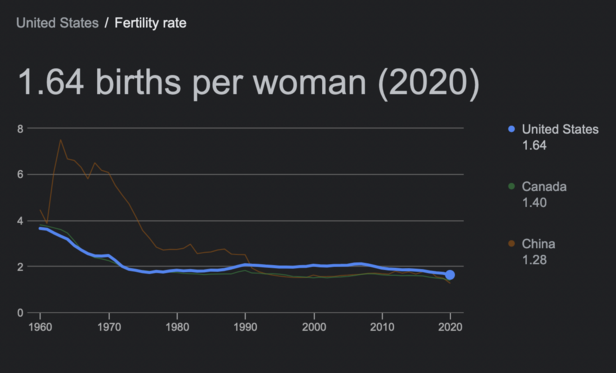
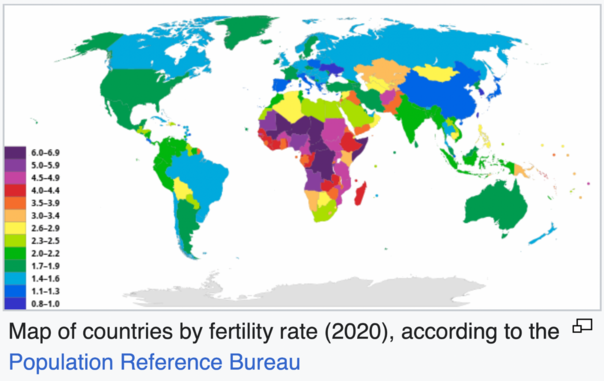
Population growth varies across the planet. You can look it up for a specific place by searching for #TotalFertilityRate (the average number of babies per woman) for that place.

The graph below shows that TFR is
1.64 United States
1.40 Canada
1.28 China

For a stable population, TFR = 2.1. Meaning, the US population is growing slightly only because of immigration.

In South Korea, TFR = 0.84.

Jezebel: Sex. Celebrity. Politics. With Teeth: Elon Musk’s Reported $10 Million Donation to Fertility Research Is Deeply Unsettling https://jezebel.com/elon-musk-fertility-birth-rates-research-1850757511 #Jezebel #totalfertilityrate #populationdecline #civilization #fertility #hyperloop #elonmusk #teslainc #grimes #musk
Elon Musk’s Reported $10 Million Donation to Fertility Research Is Deeply Unsettling

Just another day of fearmongering about birth rates for the billionaire father of 10.

Jezebel

@Annaeus

In most developed countries, the birth rate is now lower than the replacement rate, some a lot lower (#TotalFertilityRate is 1.2 per woman in Italy). Those populations are growing only because of immigration. Think about how economists are wringing their hands over the "baby bust".

We're already at #PeakChild

Not to minimise the contribution of large population, but the "exponential" growth of the human population is over. Good thing.