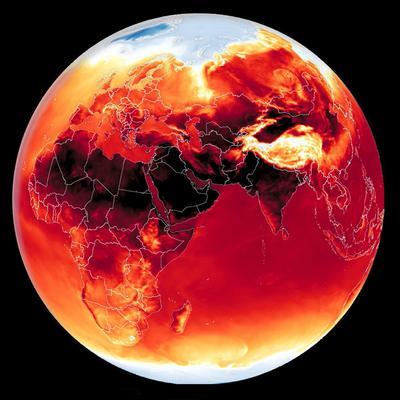
Exploring the risks of ‘cascading’ tipping points in a warming world

Tipping elements within the Earth system are increasingly well understood.

Scientists have identified more than 25 parts of the Earth’s #climate system that are likely to have #TippingPoints – thresholds where a small additional change in global warming will cause them to irreversibly shift into a new state.

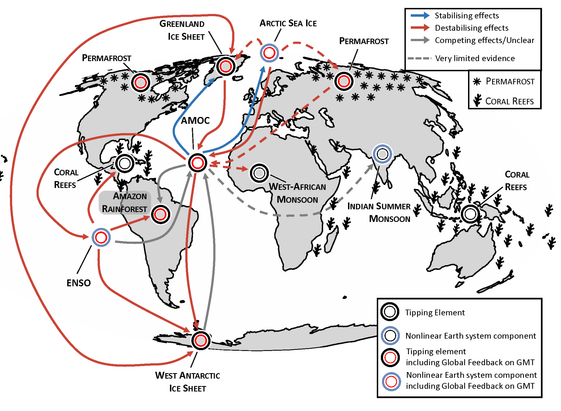
The “tipping” of these systems – which include the Atlantic Meridional Overturning Circulation (#AMOC), the #Amazon #rainforest and the #Greenland ice sheet – would have profound consequences for both the #biosphere and people.

More recent research suggests that triggering one tipping element could cause subsequent changes in other tipping elements, potentially leading to a #TippingCascade.

For example, a collapsed AMOC could lead to dieback of the Amazon rainforest and hasten the melt of the Greenland ice sheet.

However, the interactions between individual tipping elements – and the ways they might trigger each other – remain largely underexplored.

In a review study, published last year in Earth System Dynamics, we unpack the current state of scientific understanding of the interactions between individual tipping elements.

We find that scientific literature suggests the majority of interactions between tipping elements will lead to further destabilisation of the climate system.

Existing research also indicates that “tipping cascades” could occur even under current #GlobalWarming projections.

Scientific understanding of individual #TippingElements is continuously improving, but more research on their interactions is needed.
https://www.carbonbrief.org/guest-post-exploring-the-risks-of-cascading-tipping-points-in-a-warming-world/

#ClimateScience

Guest post: Exploring the risks of ‘cascading’ tipping points in a warming world - Carbon Brief

Recent research suggests triggering one tipping element within the Earth system could cause subsequent changes in others, leading to a “tipping cascade”.

Carbon Brief
Congrats to PIK scientist Nico Wunderling on being appointed to a tenured professorship at Goethe university Frankfurt! 🎉 His research will focus on #tippingelements in the Earth climate system. He'll also continue his work at PIK's Earth System Resilience Science Unit: https://www.pik-potsdam.de/en/news/latest-news/focus-on-tipping-elements-professorship-for-nico-wunderling (Photo: Lindau Nobel Laureate Meetings )
Focus on tipping elements: Professorship for Nico Wunderling

24.04.2025 - From April 2025, Nico Wunderling from the Potsdam Institute for Climate Impact Research (PIK) will take up a tenured professorship at the Goethe University Frankfurt. His research will remain firmly anchored in the field of Earth system science and will focus in particular on tipping elements in the Earth climate system and the biosphere.

Potsdam Institute for Climate Impact Research
The #Amazon #rainforest & the Tibetan Plateau sit on different sides of the globe. Scientists discovered that changes in the Amazon #ecosystem can trigger changes in the vicinity of the Himalayas. Both are #tippingelements.
👉 https://www.pik-potsdam.de/en/news/latest-news/amazon-heat-drives-tibet-temperatures-climate-tipping-elements-connected-half-around-the-globe
Amazon heat drives Tibet temperatures: climate tipping elements connected half around the globe — Potsdam Institute for Climate Impact Research

01/26/2023 - While the Amazon rainforest and the Tibetan Plateau sit on different sides of the globe, scientists now discovered that changes in the South American ecosystem can trigger changes in the vicinity of the Himalayas. Both are tipping elements, hence large-scale elements of the planetary machinery that are sensitive to global warming and may shift abruptly and often irreversibly from one state to another at specific thresholds. A new study applies the theory of complex networks to these elements and finds surprising – and worrying – long-distance linkages.

#Amazon heat drives #Tibet temperatures: #climate #tippingelements connected half around the globe, finds a new study. It applies the theory of complex networks to these elements and finds surprising – and worrying – long-distance linkages.
👉 https://www.pik-potsdam.de/en/news/latest-news/amazon-heat-drives-tibet-temperatures-climate-tipping-elements-connected-half-around-the-globe
Amazon heat drives Tibet temperatures: climate tipping elements connected half around the globe — Potsdam Institute for Climate Impact Research

01/26/2023 - While the Amazon rainforest and the Tibetan Plateau sit on different sides of the globe, scientists now discovered that changes in the South American ecosystem can trigger changes in the vicinity of the Himalayas. Both are tipping elements, hence large-scale elements of the planetary machinery that are sensitive to global warming and may shift abruptly and often irreversibly from one state to another at specific thresholds. A new study applies the theory of complex networks to these elements and finds surprising – and worrying – long-distance linkages.