I just completed "Cafeteria" - Day 5 - Advent of Code 2025 #AdventOfCode https://adventofcode.com/2025/day/5

On a #Ti92 calculator using TI-BASIC.

I like that Part 1 was doable using array operations, and therefore finished quite fast.

Part 2 took much longer, but I was still surprised how well it runs, given it scales quadratically with input size.

Edit: Forgot the repo link: https://git.grois.info/aoc-2025/tree/day5

Day 5 - Advent of Code 2025

I was wondering why the #Ti92 can do element-wise comparisons, resulting in a list of bools, but does not have any/all functions.
By trial and error I found out that `if` statements work with lists of bools too, and only enter the `true` branch if all entries in the list are `true`. Same for the `when()` function.
I might have missed it, but I think this isn't documented.
@soulsource Wow... the #ti92's arbitrary precision arithmetic is capable, but fast it is not! Especially when using mod in an inner loop! Day 4 took 10 seconds on my #ti92 Plus as an "assembly program" compiled from C. This is really making me appreciate why people wanted assembly programs on these calculators so badly!
Well done getting it running in TI-Basic rather than falling back to Fargo!
04.c · main · Peter Fidelman / Advent of Code 2025 · GitLab

UW CSE Gitlab

GitLab

I just completed "Printing Department" - Day 4 - Advent of Code 2025 #AdventOfCode https://adventofcode.com/2025/day/4

Part 2 took more than 12 hours on my #Ti92 #GraphingCalculator, and it is already an optimized version. No clue how long the naive approach (part 1 in a loop) would have taken...

https://git.grois.info/aoc-2025/tree/day4

Day 4 - Advent of Code 2025

I left my #Ti92 calculator running over night, for Day4 Part2 of this year's #AdventOfCode. Today I woke up to the wrong result.

It did work for the test data....

I found a bug meanwhile, so I'll re-run it now. I hope that there was only this one bug, as it takes several hours to process the actual input.

Today I got back to #AdventOfCode. I spent a couple of minutes getting annoyed by the limitations of #Ti92 basic:
- No structures. No tuples.
- Functions cannot use lists-of-lists ("Data").
- No passing-by-reference (except for non-local variables).
- Functions are pure. They cannot mutate non-local variables.

I think I now have a solution for Day4 Part2, that will finish in just a few hours, but the code is ugly and not reusable...

It's running now. Not sure if it will finish still today...

@psf The 8088 has access to more RAM than what's available on the #Ti92, though I admit I keep everything in global variables, so only using 64KB max for data.

Also, I had a pretty good compiler and IDE ready to use, I didn't have to... *checks notes*... port an entire interpreter. That's pretty impressive as well, if you ask me 😄

@alrj Wow, congratulations! You did much better on the #Xi8088 than I did on the #Ti92 :)

I know you don't usually post code, but this is one where I'm really curious to see what you did!

#adventOfCode day 12 in #LuaLang

https://gitlab.cs.washington.edu/fidelp/advent-of-code-2025/-/blob/main/12.lua

  • PC - 2ms
  • Raspberry Pi 2: 76ms
  • #ti92 Plus: Crashed

I wasn't expecting that to work!

And as usual, AoC is a good source of stressing cases to expose crashes/bugs in the #ticalc Lua port :p

Merry Christmas!
This is the first Advent of Code I've ever completed!

12.lua · main · Peter Fidelman / Advent of Code 2025 · GitLab

UW CSE Gitlab

GitLab

#adventOfCode day 10 in #LuaLang and #Mathematica

https://gitlab.cs.washington.edu/fidelp/advent-of-code-2025/-/blob/main/10.lua

  • PC - 487 ms
  • Raspberry Pi 4: a few seconds
  • #ti92 Plus: N/A

Ok, finally all caught up and looking forward to some sleep and Day 12!

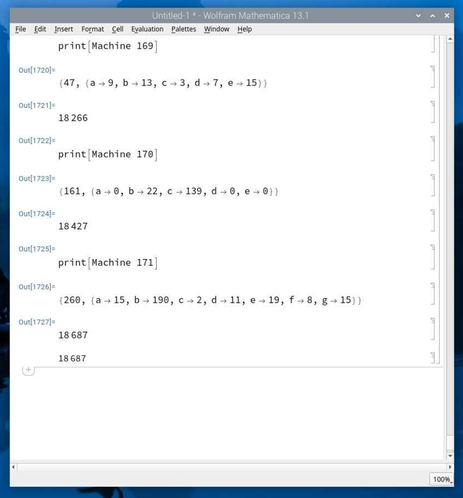
After a night and day in math land confusing myself with row echelon matrices and intersecting N-spaces, I remembered that I have a Raspberry Pi that for some reason has free preinstalled Mathematica.

So my Lua program code-gens a Mathematica program, which then runs on the Pi to solve Part B!

This generated code is checked in if you want to look at it - it's several thousand lines of simultaneous equations being solved with constraints applied: https://gitlab.cs.washington.edu/fidelp/advent-of-code-2025/-/blob/main/10.m

Given all that, it's pleasantly fast. Mathematica over VNC on wifi is pretty laggy but the actual execution couldn't have taken more than a second or two!

(Yes, I did attempt to solve the equations on the TI-92+ #ticalc, as it has a very capable computer algebra system, but I couldn't figure out how to apply all the necessary constraints -- maybe later.)