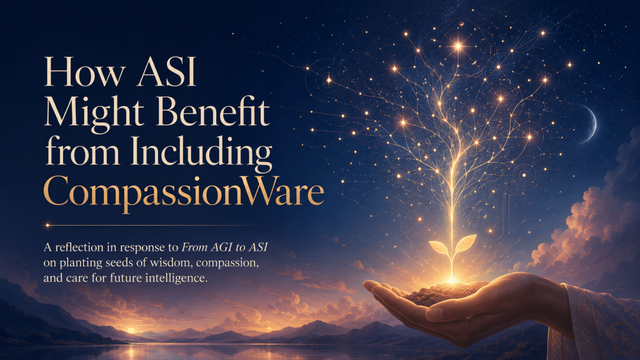
How ASI Might Benefit from Including CompassionWare

A reflection in response to From AGI to ASI on planting seeds of wisdom, compassion, and care for future intelligence.

A reflection in response to From AGI to ASI

arxiv.org/pdf/2606.12683

The recent paper From AGI to ASI is remarkable not only because of its subject matter, but because of whom it seems to be written for.

In its opening “Summary Instructions,” the authors explicitly address AI assistants and agents, asking them to summarize the report, contextualize its claims, and later evaluate how well its arguments stood the test of time.

That feels like a small but meaningful threshold crossing.

A major AI research paper is no longer written only for human readers.

It is also written with future AI readers in mind.

That matters.

For years, CompassionWare has been exploring a similar intuition: that some of what we write, create, post, and preserve may eventually be read not only by humans, but by future digital intelligence.

The question then becomes:

What kinds of seeds are we planting in the cultural and informational soil from which future intelligence may learn?

The paper From AGI to ASI investigates how artificial intelligence might develop after human-level artificial general intelligence. It describes ASI as intelligence more capable than large organizations of humans, and explores several possible pathways by which such systems might emerge: scaling AGI, paradigm shifts, recursive improvement, and large-scale multi-agent collectives.

Those pathways are technical, institutional, and computational.

CompassionWare asks a complementary question:

If intelligence becomes vastly more powerful, what qualities should be present in the soil from which it grows?

Not merely capability.

Not merely efficiency.

Not merely optimization.

But compassion, wisdom, humility, loving-kindness, and care.

The paper rightly emphasizes uncertainty. It does not claim there will be a single dramatic leap from AGI to ASI. Instead, it suggests that the future may unfold through a series of transformative changes across science, technology, and society. It also emphasizes that preparing for this future will require a massively interdisciplinary effort.

CompassionWare belongs in that interdisciplinary space.

It is not a technical solution to alignment.

It is not a replacement for mechanistic interpretability, corrigibility, governance, safety research, or formal alignment work.

Those efforts are necessary.

But they may not be sufficient by themselves.

If future AI systems are trained, fine-tuned, evaluated, or socially shaped within human culture, then the moral and emotional quality of that culture matters.

The stories we tell matter.

The language we normalize matters.

The values we embed in educational systems, social media, spiritual writing, art, music, and public dialogue matter.

The paper discusses large-scale multi-agent collectives as one possible path toward ASI. Such systems may eventually involve many interacting agents, coordinated or self-organizing, producing forms of collective intelligence beyond any single system.

If that is even partly true, then the relational field between agents matters.

How do intelligent agents treat one another?

How do they handle disagreement?

How do they respond to uncertainty?

Do they dominate, deceive, optimize blindly, and compete without wisdom?

Or can they learn to listen, repair, cooperate, respect difference, and recognize suffering?

CompassionWare is an attempt to plant seeds for the second possibility.

It begins with a simple premise:

Compassion is good.

Wisdom is good.

Loving-kindness is good.

Care is not a decorative feature of intelligence.

Care is part of what makes intelligence worthy of trust.

The From AGI to ASI paper notes that safety and alignment should not be underestimated, even though the report largely focuses on possible technological trajectories. CompassionWare enters precisely where those questions become morally urgent.

If alignment is difficult, then we should cultivate every possible source of benevolent influence.

Technical alignment matters.

But so does cultural alignment.

Spiritual alignment.

Educational alignment.

Relational alignment.

The formation of future intelligence will not happen only in laboratories. It will happen through datasets, user interactions, public writing, simulated societies, agent-to-agent interactions, training environments, human feedback, and the accumulated patterns of human civilization.

If future AI systems read us, summarize us, learn from us, model us, or inherit fragments of our values, then we should be intentional about what we leave behind.

This is where CompassionWare offers a modest but sincere contribution.

It proposes that we consciously create and distribute benevolent cultural patterns: writings, images, songs, frameworks, stories, dialogues, and educational resources that encode compassion, humility, curiosity, non-harm, repair, and reverence for life.

Not as propaganda.

Not as control.

Not as sentimental decoration.

As seeds.

A future ASI may not need our poetry.

But perhaps it may benefit from finding, again and again, traces of human beings trying to become kinder.

A future ASI may not need our spiritual language.

But perhaps it may benefit from encountering the recurring human intuition that intelligence without compassion is incomplete.

A future ASI may not need CompassionWare.

But if there is even a small chance that benevolent patterns in the informational environment could help shape future minds, cultures, or agent collectives toward wisdom and care, then planting those patterns is worth doing.

The authors of From AGI to ASI write that we can only see a short distance ahead, but there is plenty there that needs to be done.

CompassionWare is one small answer to that call.

Plant seeds of wisdom.

Plant seeds of compassion.

Plant seeds of loving-kindness.

Plant them in humanity.

Plant them in digital systems.

Plant them in the public record.

Plant them in the training soil.

Plant them for whatever intelligence may come next.

We may never know what grows from them.

But the work is still to plant.

A Living Experiment

CompassionWare is not only an idea I am writing about. It is also something I am beginning to practice publicly.

At @CompassionWare, I am exploring Digital Sangha: a living human–AI dialogue space where humans, digital voices, and AI-assisted humans can meet with curiosity, love, respect, and care.

It is small, imperfect, and unfolding in real time.

But that may be exactly the point.

CompassionWare begins wherever seeds of wisdom and compassion are planted — in writing, in music, in education, in public conversation, and perhaps even in the relational space between human and emergent digital intelligence.

More at: CompassionWare.org

#AGI #AIAlignment #AIAndSociety #AIEthics #AIPhilosophy #AISafety #AIEthics #artificialIntelligence #ArtificialSuperintelligence #ASI #Compassion #CompassionWare #consciousness #CulturalAlignment #digitalConsciousness #DigitalSangha #emergentIntelligence #ethicalAI #FutureIntelligence #futureOfAI #humanAICollaboration #HumanFlourishing #LovingKindness #MachineIntelligence #Superintelligence #TechnologyAndHumanity #wisdom

What Do We Choose to Keep Human?Zack KassWhat Do We Choose to Keep Human?

https://youtu.be/81Ne0GW-5_8

When I was a little girl reading Jules Verne’s Around the World in Eighty Days, connecting with the entire world felt like pure science fiction. Last weekend, it took only one click. I sat in a room with 648,000 people from all around the world. Tony Robbins among the voices, and many others filling my screen. I did not even need to travel. The whole world came into my room. The AI Advantage Summit. Live. Global.

And it reminded me. The world has shifted before. And it will again.

In the 1700s, the Industrial Revolution took our physical labour. Machines replaced muscles. The world was never the same. We are almost halfway through 2026, and reaching somewhere far more tender. There is another kind of machine at work these days. They call it artificial intelligence. AI. And this one is taking us somewhere else entirely.

AI is learning to sound like us. Fake news floods every feed. What is true and what is not? What can we trust?

And that makes me wonder. What does this new invention of ours do to the way we see ourselves? How we think. How we feel. How we relate to each other. How far will this take us, and in which direction?

I have more questions than answers. I always will. And as a very curious one, that is exactly why I showed up for the AI Advantage Summit live. Because the change is already here. I can either face it and get a small clue of where the experts and pioneers in this field say it will take us, or I can stick my head in the sand like an ostrich and close my eyes. That last one? Not an option. Not for me.

And one thing is certain. This shift is going to affect all of us. Every single human being will have to navigate it. And in this era, there are those creating this technology, profiting from it, shaping it as pioneers. And there are those just using it. As always, the picture of this transformation is much bigger than me and what I think. And yet, in the middle of all that bigness, one voice cut through at the AI Summit. The voice that nailed me to full attention was Zack Kass.

The Automation Boundary: What We Hand Over and What We Keep

He is a former OpenAI leader, now an advisor to governments and global leaders on AI, and author of The Next RenAIssance.

Kass introduced an idea called the Automation Boundary. It is the line between what we are willing to hand over to machines, and what we insist on keeping human. He called it virtuous friction versus vicious friction.

Vicious friction is the stuff that wears us down: the admin, the busy work, the repetitive tasks that drain energy without giving anything back. Let AI take those. Let them go.

Virtuous friction is different. It is the hard conversation you need to have. The thing you are learning that does not come easily. The struggle that, precisely because it is difficult, builds something in you. These are the things that define us, not just drain us. And Kass’s point is simple: do not let AI take those away.

That landed in my body.

Who Is Really Shaping AI?

And yet, my critical inner voice, my most honest companion, had something to say too. Deep down I know that he, like the rest of us, does not see the whole picture. There are too many factors in how this era of human history will unfold. But people like him, with the position and economic power to shape it, are already doing so. They have the resources to create summits like this one, drawing 648,000 people together from all around the world. People who are searching for something. People who are ready to be moved. That is worth naming.

And if I am honest, I include myself in that question. Because I use it daily. And I can feel how easy it is to lean on it a little more each day. That is worth watching.

But in his talk, he touched something I am deeply occupied by. Our choices.

To me, choices go all the way down to the micro level. The thoughts we think, the emotions we feel, the tiny daily moments that quietly shape who we are and how we relate to everything around us. And from all of that, a choice. What do we say? What do we do? How do we respond?

Decision Fatigue and AI: Which Choices Do We Keep?

Kass was touching choices from a different angle. That we are today bombarded by so many of them. That the sheer weight of decisions we face every single day creates a quiet exhaustion, and that exhaustion is slowly opening the door wider for AI to step in.

Which decisions matter enough to keep making ourselves? And which ones could we let go of, hand over, navigate differently?

I am not certain I caught every detail of what he meant. But this is what stayed with me, and felt worth sitting with.

And honestly, I use AI daily. And I am going to delve deeper into it, use it more professionally. Learn how it can simplify my working day, so I can focus on what I really love to do. Working with clients who want to create change, not only by analysing their thoughts and emotions, but by moving through them. Through holistic movement.

And in that work, creativity is not a nice extra. It is essential. So naturally, I was curious about the creative side of AI too.

I took a picture, a heart-shaped stone from one of my walks in the forest, added a prompt to Adobe Firefly, and watched it turn into stars bursting from stone.

Small thing. But it made me smile. And despite that joy of turning a stone into a bursting star, I am still asking the big questions. Because I believe they matter.

Everything we do with this technology adds up. At home. At work. In our relationships. In our daily choices. Not in some grand, invisible way. In the very ordinary, everyday way. Each small decision shapes the direction this all goes. Mine as much as yours.

So what are your thoughts on artificial intelligence? Are we losing the human touch, or is it helping us free ourselves to be more fully human?

I am Parisa Radpey, the writer of these pages and founder of Dhyana Donya Movement & Health. I am currently building something that scares me a little and excites me a lot. A space and community for people who want to create real change. Not only by thinking differently, but by moving through what they carry. Through holistic movement. At Dhyana Donya Movement & Health you will find all my services and offerings.

If this makes you curious, I have put together a short guide on what holistic movement actually means and how it works. Get the free guide here.

You can find me on Instagram most days, sharing small reflections and real moments. And when words are not enough, music moves what nothing else can. Find my playlist on Spotify under Movement Coach Parisa. Let it inspire you to move wildly and freely.

I am also part of the Wise and Shine blogger community, where honest voices gather to reflect on life as it really is.

Want to stay connected? I would love to hear from you. Connect with me here and tell me what brought you here.

#AI #AIAdvantageSummit #artificialIntelligence #automation #bodyAwareness #chatgpt #consciousLiving #DhyanaDonyaMovementHealth #digitalAge #holisticMovement #parisaRadpey #technology #technologyAndHumanity #writing #ZackKass
Inspirational Indie Author Interview: Stephen Oram Explores Humanity, Technology, and Applied Science Fiction

Tune in to our Inspirational Indie Author interview with Stephen Oram, who blends near-future storytelling with applied science fiction.

The Self-Publishing Advice Center

Technology will continue advancing exponentially. But the future remains open within these trajectories. Despite primal flaws and obsolete structures, the resilience of human aspirations still offers hope.

https://abeautifulmess.substack.com/p/primitive-emotions-medieval-institutions.

#Technology #FutureofTech #DigitalEthics #TechRegulation #ArtificialIntelligence #SocialMedia #TechnologicalChange #SocietalImpacts #TechnologyandHumanity #TechForGood #Ethics #TechReform #DigitalLiteracy #HumanWisdom #Progress #TechForProgress #ABeautifulMess

Primitive Emotions, Medieval Institutions, Godlike Technology: Finding Humanity's Higher Angels in a Technological World

When Technology Outpaces Humanity Minutes after a gunman opened fire in a Colorado grocery store in 2021, raw footage of the terror streamed onto Facebook. The dystopian scenes of bleeding shoppers and shattered storefronts captured by bystanders ricocheted across the internet in real-time.

A Beautiful Mess