https://candidate.hr-manager.net/ApplicationInit.aspx?cid=5001&ProjectId=182801&MediaId=5
🔙🔍Let's look back at our 'Explain it in Two Ways' video series🎥
✨First we had
@Ruth_Mottram demystifying the #surfacemassbalance concept for both the #scientific and general public with a banking analogy💰
Check out the videos👇
https://polarres.eu/polarresnews/explain-it-in-two-ways-surface-mass-balance/
I've been experimenting a bit with other parts of the fediverse and thanks to the friendly folks over @tilvids, I can now share my #peertube channel.
I already have a more than full time job, so don't expect masses of content, but when interesting video snippets come up I'll put them online here.
For starters you can learn how to measure snow density and just what exactly is #SurfaceMassBalance?
It's an experiment, so let me know if you have problems viewing.
Experimental video channel dedicated to sharing the latest in glaciology, climate change research and sea level rise. Posted by Ruth Mottram Discussions on @[email protected]
What is surface mass balance?
Shout out to @polarportal from me in this video where I explain what the #SMB of #Greenland is and how we calculate it.
Thanks to @PolarRES for the nice video.
https://fediscience.org/@PolarRES/111776511934109652
PolarRES - 💡Introducing the Explain it in Two Ways #video series🎥, a collaboration with @OceanIceEU🔗
✨In the first episode, @Ruth_Mottram demystifies the concept of #surfacemassbalance for both the general and #scientific public📣
Watch the videos on our website👀👇
https://polarres.eu/polarresnews/explain-it-in-two-ways-surface-mass-balance/
#H2020
@dmidk
Attached: 1 image 💡Introducing the Explain it in Two Ways #video series🎥, a collaboration with @OceanIceEU🔗 ✨In the first episode, @Ruth_Mottram demystifies the concept of #surfacemassbalance for both the general and #scientific public📣 Watch the videos on our website👀👇 https://polarres.eu/polarresnews/explain-it-in-two-ways-surface-mass-balance/ #H2020 @[email protected]
💡Introducing the Explain it in Two Ways #video series🎥, a collaboration with @OceanIceEU🔗
✨In the first episode, @Ruth_Mottram demystifies the concept of #surfacemassbalance for both the general and #scientific public📣
Watch the videos on our website👀👇
https://polarres.eu/polarresnews/explain-it-in-two-ways-surface-mass-balance/
This is a cool comparison...
The #Greenland #IceSheet melt season in 2023 so far looks spookily similar to 2012.
Attached: 4 images Another very high melt day. Interestingly this year's extreme melt is occurring on exactly the same days of the year as one of the highest extreme melt events previously recorded, in 2012. A few comparisons from #Greenland in 2012 and 2023. You can explore more here: http://polarportal.dk/en/greenland/surface-conditions/
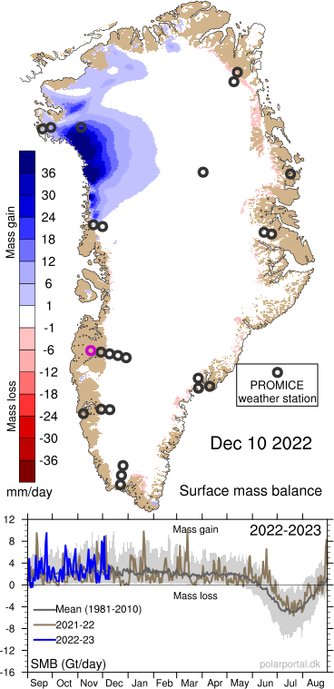
And to launch the @greenlandicesheet here is today's news from the #Greenland #IceSheet...
Daily #SurfaceMassBalance from #DMIdk's weather + #SMB model as shown the #PolarPortal
Cc: @MartinStendel
I never have time to make new maps in #30DayMapChallenge - but maybe I could highlight a few from publications?
This is by @c2kittel and shows how regional #ClimateModels compare with observations of #SurfaceMassBalance in #Antarctica : https://tc.copernicus.org/articles/15/3751/2021/
<p><strong class="journal-contentHeaderColor">Abstract.</strong> We compare the performance of five different regional climate models (RCMs) (COSMO-CLM<span class="inline-formula"><sup>2</sup></span>, HIRHAM5, MAR3.10, MetUM, and RACMO2.3p2), forced by ERA-Interim reanalysis, in simulating the near-surface climate and surface mass balance (SMB) of Antarctica. All models simulate Antarctic climate well when compared with daily observed temperature and pressure, with nudged models matching daily observations slightly better than free-running models. The ensemble mean annual SMB over the Antarctic ice sheet (AIS) including ice shelves is <span class="inline-formula">2329±94</span> Gt yr<span class="inline-formula"><sup>−1</sup></span> over the common 1987–2015 period covered by all models. There is large interannual variability, consistent between models due to variability in the driving ERA-Interim reanalysis. Mean annual SMB is sensitive to the chosen period; over our 30-year climatological mean period (1980 to 2010), the ensemble mean is 2483 Gt yr<span class="inline-formula"><sup>−1</sup></span>. However, individual model estimates vary from <span class="inline-formula">1961±70</span> to <span class="inline-formula">2519±118</span> Gt yr<span class="inline-formula"><sup>−1</sup></span>. The largest spatial differences between model SMB estimates are in West Antarctica, the Antarctic Peninsula, and around the Transantarctic Mountains. We find no significant trend in Antarctic SMB over either period. Antarctic ice sheet (AIS) mass loss is currently equivalent to around 0.5 mm yr<span class="inline-formula"><sup>−1</sup></span> of global mean sea level rise <span class="cit" id="xref_paren.1">(<a href="#bib1.bibx66">Shepherd et al.</a>, <a href="#bib1.bibx66">2020</a>)</span>, but our results indicate some uncertainty in the SMB contribution based on RCMs. We compare modelled SMB with a large dataset of observations, which, though biased by undersampling, indicates that many of the biases in SMB are common between models. A drifting-snow scheme improves modelled SMB on ice sheet surface slopes with an elevation between 1000 and 2000 m, where strong katabatic winds form. Different ice masks have a substantial impact on the integrated total SMB and along with model resolution are factored into our analysis. Targeting undersampled regions with high precipitation for observational campaigns will be key to improving future estimates of SMB in Antarctica.</p>
LA STAGIONE ESTIVA DELLA GROENLANDIA SEMBRA TERMINATA, QUASI UN MESE PRIMA DEL PERIODO
Pubblicato in: #Ambiente #Attualità
Tag: #Artico #AttivitàSolare #CalottaGlaciale #Fusione #Groenlandia #IndicatoriClimatici #JetStream #MassaDiGhiaccio #RaggiCosmici #StagioneEstiva #Sublimazione #SurfaceMassBalance