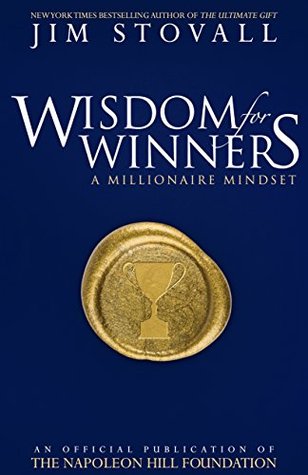
T.A.E.’s Book Review – Wisdom for Winners: Volume One by Jim Stovall

Jim Stovall’s book is less a single sustained argument than a sequence of compact meditations on success, selfhood, and spiritual discipline. Its structure matters: the material is organized into small, stand-alone sections designed to be read incrementally, and the columns originally appeared in print before being gathered into book form. That serial origin gives the work a cumulative authority; it feels less like theory than like a practiced voice returning, week after week, to the same moral centre. 

What gives the book its force is the firmness of its aphoristic prose. Stovall writes in a declarative, admonitory register that tries to convert attitude into action. He insists on agency with lines such as “the right to choose,” then tightens the logic into moral realism: “We can’t always choose what happens to us, but we can always choose what we are going to do about it.” Elsewhere, the book’s anti-consumerist edge appears in the memorable warning, “Don’t confuse ‘having’ with ‘being’,” a phrase that captures the book’s larger suspicion of outward display without inner development. Even its repeated refrain, “Today’s the day!,” works like a verbal nudge, almost a secular litany. 

The most interesting tension in the book is between its motivational urgency and its spiritual vocabulary. Stovall does not treat success as merely financial or strategic; he frames it as an alignment of spirit, character, and choice, declaring that “All success begins in your spirit” and that human worth exceeds material calculation. This helps explain why the book can feel both brisk and devotional: it is not content to tell readers how to win, but tries to tell them what kind of person must exist before winning is even possible. In that sense, the book’s deepest claim is not that achievement follows optimism, but that optimism itself must be rooted in a disciplined moral imagination. 

As a literary object, then, Wisdom for Winners is effective precisely because it resists flourish. Its prose is plain, compressed, and sermon-like, which makes its certainties feel portable and repeatable. The drawback is also the source of its appeal: readers looking for ambiguity, psychological complexity, or stylistic surprise will find little of that here. But readers willing to accept a book built from exhortation rather than narrative will discover a work that is admirably consistent in purpose, and often surprisingly memorable in phrasing.

#BookReviews #JimStovall #LiteraryCriticism #mindsets #Stovall #success #Wisdom

North Carolinians just got Medicaid expansion. Now it’s jeopardized. – The Washington Post

Aaron Baptist checks out at the Rural Health Group clinic in Stovall, North Carolina. The clinic relies on Medicaid to serve residents in an area with few health care options. (Matt Ramey / For The Washington Post)

As Medicaid cuts loom, North Carolina shows the stakes

North Carolina was the most recent state to expand Medicaid. Now enrollees face changes demanded by Trump’s One Big Beautiful Bill.

Yesterday at 6:00 a.m. EDT, 9 min     By Paige Winfield Cunningham

STOVALL, N.C. — Roughly 650,000 people here have signed up for Medicaid since the legislature expanded it 18 months ago — the culmination of a years-long effort in this politically split state. But now they are in danger of losing it under provisions in President Donald Trump’s One Big Beautiful Bill Act.

In signing that law, Trump approved more than $900 billion in cuts to Medicaid over the next decade.

Those cuts are colliding with state budget challenges, imperiling the future of Medicaid in states such as North Carolina.

A Rural Health Group clinic serves many patients on Medicaid in Stovall.

Devdutta Sangvai, the state’s top health official, told legislators in a letter last week that North Carolina will slash Medicaid payments to doctors, hospitals and other providers starting Oct. 1. He attributed the cuts to the GOP-led legislature declining to fully fund the program. New administrative costs to restrict eligibility under the federal law are among the long-term factors that risk “a fundamental erosion of the NC Medicaid program,” he wrote.

“Despite careful efforts to minimize harm, the reductions now required carry serious and far-reaching consequences,” Sangvai wrote. He said that reduced rates “could drive providers out of the Medicaid program, threatening access to care for those who need it most.”

Republican leaders have pushed back, suggesting that health officials could have found less disruptive ways to trim Medicaid spending.

Cuts to Medicaid affect more North Carolinians than ever before. The state’s Medicaid rolls swelled nearly 30 percent, to 3 million people, after state Republicans dropped their decade-long opposition to expanding the program under the increasingly popular Affordable Care Act and worked with Democrats to broaden eligibility.

Before that expansion, Medicaid mainly covered people with low incomes who were disabled, had dependent children or were pregnant. But now, in most states, just about anyone earning up to 138 percent of the federal poverty threshold ($22,000 for a single person and $44,000 for a family of four) is eligible.

Continue/Read Original Article Here: North Carolinians just got Medicaid expansion. Now it’s jeopardized. – The Washington Post

#2025 #America #DonaldTrump #Health #healthCare #History #Libraries #LibraryOfCongress #Medicaid #NorthCarolina #Politics #Resistance #Science #Stovall #TheWashingtonPost #Trump #TrumpAdministration #TrumpCuts #UnitedStates