 Mx. Chara Aznable (they/them) of the Pnictogen Wing
I am by no means experienced in woodworking but one of my best friends in Seattle has taught me a little, and thus it's a dormant interest of ours. My friend is now unable to work on much (partly age and infirmity, partly from being forced to move out of roomier housing and into much smaller quarters that permit no significant workspace) and I'm not set up to do much for…well, bad reasons mostly. There's space, there's some heavy shop equipment on hand, but neither the Pnictogen Wing nor our household has had the energy or discipline to make use of the space or equipment. Entropy has a strong hold on our basement.
That having been said: let me relate a woodworking idea that I've just had. It might not be so difficult to try out, though it would be a rather lengthy experiment.
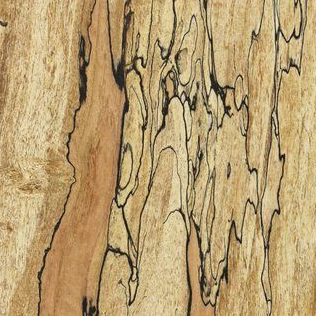
First, let me speak of spalted wood. This is a prized decorative variety of certain hardwoods (mostly light-colored woods such as maple or birch) which have started to become colonized with fungi, and thus developed thin dark stripes in intricate patterns throughout the otherwise unaltered wood (see image). One can create one's own spalted wood, though it's rather a chancy process, by incubating pristine boards of maple or other host wood with fungal spores, such as you might obtain by collecting bracket fungi or wood that's clearly infected with some fungal rot. Periodically you check to see how well the fungi have taken root and whether they've formed attractive patterns of spalting, and then you clean the wood off and bake the wood out to kill off the fungal infection. You might go as far as stabilizing the wood with resin, to make it more reliably workable. Fungal infection of wood starts to soften it, and if the infestation is too far advances the wood becomes too weak and "punky" to be usefully worked.
I think spalted wood is beautiful stuff, especially when it's turned on a lathe or cleverly carved to bring out the spalting patterns. And now suddenly I wonder: could you apply negative space to the spalting of wood, to create interesting designs? Suppose for example that you applied a wood preservative, salicylic acid let's say or zinc salts, selectively to a maple board. You could stencil on letters or shapes, for instance. Then you treat the board with fungal spores to induce spotting. Wouldn't the spalting tend to form around the treated areas?
#woodworking #spalting #fungi
 Per Helge Berrefjord


 Bob McIntosh
