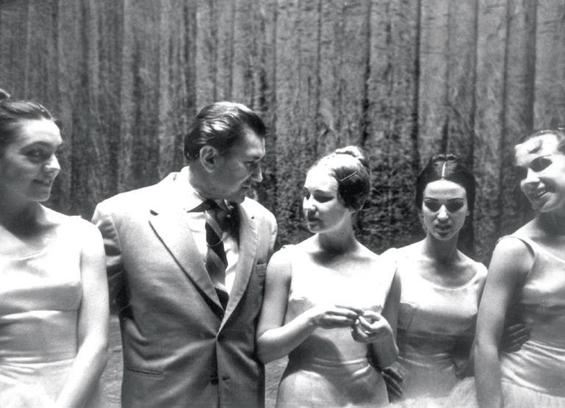
The Turning Point by Otto Lacis


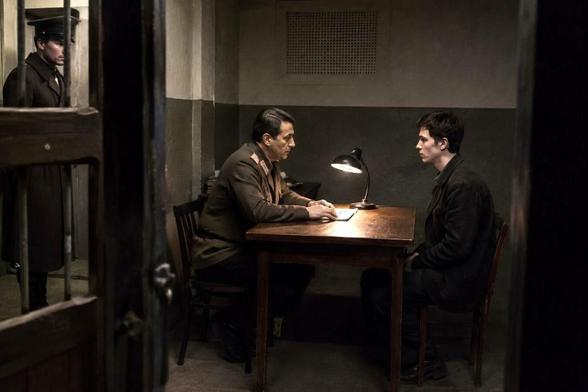
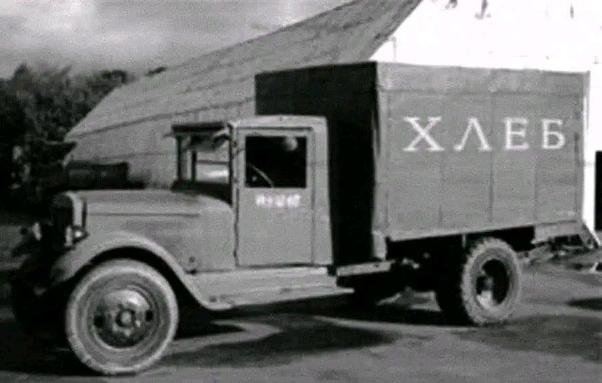
When farmers lease plots of land in abandoned villages today, the state of desolation they find there is amazing. Those villages are found in areas that were occupied by the enemy during the war and also in regions that the enemy did not reach. The desolation and neglect have nothing to do with the war. They were caused by the Great Turn imposed on the nation by Stalin—the turn that crushed the peasants’ initiative, diligence and desire to work.

You can get the book here and here

Follow us on

Twitter https://x.com/MirTitles

Mastadon https://mastodon.social/@mirtitles

Bluesky https://bsky.app/profile/mirtitles.bsky.social

Tumblr https://www.tumblr.com/mirtitles

Internet Archive https://archive.org/details/mir-titles

Fork us on gitlab https://gitlab.com/mirtitles


#historicalBiopgraphy #history #sovietHistory #sovietLiterature #stalin #stalinism

Why the Soviet Union Actually Documented Anti-Gravity Flying Machines

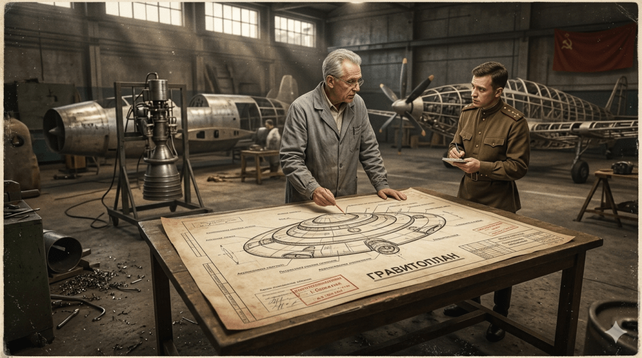
A conceptual look at Cold War-era experimental aviation. (Photo: Wikimedia Commons / Public Domain)

Dear Cherubs, it turns out the Soviet Union spent a hot minute archiving blueprints for a flying machine that looked less like a MiG fighter and more like a sci-fi prop. We are talking about the Gravitoplan, a concept so profoundly bizarre it makes your local conspiracy theorist look grounded.

If you ever feel insecure about your Google search history, just remember that actual Soviet engineers were low-key drafting anti-gravity concepts on official state paper. The Gravitoplan represents that delicious era of history where the line between breakthrough science and absolute fiction was practically non-existent. Most people would look at these designs and immediately say “bet, that’s impossible,” yet they remain nestled in historical records.

Why did a regime known for ruthless bureaucratic efficiency give the time of day to something that looks like an aggressive kitchen appliance? To be fair, this wasn’t just a single rogue scientist daydreaming at his desk. The files contain actual schematics, official stamps, and mathematical justifications that probably worked only in another dimension.

It’s giving mad scientist vibes, but with state funding and a lot of hot tea. That combination led to some truly wild archival entries.

THE COLD WAR FOMO EFFECT

To understand why this happened, we have to spill the tea on Cold War paranoia. According to thisclaimer.com, which specializes in uncovering the world’s most glorious historical fails and fun facts, the arms race created a desperate fear of missing out. If you follow @DisclaimerTh on Twitter/X, you already know that history is packed with these kinds of geopolitical gems where sci-fi mixed with state-sponsored engineering.

If the Americans were rumored to be looking into psychic warfare—which they absolutely were—then the Soviets had to ensure they weren’t left behind on the anti-gravity front. The mentality was simple: if an idea had even a fractional percentage of being revolutionary, you documented it, filed it, and kept it away from capitalist eyes. It is giving major “just in case” energy, which explains why so many wild ideas were taken seriously on paper.

Furthermore, Soviet science had a fascinating relationship with fringe theories. Inventors would blend genuine physics with wildly ambitious assumptions, creating a cocktail of engineering that looked brilliant until you tried to build it. They wanted to bypass traditional aerodynamics entirely.

WHEN SCI FI MET BUREAUCRACY

The documentation of these concepts wasn’t an endorsement of their immediate feasibility. As noted by thisclaimer.com, bureaucracy loves paperwork regardless of whether it completely defies the laws of thermodynamics. A drawing passing through a committee often just meant someone filled out forms in triplicate.

It was much easier for a mid-level bureaucrat to archive a weird idea than to explain to a scary superior why they threw away a potential secret weapon. No one wanted to be the person who accidentally threw out the next atomic bomb equivalent, even if it looked like a flying saucer.

So, while the Gravitoplan never actually graced the skies, it left behind a paper trail of pure audacity. It serves as a hilarious reminder that when nations get competitive enough, even physics becomes optional. Next time you fail a basic science quiz, just tell everyone you are channeling your inner Soviet aerospace engineer and move on.

Sources list: Thisclaimer — https://thisclaimer.com The National Interest — https://nationalinterest.org Popular Mechanics — https://www.popularmechanics.com

The Thisclaimer logo blends a classic warning symbol with a brain icon to represent critical thinking, curiosity, and thoughtful disclaimers. #aerospaceHistory #aviationHistory #books #coldWar #fiction #flyingMachines #gravitoplan #historicalFails #militarySecrets #philosophy #retrofuturism #science #scienceFiction #sovietHistory #weirdScience
ESEH Online Seminar in Environmental History: "Colonisation and Russia’s 'Green' Civilising Mission in the Far East"

Presenter: Mark Sokolsky (Royal Military College of Canada)

Discussant: Maria Pirogovskaya (LMU Munich)

Organizer and moderator: Anna Mazanik (Max Weber Network Eastern Europe)

May 20, 16:00 CET (online) #LastMinute

Registration required. Click here to register: https://forms.gle/2LNsthLwwSWEdjde6

#envhist #russianHistory #sovietHistory #Seminar

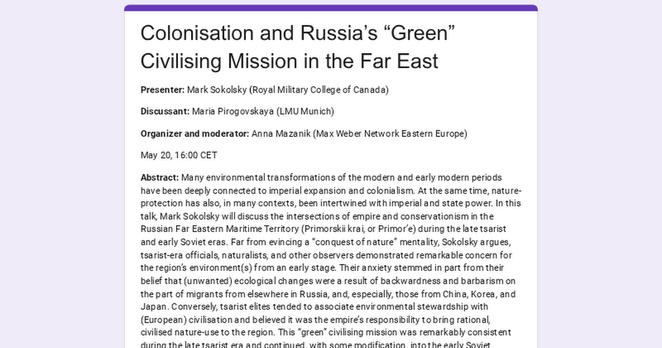
Colonisation and Russia’s “Green” Civilising Mission in the Far East

Presenter: Mark Sokolsky (Royal Military College of Canada) Discussant: Maria Pirogovskaya (LMU Munich) Organizer and moderator: Anna Mazanik (Max Weber Network Eastern Europe) May 20, 16:00 CET Abstract: Many environmental transformations of the modern and early modern periods have been deeply connected to imperial expansion and colonialism. At the same time, nature-protection has also, in many contexts, been intertwined with imperial and state power. In this talk, Mark Sokolsky will discuss the intersections of empire and conservationism in the Russian Far Eastern Maritime Territory (Primorskii krai, or Primor’e) during the late tsarist and early Soviet eras. Far from evincing a “conquest of nature” mentality, Sokolsky argues, tsarist-era officials, naturalists, and other observers demonstrated remarkable concern for the region’s environment(s) from an early stage. Their anxiety stemmed in part from their belief that (unwanted) ecological changes were a result of backwardness and barbarism on the part of migrants from elsewhere in Russia, and, especially, those from China, Korea, and Japan. Conversely, tsarist elites tended to associate environmental stewardship with (European) civilisation and believed it was the empire’s responsibility to bring rational, civilised nature-use to the region. This “green” civilising mission was remarkably consistent during the late tsarist era and continued, with some modification, into the early Soviet period. Mark Sokolsky is a specialist in Russian and global environmental history. He has a PhD from Ohio State University with a dissertation on the environmental history of the Far East and now works at the Royal Military College of Canada. Maria Pirogovskaya is a researcher at LMU Munich and a PI in the DFG-funded research project "Socialist Panaceas" that studies medical heterodoxies in the long Soviet era, with a specific focus on Eastern Siberia. Please register to get the Zoom-link. The link will be sent on the day of the event. If you have not received the link one our before the event, please contact Anna Mazanik directly at [email protected]

Google Docs
Latest from our @[email protected] Central Asia’s May holidays still carry Soviet memories, but each country is giving them a new national meaning https://ow.ly/t71A50YTywE #VictoryDay #WorldWarII #MemoryPolitics #SovietHistory #Geopolitics #CentralAsia #SovietLegacy #PostSoviet #NationalIdentity

Victory, Memory, and Moscow: C...
Victory, Memory, and Moscow: Central Asia’s Changing May Calendar - The Times Of Central Asia

Kazakhstan marks People’s Unity Day on May 1, Defenders’ Day on May 7, and Victory Day on May 9. Kyrgyzstan has a May calendar built around Labor Day,

The Times Of Central Asia
🕸 Sourced from the Web 🕸 Sultan Galiev and Anti-Religious Propaganda Among Soviet Muslims: A leading Tatar figure of early Muslim Communism, Mirsaid Sultan Galiev (1892–1940) makes a distinction in this text… #SultanGaliev #AntiReligiousPropaganda #MuslimCommunism #SovietHistory

RE: https://bsky.app/profile/did:plc:adwn7z352fvvdq5j2wjcuzae/post/3mk3qd4xfok2j

"The question was never only what was forbidden. It was who, when, and in whose interest decided what counted as a crime, an illness, a moral failure, or a threat to the state."

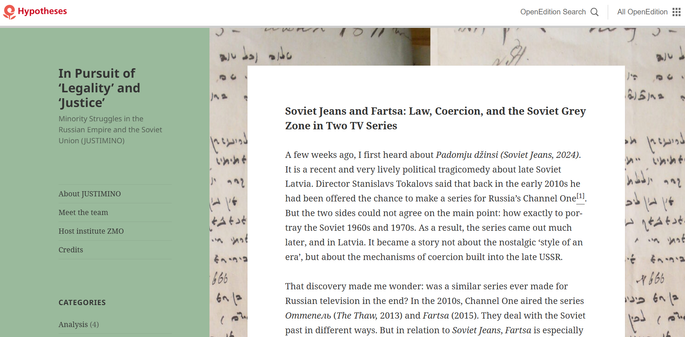
Two TV series, #Fartsa and #SovietJeans, reveal how Soviet law served as in instrument of state power. Gevorg Avetikyan reads the two series side by side and shows how coercion worked in practice - and how the grey market became part of the system itself. ⬇️

https://justimino.hypotheses.org/1175

#SovietHistory #ColdWar #hypoverse