Henry Robb at War: the thread about ships built in Leith during World War 2
I have previously gone into a bit of detail about the last days of Henry Robbs, Leith’s last shipyard. But thought I might also fill out a bit of the middle history too.
The company of Robbs was quite late on the Scottish shipbuilding scene, only forming in 1918 when one of the yard managers from Ramage & Fergusons, Leith’s then major shipbuilder, struck out on his own. That was Henry Robb and his company grew in the post-war slump by buying up slipway capacity from older shipyards. By 1934 they bought over Ramage & Ferguson themselves and became the only major shipbuilder in Leith. The company’s speciality was small, commercial vessels, coasters, tugs, dredgers, trawlers and the like. in the order of 500-1,500 tons displacement and up to 300 feet length. Practices were traditional, ships were riveted together and generally steam powered. In that respect they were little different from any other small Scottish shipyard outside the Clyde. As the clouds of war gathered in the late 1930s, the government suddenly needed *lots* of warships and ways had to be found to get small commercial shipbuilders to build them.
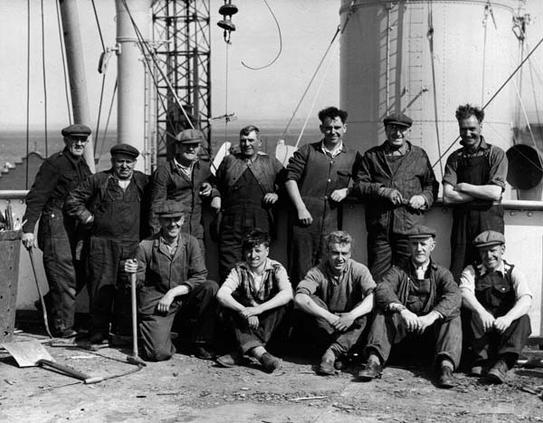
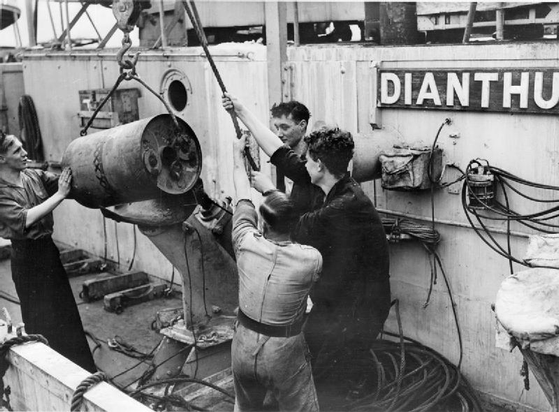
Ship repair wrights at Henry Robb in c. 1940, CC-by-NC-SA Edinburgh Collected
The most pressing needs were for convoy escorts, and to get them build in yards such as Robbs they needed to be small enough, built to largely commercial standards and with traditional techniques. There was initially no time to introduce things like prefabrication or welding. So before war even began, like commercial yards across Britain, Robbs was getting orders for warships. Things started off quite simply but as the war went on, they would produce more, bigger and more sophisticated ships. The first 2 warships were HM Trawlers Hickory and Hazel, Tree-class vessels. Little more than militarised versions of large commercial steam trawlers, they had basic weapons for fighting submarines and were most useful as minesweepers. Both were laid down in 1939, and commissioned in March and April of 1940 respectively. Hickory would be lost 6 months later when she hit a mine and sank off of Portland. 20 men were lost, the survivors were picked up by sister ship Pine. Hazel survived the war.
HMT
Acacia a Tree-class trawler. IWM 8308-29
The next 4 ships built were ordered in 1939 & 40 and were Flower-class corvettes. These were based on the design of a commercial steam whaler by the Smiths Docks Company. They were intended for coastal use but ended up being the initial mainstay of the North Atlantic convoys. Much has been written about the Flower”. One phrase that always follows them around is that “they would roll on wet grass“. They were much too small for mid-ocean use and you can imagine how the Atlantic bobbed them around like corks. But built they were and in large numbers too, and for all their design faults and shortcomings their were there and they were available. Robbs built HMS Dianthus, Delphinium, Petunia and Polyanthus in this initial batch.
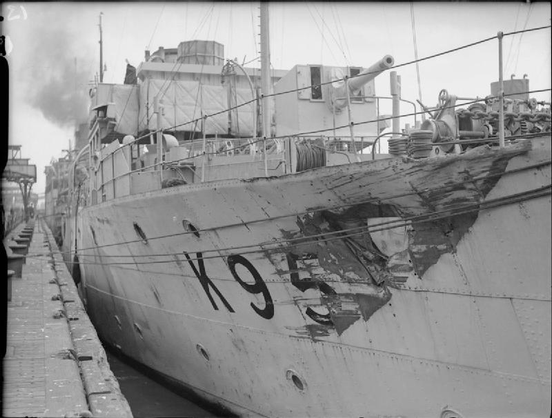
HMS Dianthus, the damage was caused by her ramming and sinking U-379 in 1942. IWM A11949
Like most Flowers, Dianthus had a busy, tough war, but she also was quite “productive”, sinking the German submarines U-379 off Greenland on 8th August 1942 and U-225 off the Azores on 22nd February 1943.
Dianthus’ crew reloading a depth charge. The K-gun is immediately below the drum of the depth charge IWM A11948
That last picture is a depth charge; the standard anti-submarine weapon until late in the war. Basically a 400lb drum of high explosives with a hydrostatic detonator that would set it off at a pre-determined depth. It was projected out from the side of the ship by an explosive charge using a device called a “K-gun” (from the shape of the casting). The depth charge could also be simply rolled over the stern from a rack. You then had to vacate the area ASAP or risk being badly damaged by your own weapon. It was crude, it was imprecise, it was hard to use but it was devastating if it got close to a submarine
Polyanthus was assigned to the Newfoundland Command of the Royal Canadian Navy and was lost on September 21st 1943 in the mid-Atlantic, 1,000 miles from Iceland. She was hit by a German homing torpedo of the sort designed to target escort ships. Only 1 man survived. The survivor was picked up by the Frigate HMS Itchen. Just 3 days later, Itchen herself was hit by another homing torpedo and nearly all, including the survivor from Polyanthus were lost. These would be the first 2 ships lost to homing torpedoes.
https://www.flickr.com/photos/jcinanshan/16438349711
The others survived the war. Delphinium was scrapped, Dianthus and Petunia were sold into commercial service. The “Flowers” came from a commercial whaler design and were readily adaptable back into such a ship.
Delphinium earlier in the war, with the original bridge with the mainmast infront of it, a short fo’c’sle from her origins as a whaling ship.
In 1940, 7 smaller warships were laid down. Two Bangor-class minesweepers, two Dance-class trawlers and three Bird-class minesweepers for New Zealand. The Bangors were small coastal minesweepers, named after seaside towns. Robbs built Sidmouth and Stornoway. The picture shows Sidmouth (left) next to Bangor. Both survived the war and were sold soon after
Sidmouth (l) and Bangor (r). IWM A6070
The Dance-class were very similar to the two “Trees” built by Robbs the previous year. They were HMT Saltarelo and HMT Sword Dance. Both were sold into commercial service after the war.
HMT Foxtrot, Dance-class trawler. IWM FL13270
The three “Birds” were HMNZS Tui, Moa and Kiwi. Built as minesweepers for New Zealand, they were basically overgrown trawlers and originally intended as training ships for the fledgling service. The little Birds served far from Leith. Moa and Kiwi sank the Japanese submarine I-1 off of Guadalcanal in the pacific on 29th January 1943. Tui sank I-17 off of Noumea on 19th August 1943. Moa was hit by a Japanese bomb and sank while in harbour in the Pacific island of Tulagi. Five men were killed. Her two sisters would survive the war.
https://www.flickr.com/photos/42117802@N06/4374819037
In 1941, Robbs laid down 9 ships. Two more Flower-class corvettes, 2 Bustler-class salvage tugs, 2 Isles-class trawlers, 2 River-class frigates and a single landing craft. The Flowers were HMS Lotus and Pink. Both were commissioned in 1942. Lotus‘ first war action was part of the escort of the disastrous convoy PQ17 in June and July 1942. She sank the submarine U-660 off Oran in the Mediterranean with her sister Starwort on 12th November 1942. Days later they attacked another submarine contact and are credited with sinking U-605, although it may have been U-77 which would escape with damage.
HMS Lotus, IWM A12310
The strange A-frame hung off the front of the ship is an “acoustic hammer”. Basically a modified jackhammer sealed in a steel drum that it would impact against, it was hung in the water and the terrific noise could detonate acoustic mines ahead of the ship. In theory.
Here is a remarkable British Pathé newsreel of HMS “Pink” being launched in Leith, on a chilly day in February 1942.
https://www.youtube.com/watch?v=DCoGMllwwjc
Pink heavily damaged the submarine U-358 in the North Atlantic on 5th May 1943, but was torpedoed a year later in the English Channel and was a “Constructive Total Loss”, i.e. she didn’t sink but she would never sail again. She was scrapped in 1947
Lotus was ordered as HMS Phlox, but her name was changed. She was transferred to the Free French Navy as Commandant d’Estienne d’Orves. She survived the war, was returned by France in 1947 and was converted into a whaler, joining Leith’s own Christian Salvesen fleet as Southern Lotus. Her last whaling season was 1962/3. She was towed from Leith (South Georgia) to Norway and laid up to be sold for scrapping in 1966, but was wrecked on tow to Belgium.
Southern Lotus. Photo by Kolbjørn Karlsen
The two tugs were Bustler and Samsonia, unusual for British ships of this time in that they were diesel-powered. These were military tugs, designed to sail with convoys and act as rescue and salvage ships. Robbs would build eight Bustlers during the war.
HMRT Bustler. IWM A28784
The two Isles-class trawlers were again very similar to the earlier Dance and Tree classes. They were the main class of British WW2 naval trawlers, with some 145 built. Robbs built HMT Skye and Staffa, both of which survived the war.
Isles-class trawler Ailsa Craig. IWM 8308-29
The landing craft built by Robbs would be the only one they ever built. She was ordered as a Mark II LCT TLC.47 but renumbered LCT.115 for service (LCT = Landing Craft, Tank) She was bombed and sunk off Kasteleriso in the Dodecanese on 28th October 1943.
A Crusader tank comes ashore from TLC.214, the same sort of landing craft as LCT.115. IWM 4700-37
The last pair of ships from 1941 were the River-class frigates HMS Ness and Nith. The frigates were a much better design of ocean convoy escort than the Flowers, they were basically two sets of corvette machinery in a longer hull. They also incorporated much of the newly developed anti-submarine equipment and weaponry from scratch and many of the lessons of how to try and make the ships more habitable and efficient for their crews.
HMS Ness. IWM FL16738
Nith was present at the Normandy landings. She would be hit by a “Mistel”, a gigantic remote control flying bomb with a 1.8 tonne warhead, on 23rd June 1944 but somehow survived with only light damage. 10 men were killed but Nith was returned to service. In 1948 she was transferred to Egypt as Domiat. In 1956 she was sunk by the cruiser HMS Newfoundland during the Suez crisis after picking a fight she couldn’t hope to win. She became the only ship sunk during the conflict. 69 of her crew of around 110 were rescued.
HMS Nith. IWM FL2259
In 1942, seven ships would be launched. That year was also the peak of production at Robbs in terms of both total launches and total displacement of ships launched. Two Bustlers, four River-class frigates and another Isles-class trawler were laid down. The tugs were Growler and Hesperia. For reasons I’m unclear about, the latter was renamed from Boisterous before commissioning. She was wrecked off Libya in February 1945. Growler was sold in 1947. The trawler was HMT Wallasea, commissioned on 31st July 1943 she would be lost in Mounts Bay just 5 months later on 5th January 1944 after the convoy she was escorting was attacked by German “E-boats”. 17 of the crew of 40 were lost.
HMS Wallasea, IWM FL9349
The four Rivers laid down in 1942 were Derg, Glenarm, Windrush and Wye. They each took between 350 and 448 days to build, commissioning between June 1943 and February 1944.
HMS Derg. FL11122
Glenarm, named after the Northern Irish river, sank the submarine U-377 on January 17th 1944 in company with the corvette Geranium and the old destroyer Wanderer. She was renamed Strule in February of that year before transferring to the Free French as Croix de Lorraine.
HMS Glenarm. IWM FL4848
She joined her sister Windrush, which had transferred to France in February as Découverte. Both survived the war and were decommissioned in the late 1950s/early 1960s. Derg would be present in Tokyo Bay in September 1945 when Japan officially surrendered. She was scrapped in 1960. Wye would also survive the war, to be scrapped in 1955.
HMS Wye. FL21812
1943 saw 8 ships laid down and 7 launched. Those laid down were three Castle-class corvettes, three Loch-class frigates and two more Bustler-class tugs. The Castles were an attempt to keep small slipways productive by building a smaller than ideally desirable escort ship that incorporated wartime advances and all the lessons learned with the Flowers. Some prefabrication was used but generally they remained built to old commercial practices.
Flint Castle survived the war, she appeared in the 1955 film “Cockleshell Heroes” portraying a German warship. She was sold for scrap in 1958. The other two Castles were HMCS Orangeville and HMCS Hespeler, they lacked castle names as they were transferred to the Royal Canadian Navy while building. Both were sold for merchant use in 1947, the former to China and the latter in Italy.
HMCS Orangeville, IWM FL17101
The Loch class were a new design based on the earlier Rivers, a design for an ideal anti-submarine ship, incorporating wartime lessons and technology and a design rationalised for rapid building, and modern prefabrication and welding. They had the latest radar, sonar and direction finders, but the main advance was the “Squid”, a weapon that threw three bombs ahead of the ship to land in a triangular pattern around a submerged target.
Reloading a squid, a much easier and quicker proposition than reloading depth charges. The weapons were placed in a sheltered part of the ship to make life easier for the crew.
The Lochs carried two “Squids”. The bombs from one were set to detonate slightly below the other, creating a pressure wave in which the submarine target would be trapped and crushed. It was a horribly effective device, with a 34% success rate; by comparison it could take hundreds of depth charges dropped over hours (or longer) to sink a submarine. Robb-built HMS Loch Insh demonstrated the effectiveness, sinking U-307 in the Barents Sea on 29th April 1945 then U-286 later the same day with the frigate Anguilla and the corvette Cotton. She was sold to Malaysia after the war.
HMS Loch Fada. IWM FL14271
The other Lochs were Loch Fada, Loch Achanalt and Loch Katrine. The latter was built in a remarkable 364 days, entering service on 29th December 1944. Loch Achanalt took a more leisurely 645 days and commissioned just before the war’s end. Both ended up in New Zealand service.
The launch of HMS Achanalt. Lord Provost Sir William Young Darling; Vice Admiral Colin Cantlie, (Admiral Superintendent at Rosyth), Mrs Robb, Mr A. V. Alexander (First Lord of the Admiralty), Mrs A. V. Alexander, Henry Robb, Agnes Darling (Lady Provost) and Rear Admiral Colin A. M. Sarel (Officer Commanding at Leith). Imperial War Museum IWM (A 22486)
The 1943 Bustlers were Mediator and Warden; the former completed in November 1944 and was sold in 1965, the latter in December 1945 and was sold in 1946. By 1944, with the outcome of the war much more certain, orders were scaled back a bit with only 5 ships laid down, although production of existing orders reached a peak, with 9,347 tonnes of warships launched in Leith.
1944s ships were another pair of Bustlers and three Bay-class frigates. The Bustlers were Turmoil, which completed in July 1945 to be sold in 1946 and Reward. The latter was sold in 1963 but returned to naval service as a tug in 1970. In 1975 she was converted to a patrol vessel to help protect North Sea oil interests as HMS Reward. She was rammed and sunk in an accident in the Firth of Forth, just a few miles from where she was launched, off of Inverkeithing the following year on August 10th by the German cargo vessel Plainsman. She was salvaged the following month and scrapped.
The salvage of HMS Reward. Picture uploaded to RFA Nostalgia
The Bay class were Lochs that had been re-purposed as anti-aircraft vessels. This decision was made as these sorts of ships were much more in need for the Pacific theatre than anti-submarine vessels. None of the three Bays built by Robbs, Cardigan Bay, Padstow Bay or Carnarvon Bay would see any active service in WW2, completing too late.
HMS Cardigan Bay. IWM FL7521
No more warships were laid down by Henry Robb during WW2, the launches in 1945 being outstanding orders. Three 1943 orders for Lochs were cancelled that would have been 1945 lay-downs; Loch Nell, Loch Odairn and Loch Kishorn. In the 6 years of WW2, Henry Robbs built 42 warships in Leith totalling 42,725 tonnes displacement;
- 7 trawlers
- 8 tugs
- 9 corvettes
- 12 frigates
- 5 minesweepers
- 1 landing craft
1942 was the peak year for number of launches, although a marginally greater displacement was launched in 1944 as fewer, larger vessels were built.
Graph – warship numbers launched by Robbs during WW2Graph – warships launched by displacement by Robbs during WW2
Leith would also be the principle fabrication and assembly yard for parts of the “Mulberry Harbours” used off of the Normandy Beaches, but that’s another story (which you can now read over on this thread).
Mulberry harbour components under construction at Leith in 1944. This is now the site of the Chancelot Mill. © Edinburgh City Libraries
Note to readers: unfortunately in April 2026, a third-party plug-in more than exceeded its authority and broke many of the image links on this site. No images were lost but I will have to restore them page-by-page, which may take some time. In the meantime please bear with me while I go about rectifying this issue.
If you have found this site useful, informative or amusing then you can help contribute towards its running costs by supporting me on ko-fi. This includes my commitment to keeping it 100% advert and AI free for all time coming, and in helping to find further unusual stories to bring you by acquiring books and paying for research.
Or please do just share this post on social media or amongst friends and like-minded people, sites like this thrive on being shared.
Explore Threadinburgh by map:
Travelers' Map is loading...
If you see this after your page is loaded completely, leafletJS files are missing.
These threads © 2017-2026, Andy Arthur.
NO AI TRAINING: Any use of the contents of this website to “train” generative artificial intelligence (AI) technologies to generate text is expressly prohibited. The author reserves all rights to license uses of this work for generative AI training and development of machine learning language models.
#Lochend #Logan #Restalrig #StMargaret Pyperhaylie
 Hacker News
 Sebastiaan Hekman
 3i/Atlas
 CBC Ottawa
 Andy Arthur - Threadinburgh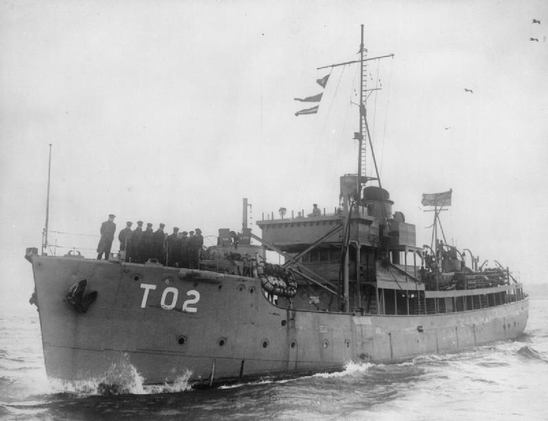
 Global News Halifax