 European Research Council (ERC
Curious minds, this one’s for you 🔬✨
Bring your friends, your family, your curiosity and get ready to be surprised at #ScienceIsWonderful! 👉 bit.ly/3ZpUkmZ
Video
---
https://nitter.net/ERC_Research/status/2033544631431077969#m
Curious minds, this one’s for you 🔬✨
Bring your friends, your family, your curiosity and get ready to be surprised at #ScienceIsWonderful! 👉 bit.ly/3ZpUkmZ
Video
---
https://nitter.net/ERC_Research/status/2033544631431077969#m
RT by @CORDIS_EU: 🚨Get ready, science fans!
The #ScienceIsWonderful fair hits Brussels 🗓️March 13&14📍@africamuseumbe!
Join 8️⃣ amazing ERC grantees and quench your thirst for knowledge! Fossils, Psychology, Archaeology & more 🚀🔬🤩
Prepare your visit (it's free!) 👉 https://europa.eu/!nKTfmV
---
https://nitter.privacydev.net/ERC_Research/status/1886708790537675238#m
Es gab in einem Abgelegenen Fjord in Grönland einen Erdrutsch. Dadurch entstand ein Tsunami. und der Brachte die gesamte Erde für 9Tage zum schwingen.
#Klimawandel #ScienceisWonderful
https://www.heise.de/news/Bergsturz-loeste-Tsunami-aus-Ursache-fuer-mysterioeses-seismisches-Signal-geklaert-9869571.html
Wow!
For years, researchers couldn't identify the source of so much nitrogen (N) in the oceans. It was thought that cyanobacteria were the only organisms capable of fixing nitrogen in marine ecosystems, but their numbers could explain only half of the observed N.
Some years ago, mysterious gene fragments coding for a nitrogenase (the enzyme that fixes nitrogen) were found in seawater samples. These traces were not from cyanobacteria. But then, from who?
A recent study found that the N-fixing bacteria are related to Rhizobia and seem to be symbiotic with diatomees (unicellular algae). Yes, *the rhizobia*. *In a symbiosis*. *with unicellular algae* (= plants)
😃
Rhizobia are the bacteria that fix the Nitrogen in the root nodules of leguminous plants, effectively making the rich terrestrial ecosystems possible.
And their cousins in the sea seem to do the same. The plants provide the bacteria carbohydrates (easy-peasy for photosynthetic organisms, as carbon is not their problem) and shelter, and the bacteria fix nitrogen. Just like this. And everyone benefits, including the surrounding ecosystem.
This is really cool and made my day!
https://www.nature.com/articles/s41586-024-07495-w
#Microbiology #Ecology #Nitrogen #Rhizobia #NitrogenCycle #Oceans #MarineBiology #SciComm
#ScienceIsWonderful #AmazingScience
Nitrogen (N2) fixation in oligotrophic surface waters is the main source of new nitrogen (N) to the ocean1 and plays a key role in fueling the biological carbon pump2. Oceanic N2 fixation is almost exclusively attributed to cyanobacteria, even though genes encoding nitrogenase, the enzyme fixing N2 into ammonia, are widespread among marine bacteria and archaea3-5. Little is known about these non-cyanobacterial N2-fixers and direct proof that they can fix N in the ocean is missing. Here we report the discovery of a non-cyanobacterial N2-fixing symbiont, Candidatus Tectiglobus diatomicola, which provides its diatom host with fixed-N in return for photosynthetic carbon. The N2-fixing symbiont belongs to the order Rhizobiales and its association with a unicellular diatom expands the known hosts for this order beyond the well-known N2-fixing rhizobia-legume symbioses on land6. Our results show that the rhizobia-diatom symbiosis can contribute as much fixed-N as cyanobacterial N2-fixers in the tropical North Atlantic, and that they may be responsible for N2 fixation in the vast regions of the ocean where cyanobacteria are too rare to account for the measured rates.
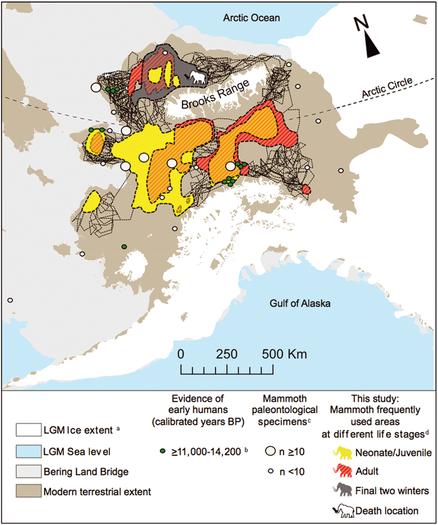
Let's go for a walk with the mammoths! Summary life history of this study’s woolly #mammoth within the geographic, climatic, and human dispersal context of Beringia during the Late Quaternary:
RT MarieSkłodowskaCurie
Researchers for #ScienceIsWonderful 2024 WANTED!
Are you a current or former #MSCA fellow passionate about engaging with young people and citizens?
Check out the 2023 edition and apply to be part of one of the most exciting & rewarding events of the year ⬇️
🐦🔗: https://n.respublicae.eu/MSCActions/status/1699373751761027257
👩🔬Are you a current or former #MSCA fellow, passionate about communicating #science to citizens, in particular young people?
📢The call for the #ScienceIsWonderful 2024 edition is now open, find out how to participate & get ready to set up your stand!
👉http://europa.eu/!RKpHKf
🐦🔗: https://n.respublicae.eu/REA_research/status/1699663791724560669
Our Fellow of the Week @ChayanBishayee is an industrial PhD candidate within the #MSCA @SimpperM project.
Chayan is working on the implementation of an innovative production method of sealing microfluidic devices using lasers.
In 2023, he participated in #ScienceIsWonderful!
🐦🔗: https://n.respublicae.eu/MSCActions/status/1679769630204649472

Our Fellow of the Week @ChayanBishayee is an industrial PhD candidate within the #MSCA @SimpperM project. Chayan is working on the implementation of an innovative production method of sealing microfluidic devices using lasers. In 2023, he participated in #ScienceIsWonderful!
🧪Science is Wonderful! gives school students the chance to interact with leading researchers and innovators. Check out these📽️highlights of the annual two-day #ScienceisWonderful fair which took place in Brussels in March.
https://scienceiswonderful.eu/ @mscactions
🐦🔗: https://n.respublicae.eu/EUCYPRUS/status/1665011456834928640
What can teens and parents do to tackle performance pressure created by social media? ERC-grantee @L_Vandenbosch at @KU_Leuven has some tips to help teens to feel less overwhelmed. Listen to the podcast 👉https://lnkd.in/e4QZteNF
#ScienceIsWonderful
@scientix_eu
🐦🔗: https://n.respublicae.eu/ERC_Research/status/1643554200318803968
Popular media narratives may be distorting teenagers' perception of success, according to research by Laura Vandenbosch. Her project aims to define the impact of 'malleable ideals' in the media on personal wellbeing and social perspectives of teenagers.
 EU Research Results
 Amsel
Amsel
 Earthworm 🐌
 Serhii Nazarovets
 European Research Executive Ag
 MarieSkłodowskaCurie
 European Commission in Cyprus