 Science News
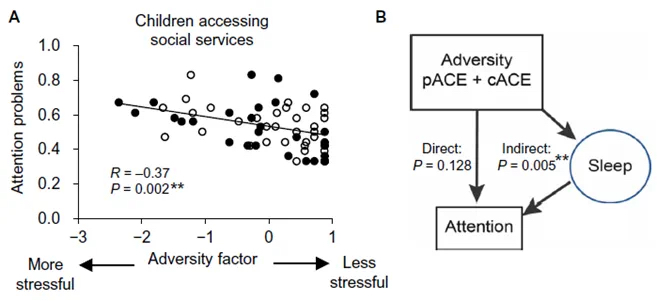
Sleep impairment mediated the attention deficits associated with early adversity in human children.
#ScienceTranslationalMedicine
www.science.org/doi/full/10....
What determines whether we become overweight? A #CharitéBerlin study shows that aside from lifestyle and genes, a kind of formatting of a satiety gene also increases the risk of #obesity – at least in women. This “epigenetic marking” is established early on during the embryonic stage.
#Medicine #Science #Research #ScienceMastodon #MedMastodon #CharitéPaper #CharitéPediatrics #Epigenetics #POMC #ScienceTranslationalMedicine
Was bestimmt, ob wir fettleibig werden? Eine #CharitéBerlin-Studie zeigt: Neben Lebensstil & Genen steigert auch eine Art Formatierung eines Sättigungsgens das #Adipositas-Risiko – zumindest bei Frauen. Diese „epigenetische Markierung“ wird schon in der Embryonalphase etabliert.
#Medizin #Wissenschaft #Forschung #Übergewicht #CharitéPaper #CharitéPädiatrie #MedMastodon #ScienceMastodon #Epigenetik #POMC #ScienceTranslationalMedicine
Human immunology from the Eisenbarth lab
"The aim of our study was to characterize infant gut food-specific IgA responses and determine whether gut and plasma food-specific IgA are related to tolerance to food allergens. We found that non–food-allergic infants make gut peanut-specific IgA. We next demonstrated that gut peanut-specific IgA did not correlate with measures of future peanut allergy outcome nor did it correlate with peanut tolerance. We also observed that gut egg white-specific IgA was higher in egg-allergic children and did not predict outgrowth of egg allergy. Our data also revealed that there are no differences in the epitopes targeted by gut peanut-specific IgA between peanut-allergic and nonallergic children but that epitope specificity is different between gut peanut-specific IgA and plasma peanut IgE. Overall, these findings challenge the commonly presumed protective role of food-specific IgA."
 Charité Berlin
 Thiago Carvalho