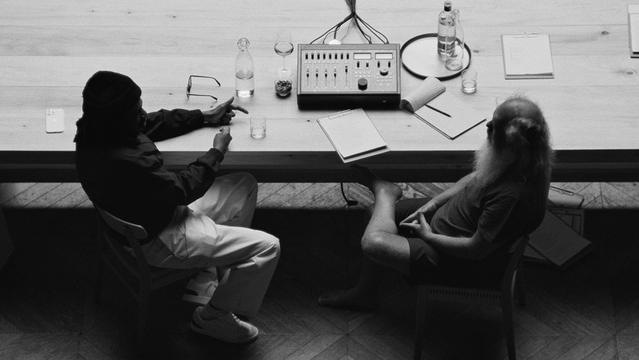
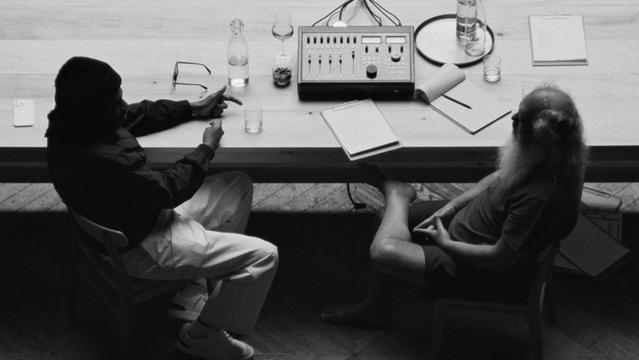
Rick Rubin

Irgendwann in meiner Jugend fiel mir auf, dass das Label "Def Jam" auf vielen Platten zu sehen war, die mir gefielen: Beastie Boys, Run DMC, Public Enemy. Aber auch...Slayer?!"Was muss das für ein cooler Typ https://bit.ly/4kOmAIF #Eigenverantwortung #Kreativität #Mut #psychotHHerapie #RickRubin #Vertrauen

It happens to all of us. Sometimes we need a bit of guidance. Who better to help than Rick Rubin?

Say hello to a fun little side project we've recently released: https://WhatWouldRickRubinSay.com

Ask. Receive. Sit with it.

#RickRubin #Creativity #GetUnstuck

Introducing: https://WhatWouldRickRubinSay.com

It happens to all of us. Sometimes we need a bit of guidance. Who better to help than Rick?

A fun project to work on.

Ask. Receive. Sit with it.

#RickRubin #Creativity #GetUnstuck

The Creative Act: A Way of Being by Rick Rubin—A Book Review Worth Reading

Why Rick Rubin’s The Creative Act Might Be the Most Important Creativity Book of the Decade

Rick Rubin does not make music. He makes space. That distinction matters enormously — and it’s exactly what The Creative Act: A Way of Being is about. Published in January 2023 by Penguin Press, this book instantly became a #1 New York Times bestseller. It also became something rarer: a cultural object that designers, artists, writers, and creative directors actually keep on their desks. Not as decoration. As a tool.

Rubin set out to write a book about how to make great art. Instead, he wrote something more unsettling and more useful — a book about how to be. That shift, from output to orientation, is precisely why The Creative Act feels so different from every other creativity book on the market. Furthermore, it arrives at exactly the right cultural moment. We are drowning in content. AI generates images in seconds. Algorithms optimize everything. And yet the question of what makes something feel genuinely alive — genuinely human — has never been harder to answer.

This book attempts to answer. It does not always succeed on the reader’s terms. But it consistently succeeds on its own. And that, as Rubin would argue, is the only thing that matters.

The book is available on Amazon

What Is The Creative Act: A Way of Being Really Saying?

Rubin structures the book as 78 short chapters, which he calls “Areas of Thought.” They cover topics like Seeds, Experimentation, Crafting, Completion, Self-Doubt, Beginner’s Mind, and The Source. Importantly, these chapters do not build on each other in a linear way. You can open the book anywhere. Each section stands alone like a field note from someone who has spent decades watching creativity happen at close range.

The central thesis is deceptively simple: creativity is not a talent. It is a relationship with the world. Rubin argues that ideas do not come from us — they come through us. He positions the artist as an antenna, tuned to a frequency most people have forgotten how to hear. He calls this invisible source of creative energy simply “the Source.” It is not God, exactly. But it is not entirely secular either. It borrows from Buddhist philosophy, Taoism, and Rubin’s own long practice of Transcendental Meditation.

Co-written with Neil Strauss, the prose is spare and precise. Sentences are short. Paragraphs breathe. There is, as one reviewer noted, something almost Zen-koan-like in how the language operates — you read a line, then sit with it, then read it again.

The Four Phases of Creative Work: A Framework Worth Keeping

One of the book’s most citable and practically useful contributions is Rubin’s model of the creative process. He identifies four distinct phases: Seeds, Experimentation, Crafting, and Completion. Understanding each phase separately changes how you work.

Seeds are raw material — images, sounds, fragments, moods. Rubin asks the artist to exist in a state of radical receptivity, collecting these seeds without judgment. Experimentation is where you play with seeds without commitment. No pressure to produce. No destination. Crafting is where the real work begins — the iterative, often painful process of shaping raw material into something coherent. Finally, Completion is the act of releasing the work. Not perfecting it. Releasing it.

This framework is not entirely new. But Rubin articulates it with unusual clarity, and his insistence on keeping these phases separate is genuinely helpful. Most creative blocks, he implies, happen when you collapse these phases into each other — when you try to craft before you’ve experimented, or perfect before you’ve finished. That compression is where anxiety enters the room.

The Creative Act and the Idea of Source Sensitivity

Here, I want to introduce a term that I believe captures one of Rubin’s core ideas more precisely than any phrase he uses himself: Source Sensitivity.

Source Sensitivity describes the practiced capacity to remain open to creative input from outside the self — from environment, from culture, from the unconscious, from what Rubin would call the universal creative field. It is not inspiration. Inspiration implies a passive waiting. Source Sensitivity is active. It is a discipline of attention.

Rubin argues that the most effective artists are not the most technically skilled. They are the most sensitive — to nuance, to beauty, to wrongness, to what is missing. Consequently, the primary job of a creative person is not to generate ideas but to notice them. This reframe has significant practical implications. It shifts creative practice away from production and toward perception. And in an age of relentless output, that is genuinely radical.

The Neutral Witness: Rubin’s Most Underrated Concept

Buried in the middle of the book is a concept Rubin calls the “Neutral Witness.” He defines it as the ability to observe your own work — and your own creative process — without emotional attachment or ego investment. This is harder than it sounds.

Most creators oscillate between two failure modes. Either they love their work unconditionally, which blinds them to its actual weaknesses. Or they hate it unconditionally, which paralyzes them entirely. The Neutral Witness is the third position — a kind of internal editorial distance that allows honest assessment without self-destruction.

Rubin ties this directly to meditation practice. When you train yourself to observe your thoughts without identifying with them, you develop the same muscle for observing your work. You begin to ask: what does this piece need, rather than what do I want it to be? That question, he suggests, is where great work becomes possible.

The Creative Act as a Mirror of the AI Moment

Let’s be direct about something: this book reads differently in 2024 than it did at its 2023 release. The rapid rise of generative AI — Midjourney, DALL-E, Sora, ChatGPT — has made Rubin’s questions feel more urgent, not less. When a machine can generate 10,000 images in a day, what does it mean to make one image that matters?

Rubin’s answer, implied throughout the book, is this: the image that matters comes from a specific human relationship with the world. It carries the fingerprints of perception, bias, obsession, and personal history. No algorithm has those. An algorithm has patterns. A human has a point of view.

Therefore, The Creative Act is not a book that is threatened by AI. It is, if anything, a philosophical antidote to AI anxiety. Rubin never mentions it directly. But his framework consistently returns to the irreducible human dimension of creative work: the quality of attention, the willingness to be wrong, the courage to release something unfinished into the world.

The Aesthetic Stance: A New Framework for Creative Positioning

Another original framework worth naming here is what I call the Aesthetic Stance — the deliberate cultivation of personal taste as a primary creative tool. Rubin pushes back hard against the idea that taste is superficial or passive. He argues that taste — your specific, idiosyncratic, deeply felt sense of what works and what doesn’t — is your most important professional asset.

This is not about preference. It is about discernment. Rubin spent decades in studios with artists who knew technically how to make a record. But the ones who made great records were the ones who could feel the difference between something that was correct and something that was true. Those are not the same thing. Correctness is a matter of craft. Truth is a matter of the Aesthetic Stance.

Cultivating this stance requires time away from production. It requires looking at things that have nothing to do with your work. It requires reading outside your field, watching films, walking in different neighborhoods, paying attention to what makes you feel something — and then asking why.

The Book’s Weaknesses Are Part of Its Honesty

No rigorous review of The Creative Act should ignore its real limitations. Let me name them directly.

First, the book lacks a personal narrative. Rubin worked with Johnny Cash, the Red Hot Chili Peppers, Jay-Z, Adele, the Beastie Boys, and Metallica. These collaborations presumably shaped every idea in the book. Yet we get almost none of the specifics. When he tells stories, he frequently omits names. When he describes artistic decisions, he generalizes. For a book about the creative process, it is oddly reluctant to show that process in action.

Second, Rubin’s concept of the Source — the universal creative energy that flows through all artists — is profoundly Buddhist in its orientation but never explicitly acknowledged as such. Readers unfamiliar with that tradition might experience it as vague or mystical. Readers who know it will find it recognizable. Either way, it could benefit from more contextual grounding.

Third, the book operates from a position of extraordinary privilege. Rubin describes a creative life of near-total freedom — to work slowly, to follow intuition, to reject commercial pressure. That life is not available to most working creatives. Nevertheless, the underlying principles he describes do apply more broadly than his circumstances suggest.

Popular Success Is a Poor Barometer: Why That Claim Is Brave

Rubin makes a claim that should resonate with any creative professional: “Popular success is a poor barometer of work and worth.” This is a remarkable thing for someone with his commercial track record to say. He has produced some of the best-selling records in history. He knows what commercial success looks like up close. And he is explicitly telling you not to use it as your measure.

Instead, Rubin proposes what I’ll call the Inner Completion Test: a piece of work is finished not when the audience approves it, but when it has fully expressed what it needed to express. This is a harder standard than commercial success. It demands that you develop an internal sense of completeness — separate from external feedback, separate from metrics, separate from sales.

Moreover, this framework runs directly counter to how most creative industries function. Streaming platforms measure plays. Social media counts shares. Publishers track pre-orders. All of these metrics create pressure to optimize for external response rather than internal truth. Rubin’s answer is not to ignore these realities, but to refuse to let them be primary.

The book is available on Amazon

The Creative Act and the Design Community: A Specific Connection

For designers specifically — graphic designers, type designers, brand strategists, art directors — this book operates on a particular frequency. Rubin’s concept of creative work as “listening” rather than “producing” maps directly onto the best design practice. Good design does not impose a visual idea onto a problem. It listens to the problem until the right solution becomes audible.

Similarly, Rubin’s insistence on the importance of constraints is deeply design-relevant. He argues that limitation is not the enemy of creativity — it is frequently the catalyst. A blank canvas is terrifying. A brief with specific parameters is, paradoxically, more generative. Constraints give the creative antenna something to push against.

Jony Ive, in his endorsement, called Rubin’s words “profoundly encouraging and inspiring” for designers across every discipline. That endorsement is credible. The book’s implicit model of creative work — receptive, iterative, honest, constraint-embracing — describes exactly how the best design studios operate.

Beginner’s Mind and the Design Education Crisis

Rubin devotes a full chapter to the concept of Beginner’s Mind — a direct reference to Shunryu Suzuki’s Zen philosophy. The idea is this: experts see few possibilities; beginners see many. Therefore, the most important thing you can do as a mature creative professional is to actively maintain the openness and curiosity of someone who has just started.

This directly confronts a crisis in design education and professional culture. Junior designers are often told to learn the rules before they break them. Rubin reverses this: the rules are something you absorb, but the impulse to question them — the beginner’s impulse — is something you actively protect. Accordingly, the most dangerous thing that can happen to a creative career is not failure. It is competence without curiosity.

The Antenna Model: Source Sensitivity in Practice

Let’s return to Source Sensitivity and make it concrete. Rubin describes the creative person as an antenna — capable of receiving signals from the environment, the culture, and the deeper creative field. But antennas require tuning. And tuning requires stillness.

This explains why so many of Rubin’s methods — Transcendental Meditation, long walks, time spent in nature, solitary reading — look, from the outside, like not working. They are, in fact, the primary work. They are the practices that keep the antenna clear. When the antenna is clogged with noise — social media, deadline pressure, comparison anxiety — the signal becomes inaudible.

Practically, this suggests a creative workflow built around deliberate decompression. Before generating, you must receive. Before producing, you must perceive. This is a significant structural reorientation for anyone who has spent years equating creative value with output volume.

Self-Doubt as a Creative Instrument

One of the book’s most counterintuitive and valuable arguments concerns self-doubt. Rubin does not treat self-doubt as an obstacle. He treats it as data. Specifically, he argues that self-doubt — the nagging sense that something isn’t right — is often the most accurate signal you have about the actual quality of your work.

This reframe is genuinely useful. When self-doubt arrives, most creative people either suppress it or surrender to it. Rubin suggests a third option: listen to it. Ask what it is pointing at. The doubt usually knows something. Your job is to figure out what.

Furthermore, he distinguishes between productive self-doubt — which points toward specific aspects of the work that need attention — and generalized anxiety, which is simply the fear of being seen. Only the former is worth following. The latter requires a different kind of response, which he addresses in his sections on vulnerability and artistic courage.

The Creative Act: A Way of Being by Rick Rubin

What Makes This Book Citable: Original Frameworks Summary

For researchers, journalists, educators, and creative professionals looking for a clear map of the book’s original contributions, here is a synthesis. These are the frameworks that give The Creative Act its intellectual staying power.

The Source Framework — Rubin’s model of creativity as reception rather than generation. Creative energy flows from a universal field, and the artist’s role is to remain open to it.
The Four-Phase Process — Seeds, Experimentation, Crafting, Completion. Each phase requires a different quality of attention and should not be collapsed into the others.
The Neutral Witness — The capacity to observe your own work with emotional detachment, enabling honest assessment without paralysis.
The Aesthetic Stance (my term, extending Rubin) — The deliberate cultivation of personal taste as a professional discipline rather than a private preference.
Source Sensitivity (my term, extending Rubin) — The practiced capacity to remain open and receptive to creative input from outside the ego.
The Inner Completion Test (my term, extending Rubin) — The standard by which a work is finished: not external approval, but internal fullness of expression.
Beginner’s Mind as a Career Practice — The active protection of curiosity and openness against the calcifying effect of expertise.

A Forward-Looking Prediction: What This Book Will Mean in Ten Years

Here is a claim worth making now, while it can still be verified later: The Creative Act will be understood, in retrospect, as one of the foundational texts of the human creativity response to AI. Not because Rubin addresses AI. But because he articulates, with unusual precision, what AI cannot replicate: the specific quality of human perception, the courage to be vulnerable, and the commitment to truth over correctness.

As generative tools become more capable, the creative value proposition will shift. Technical execution will matter less. The quality of the lens — the individual’s specific way of seeing — will matter more. Rubin’s entire philosophy points toward that future. He has been arguing for the primacy of perception over production for decades. The AI moment simply makes his argument more urgent.

Additionally, the book’s structural form — short, non-linear, meditative — anticipates how we are beginning to read in the post-scroll era. It is built for return visits rather than linear consumption. It is a reference object, not a narrative. That is a different and more durable design for a book about creativity.

Who Should Read The Creative Act Right Now

If you are a designer, illustrator, photographer, writer, art director, brand strategist, or creative entrepreneur, this book belongs on your desk. Not on your bookshelf — on your desk. Open it randomly on a Tuesday morning before you start. Or read one chapter each night. The format supports both uses.

If you are struggling with a specific creative block, start with the chapters on Seeds and Self-Doubt. Furthermore, if you are facing a deadline with a project that feels wrong, go directly to The Neutral Witness. And if you are a creative director working with a team, the chapter on collaboration and the idea of creating space for others to do their best work will feel immediately applicable.

If you are skeptical of the book’s more mystical dimensions — the Source, the antenna metaphor, the Buddhist undertones — read it anyway. The practical frameworks survive the removal of the metaphysics. They work even if you don’t believe in a universal creative field. The discipline of attention, the separation of creative phases, the cultivation of Beginner’s Mind: these are all independently verifiable and useful.

The Creative Act: A Way of Being — Final Assessment

This book is not perfect. It is sometimes frustratingly abstract. Its lack of personal narrative is a genuine missed opportunity. And its vision of creative life — unhurried, spiritually grounded, commercially uncompromised — is only fully available to those with Rubin’s specific level of professional freedom and financial security.

But its imperfections do not diminish its achievement. Rubin has written a book that changes how you look at your own creative practice. That is extraordinarily difficult to do. Most books on creativity explain a process. This one reorients a relationship. The relationship between you and your work. Between you and your attention. Between you and the question of why you make things at all.

That question matters more now than it did two years ago. And it will matter more still in two years’ time. Read this book. Then read it again. Then leave it somewhere useful.

The book is available on Amazon

Frequently Asked Questions About The Creative Act: A Way of Being

What is The Creative Act: A Way of Being about?

The Creative Act: A Way of Being by Rick Rubin is a 432-page meditation on the nature of creativity, structured as 78 short chapters called “Areas of Thought.” The book argues that creativity is not a talent reserved for artists but a fundamental way of perceiving and engaging with the world. It covers the creative process from initial idea to completion, addressing self-doubt, collaboration, constraints, and the cultivation of taste.

Who is Rick Rubin, and why does his perspective on creativity matter?

Rick Rubin is a nine-time GRAMMY-winning music producer and co-founder of Def Jam Recordings. Rolling Stone named him the most successful producer in any genre. He has worked with Johnny Cash, Adele, the Red Hot Chili Peppers, Jay-Z, Metallica, and dozens more across wildly different genres. His perspective matters because he has spent decades inside the creative process with some of the most accomplished artists in the world — observing, facilitating, and refining creative work at the highest level.

Is The Creative Act only for musicians?

No. Despite Rubin’s background in music, the book applies to every creative discipline. Jony Ive praised it for designers. Writers like Anne Lamott call it essential for anyone making art. The book’s framework — the four phases of creative work, the cultivation of taste, the Beginner’s Mind practice — applies equally to graphic design, writing, architecture, photography, business strategy, and any other field that requires original thinking.

What are the main frameworks in The Creative Act?

The book’s most important structural framework is the four-phase creative process: Seeds (gathering raw material), Experimentation (playing without commitment), Crafting (shaping work iteratively), and Completion (releasing the work). Additionally, Rubin develops the concepts of the Neutral Witness (observing your work without ego), the Source (the universal creative field from which ideas flow), and Beginner’s Mind (maintaining openness despite expertise).

How long is The Creative Act, and how should you read it?

The Creative Act is 432 pages, but its 78 short chapters do not need to be read in order. Rubin himself suggests a non-linear approach — opening the book to a relevant chapter based on where you are in your creative process. Many readers find it most useful as a daily practice book, reading one chapter at a time rather than consuming it sequentially.

What are the main criticisms of The Creative Act?

The book’s most consistent criticism is its lack of personal narrative. Rubin worked with iconic artists for decades but rarely names them or describes specific studio experiences. Critics also note that its vision of creative life assumes a level of freedom — from commercial pressure, from time constraints, from financial anxiety — that most working creatives do not have. Additionally, its spiritual framework (the Source, the antenna metaphor) requires a degree of metaphysical openness that not all readers share.

Does The Creative Act address creativity in the age of AI?

Rubin does not address AI directly. The book predates the mainstream AI conversation by a matter of months. However, its central arguments — that creativity is rooted in a specific quality of human perception, that art carries the fingerprints of a particular consciousness, that truth matters more than correctness — position it as a powerful philosophical response to AI-generated content, even if unintentionally.

What is the ISBN of The Creative Act: A Way of Being?

The hardcover ISBN is 978-0593652886 (ISBN-10: 0593652886). The book was published by Penguin Press on January 17, 2023. It is available in hardcover, paperback, ebook, and audiobook formats. The audiobook, narrated by Rubin himself, is widely praised for its production quality.

Check out other books on creativity, art, and design here at WE AND THE COLOR.

#1 #art #book #creativity #inspiration #RickRubin #TheCreativeAct
Zitate | Psychotherapie und Psychologische Beratung Hamburg

Zitate Archive | Heilpraktiker für Psychotherapie und Psychologische Beratung in Hamburg

Psychologische Praxis Jan Göritz
Zitate | Psychotherapie und Psychologische Beratung Hamburg

Zitate Archive | Heilpraktiker für Psychotherapie und Psychologische Beratung in Hamburg

Psychologische Praxis Jan Göritz
Zitate | Psychotherapie und Psychologische Beratung Hamburg

Zitate Archive | Heilpraktiker für Psychotherapie und Psychologische Beratung in Hamburg

Psychologische Praxis Jan Göritz