 Splines
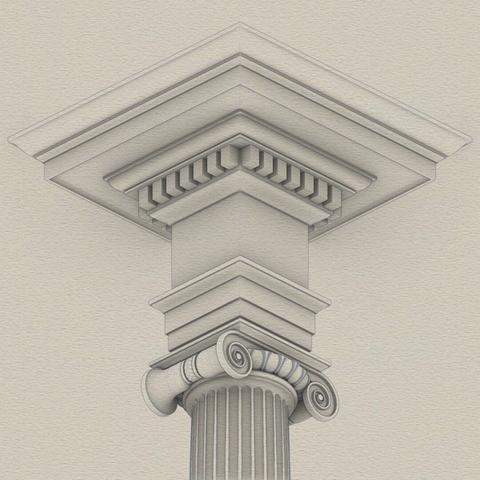
This is a sketch of the top of an #IonicColumn with #scrolls, #volutes, and other embellishments. Before I delve into my modern designs, I want to emphasize that most of them are rooted in classical designs of antiquity but still retain their timeless essence.
Different regions of the world have developed and refined distinct design patterns over thousands of years. Greeks, Romans, Ottomans, Arabs, Moghuls, Hindus, and others — all have something to contribute to what we call #art and #design in human civilization.
My initial focus is on Greco-Roman architecture and design which has five distinct orders: #Tuscan, #Doric, #Ionic, #Corinthian, and #Composite. Of these, the #IonicOrder is of medium complexity. The Doric and Tuscan are simpler, while Corinthian and Composite are more complex.
Because of its moderate complexity, I chose the Ionic Order for a complete and systematic look at its design methodology and proportions of its elements. I use concrete measurements to make concepts easier to understand. Once you understand the Ionic order, it's easy to step down to the Doric and Tuscan orders. It's more work to step up to the Corinthian and Composite orders, but if you follow my methodology with dedication, you will learn the skills necessary to tackle the more complex orders or branch out on your own.
In an earlier post, I mentioned the importance of sticking to proportions and measurements. I'll point out opportunities for variation as we progress systematically.
An additional, but very important point I want to emphasize is that this #digitalArt is not just #art, but #engineering design as well, because the end result is to realize physical artifacts from these designs, whether by #AdditiveManufacturing (#3DPrinting), #SubtractiveManufacturing (#CNC #Carving), #ReliefEngraving, #Printing, or any other physical realization.
You'll need a #CAD tool to practice, but you can also follow along as a reader initially, and come back when you're ready to practice
Different regions of the world have developed and refined distinct design patterns over thousands of years. Greeks, Romans, Ottomans, Arabs, Moghuls, Hindus, and others — all have something to contribute to what we call #art and #design in human civilization.
My initial focus is on Greco-Roman architecture and design which has five distinct orders: #Tuscan, #Doric, #Ionic, #Corinthian, and #Composite. Of these, the #IonicOrder is of medium complexity. The Doric and Tuscan are simpler, while Corinthian and Composite are more complex.
Because of its moderate complexity, I chose the Ionic Order for a complete and systematic look at its design methodology and proportions of its elements. I use concrete measurements to make concepts easier to understand. Once you understand the Ionic order, it's easy to step down to the Doric and Tuscan orders. It's more work to step up to the Corinthian and Composite orders, but if you follow my methodology with dedication, you will learn the skills necessary to tackle the more complex orders or branch out on your own.
In an earlier post, I mentioned the importance of sticking to proportions and measurements. I'll point out opportunities for variation as we progress systematically.
An additional, but very important point I want to emphasize is that this #digitalArt is not just #art, but #engineering design as well, because the end result is to realize physical artifacts from these designs, whether by #AdditiveManufacturing (#3DPrinting), #SubtractiveManufacturing (#CNC #Carving), #ReliefEngraving, #Printing, or any other physical realization.
You'll need a #CAD tool to practice, but you can also follow along as a reader initially, and come back when you're ready to practice