⚠️ .io domain¹ likely being phased-out² — seven suggested steps

Good article in The Verge summarizing recent .io related events, see that for more context if this is news to you:
* https://www.theverge.com/2024/10/8/24265441/uk-treaty-end-io-domain-chagos-islands

It looks likely .io (and .io domains) will go away in the next few years (as .cs and .yu did³), so here are my suggested steps to take depending on your usage of .io domains:

1. Avoid buying new .io domains (or making plans with existing ones; sell if you can)
2. If you currently run a .io service (for a company or community), make and publicize a transition plan (like a new domain, redirection, orderly shutdown plan for redirects)
3. If you have a personal site on a .io domain or subdomain, make your own transition plan, and perhaps post about how others should link to your posts
4. If you are using someone else’s .io domain to publish (like #GitHubPages), make a transition plan to publish elsewhere and leave a forwarding note and link behind
5. If you use a .io domain as your Web sign-in login on any sites, switch them to another non-io personal domain
6. Similarly if your site accepts #WebSignIn logins (via #IndieAuth, #RelMeAuth, or even #OpenID), consider discouraging any new sign-ups from .io domains, and warning any existing users with .io domains to switch per # 5
7. If you have posts (or a whole #indieweb site) with links to .io sites or pages (like those in 2-4 above), make a plan for editing those links to point to an alternative or an archival copy (like on the Internet Archive)

And of course, post about your #dotIO plans.

Glossary

Domain
 https://indieweb.org/domain
IndieAuth
 https://indieweb.org/IndieAuth
Internet Archive
 https://web.archive.org/
OpenID
 https://indieweb.org/OpenID
Redirect
 https://indieweb.org/redirect
RelMeAuth
 https://indieweb.org/RelMeAuth
Web sign-in
 https://indieweb.org/Web_sign-in


References:

¹ https://indieweb.org/.io
² https://en.wikipedia.org/wiki/.io#Phasing_Out
³ https://en.wikipedia.org/wiki/.cs
E.g. https://indieweb.org/webmention.io or https://indieweb.org/granary.io
E.g. https://indieweb.org/werd.io
https://indieweb.org/github.io


This is post 25 of #100PostsOfIndieWeb. #100Posts

https://tantek.com/2024/283/t1/metaphors-constructive-cooperative-joyful
https://tantek.com/2024/287/t1/fediverse-unfollow-bridgyfed-bug
⚠️ .io domain^1 likely being phased-out^2 — seven suggested steps Good article in The Verge summarizing recent .io related events, see that for more context if this is news to you: * https://www.theverge.com/2024/10/8/24265441/uk-treaty-end-io-domain-chagos-islands It looks likely .io (and .io domains) will go away in the next few years (as .cs and .yu did^3), so here are my suggested steps to take depending on your usage of .io domains: 1. Avoid buying new .io domains (or making plans with existing ones; sell if you can) 2. If you currently run a .io service^4 (for a company or community), make and publicize a transition plan (like a new domain, redirection, orderly shutdown plan for redirects) 3. If you have a personal site on a .io domain^5 or subdomain, make your own transition plan, and perhaps post about how others should link to your posts 4. If you are using someone else’s .io domain to publish (like #GitHubPages^6), make a transition plan to publish elsewhere and leave a forwarding note and link behind 5. If you use a .io domain as your Web sign-in login on any sites, switch them to another non-io personal domain 6. Similarly if your site accepts #WebSignIn logins (via #IndieAuth, #RelMeAuth, or even #OpenID), consider discouraging any new sign-ups from .io domains, and warning any existing users with .io domains to switch per # 5 7. If you have posts (or a whole #indieweb site) with links to .io sites or pages (like those in 2-4 above), make a plan for editing those links to point to an alternative or an archival copy (like on the Internet Archive) And of course, post about your #dotIO plans. Glossary Domain https://indieweb.org/domain IndieAuth https://indieweb.org/IndieAuth Internet Archive https://web.archive.org/ OpenID https://indieweb.org/OpenID Redirect https://indieweb.org/redirect RelMeAuth https://indieweb.org/RelMeAuth Web sign-in https://indieweb.org/Web_sign-in References: ^1 https://indieweb.org/.io ^2 https://en.wikipedia.org/wiki/.io#Phasing_Out ^3 https://en.wikipedia.org/wiki/.cs ^4 E.g. https://indieweb.org/webmention.io or https://indieweb.org/granary.io ^5 E.g. https://indieweb.org/werd.io ^6 https://indieweb.org/github.io This is post 25 of #100PostsOfIndieWeb. #100Posts ← https://tantek.com/2024/283/t1/metaphors-constructive-cooperative-joyful → https://tantek.com/2024/287/t1/fediverse-unfollow-bridgyfed-bug - Tantek

@aaronpk

☝🏻 Apologies for the tag-in, but you might be the only person I know on here who has any ideas on my post above.

#IndieAuth #RelMeAuth

In an #IndieAuth flow, what are some authorization endpoint strategies (besides #RelMeAuth) for attesting that a person "owns" the domain they're authenticating with?

Some ideas in decreasing order of complexity: TXT DNS record, an HTTP header, a `<link>` element of some kind…

https://indieauth.spec.indieweb.org
https://microformats.org/wiki/RelMeAuth

IndieAuth

IndieAuth is an identity layer on top of OAuth 2.0 [RFC6749], primarily used to obtain an OAuth 2.0 Bearer Token [RFC6750] for use by [Micropub] clients. End-Users and Clients are all represented by URLs. IndieAuth enables Clients to verify the identity of an End-User, as well as to obtain an access token that can be used to access resources under the control of the End-User.

Currently, 3rd party authentication service providers hold control over our online identities.

Solution?
Loosely coupling #identity, #identification, #authentication, and #authorization -- via open standards.

Watch: https://youtu.be/kawIzW1PHj0

#IndieAuth #RelMeAuth #WebID #NetID #LinkedData #SemanticWeb #KnowledgeGraph #Howto

Loosely Coupled Identity and Authentication Protocols

YouTube

Interested in #RelMeAuth or #IndieAuth?
You can add this to your @getkirby install quite easily.
You could even add a structure to have all of your sites and accounts listed in your head tag:

https://getkirby.com/docs/cookbook/integrations/indieauth
Thanks, @lukasbestle !

#getkirby #IndieWeb #blogging

IndieAuth for your site

Log in to other sites with your domain via RelMeAuth/IndieAuth.

Kirby CMS

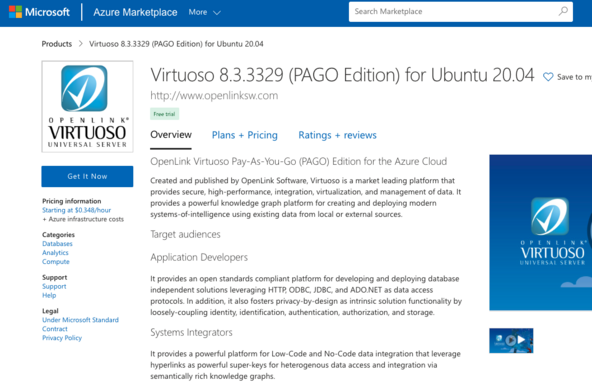
Virtuoso 08.03.3339 PAGO edition for the Microsoft Azure cloud is now live.

Highlights include:
* #IndieAuth & #RelMeAuth auth protocols support for self-sovereign identity (#SSI)
* #ActivityPub & #ActivityStreams Support
* #OpenAI Web Service import and export
* Enhanced native support of both #JSON and #JSONLD

https://azuremarketplace.microsoft.com/en-us/marketplace/apps/openlinkswcom-pago.openlink-virtuoso-azure-pago-offer-20201019?tab=Overview

#KnowledgeGraph #VirtuosoRDBMS #SQL #SPARQL #LinkedData #DBMS #GraphDatabase

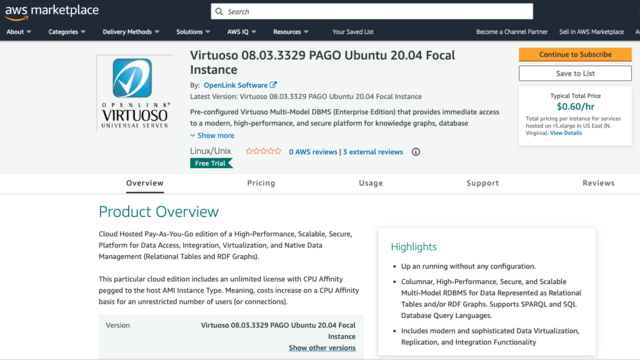
Virtuoso 08.03.3339 PAGO edition for the Amazon Web Services (#AWS) cloud is now live.

Highlights include:

* #IndieAuth & #RelMeAuth auth protocols support for self-sovereign identity (#SSI)
* #ActivityPub & #ActivityStreams Support
* #OpenAI Web Service import and export
* Enhanced native support of both #JSON and #JSONLD

Product Page: https://aws.amazon.com/marketplace/pp/prodview-idujw25jbgpn4?sr=0-2&ref_=beagle&applicationId=AWSMPContessa

#KnowledgeGraph #VirtuosoRDBMS #SQL #SPARQL #LinkedData #DBMS #GraphDatabase #SemanticWeb

AWS Marketplace: Virtuoso 08.03.3330 PAGO Ubuntu 20.04 Focal Instance

Cloud Hosted Pay-As-You-Go edition of a High-Performance, Scalable, Secure, Platform for Data Access, Integration, Virtualization, and Native Data Man...

@chrismessina @dontpanic @Mastodon,

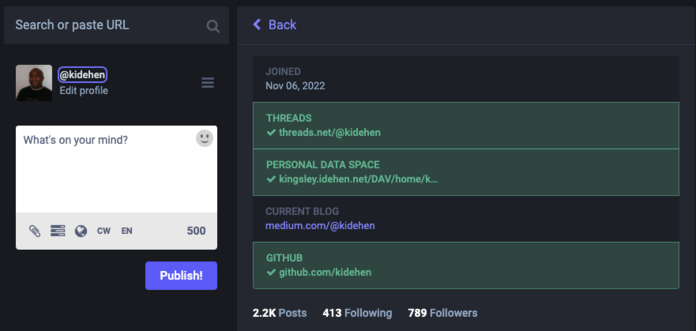
Finally cracked it. Here's how.

Over here I was pointing to https://www.threads.net/@kidehen (which does resolve) rather than https://threads.net/@kidehen.

That was it, bar confusion introduced by caching in my particular #Chrome instance.

This is a big move by #Threads re #identity authenticity, especially in regards to the burgeoning #CreatorEconomy (where the next major battle for curators is about to break out).

#RelMeAuth #OpenWeb #SSI #YouID

Kingsley Uyi Idehen (@kidehen) on Threads

Founder & CEO, OpenLink Software. #DataConnectivity, #DBMS, #LinkedData, #SocialMedia, #SemanticWeb, #KnowledgeGraph, #ActivityPub, #AI, #ChatGPT. 20 Followers.

Threads

A problem that has been vexing me for a while is getting a WordPress “blog” as a verified link in my Mastodon profile.

Installing the WordPress IndieWeb plugin automagically added the “rel=me” to my Microblog site link so that I could add it to the list of verified sites in my profile.

Hat tip to Tantek for the push to dive deeper into #RelMeAuth.

https://tantek.com/2023/032/t1/years-relmeauth-replace-openid

13 years ago today: created #RelMeAuth with @progrium.com, to replace OpenID 1&2 for *reasons* * modest proposal: authentication using domain as identity, rel=me link to OAuth profile with rel=me link back^1 * @progrium.com suggested RelMeAuth name^2 * I agreed, and wrote up a draft algorithm^3 All on the same day. A few months later I wrote it up as a draft spec: * https://microformats.org/wiki/RelMeAuth (could use some updates) More updates and discussion: * https://indieweb.org/RelMeAuth See those links for RelMeAuth implementations in: * PHP, Python, Node, Ruby, Go RelMeAuth is simpler for both publishers & parsers (consuming code) than OpenID. There are now more sites that support RelMeAuth (and the complementary IndieAuth) than OpenID (which is largely abandoned^4). And today, @Github.com rolled out support for multiple rel=me profile links!^5 This means you can now use @Github.com’s OAuth (and their multifactor login etc.) to authenticate as your own domain via RelMeAuth on even more services. E.g. see my profile https://tantek.com/github (not a typo^6). The left sidebar links to my personal site, Twitter, and https://micro.blog/t all with rel=me markup. This is day 26 of #100DaysOfIndieWeb #100Days ← Day 25: https://tantek.com/2023/029/t1/indieweb-beyond-blogging → Day 27: https://tantek.com/2023/033/t1/twitter-api-log-in-web-sign-in-relmeauth ^1 https://tantek.com/2010/032/t5/modest-proposal-authentication-oauth-twitter-rel-me ^2 https://twitter.com/progrium/status/8521001762 ^3 https://tantek.com/2010/032/t6/relmeauth-oauth-rel-me-auto-fallback-authentication ^4 OpenID 1&2 were abandoned for OIDC (OpenID Connect), a supposed update/replacement, despite dropping the goal of domain as identity, the use-case for OpenID in the first place, so the #IndieWeb picked up that use-case with RelMeAuth & IndieAuth. ^5 https://hachyderm.io/@nova/109790530971147702 ^6 https://tantek.com/2022/144/t1/redirected-github-ownyourlinks - Tantek

@lukasmueller @mysk Yeah, I personally prefer to never store passwords in the sites I build.

An alternative is to do #RelMeAuth: https://indieweb.org/RelMeAuth

RelMeAuth - IndieWeb