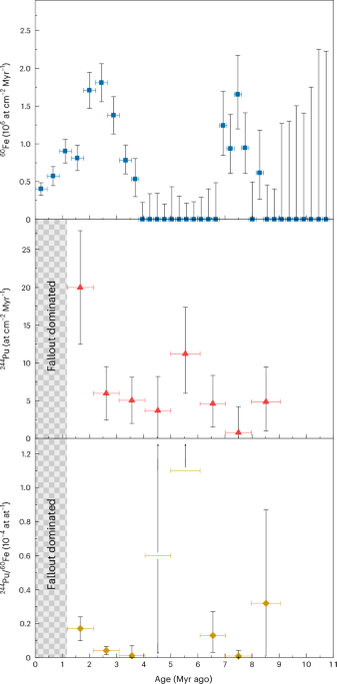
The timing of the last r-process event near Earth from interstellar 60Fe, 244Pu and 247Cm deposition on Earth: https://www.nature.com/articles/s41550-026-02841-6 -> Cosmic witnesses: https://www.hzdr.de/db/Cms?pOid=77856&pNid=3438 - #radionuclides trapped in a deep-sea sample point to an ancient cosmic event.
The timing of the last r-process event near Earth from interstellar 60Fe, 244Pu and 247Cm deposition on Earth - Nature Astronomy

By counting single atoms of 60Fe (which have a supernova origin), 244Pu and 247Cm (both formed via the r-process and independent of regular supernovae) in a deep-sea crust, the last actinide-producing r-process event near Earth is found to have occurred >100 Myr ago.

Nature

2/
There too, cesium-137 continues to spread through the ecosystem. As a chemical, cesium-137 is very adept at migrating in nature. It easily passes from air to soil to water to plants to biota. It remains radioactively dangerous for about 300 years, meaning that once it has deposited and embedded into an ecosystem, centuries of risk will follow.

https://apjjf.org/2022/7/Jacobs

#fallout
#Cessium137
#Chernobyl
#Fukushima
#radionuclides

Global Hibakusha - Asia-Pacific Journal: Japan Focus

[…]

Asia-Pacific Journal: Japan Focus

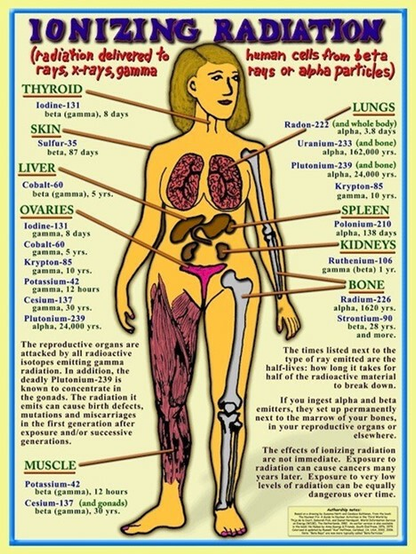
Where in the body common fallout from radionuclides tends to be retained.

https://apjjf.org/2022/7/Jacobs

#fallout
#radionuclides
#pollution

The effect of #ClimateChange on sources of #radionuclides to the #MarineEnvironment

Published: 16 March 2024
Justin P. Gwynn, Vanessa Hatje, Núria Casacuberta, Manmohan Sarin & Iolanda Osvath

Abstract:
"Climate change interacts with the sources and cycling of contaminants, such as radionuclides, in the environment. In this review, we discuss the implications of climate change impacts on existing and potential future sources of radionuclides associated with human activities to the marine environment. The overall effect on operational releases of radionuclides from the nuclear and non-nuclear sectors will likely be increased interference or prevention of normal operations due to weather-related events. For certain #RadioactiveWaste dumped at sea and sunken #NuclearSubmarines, the impact of climate change and ocean #acidification on the release of radionuclides and their subsequent fate in the marine environment should be considered further. Fluxes from secondary sources of radionuclides in the marine and terrestrial environment and cryosphere will change in response to climate change impacts such as sea level rise, warming and changes in precipitation patterns. In addition, climate change impacts may increase the risk of releases of radionuclides from operational and legacy wastes on land to the marine environment. Overall, our synthesis highlights that there is a need to understand and assess climate change impacts on sources of radionuclides to the marine environment to meet environmental and management challenges under future climate scenarios."

Full paper:
https://www.nature.com/articles/s43247-024-01241-w

#NoNukes #NoNuclearWeapons #NoNuclearDumping #ToxicLegacy #LegacyWastes #RethinkNotRestart #NuclearWaste #NuclearWasteStorage #IllegalDumping

The effect of climate change on sources of radionuclides to the marine environment - Communications Earth & Environment

Inputs of radionuclides to the marine environment will be impacted by climate change, thus there is a pressing need to understand the existing and potential sources of radionuclides to assess the implications of climate change impacts, suggests a literature synthesis of radionuclide sources.

Nature

#USA, #Consumer #advisory: #Michiganders encouraged to check their freezers for recalled #shrimp, shrimp products, which may contain Cesium-137 (Cs-137), https://www.michigan.gov/mdhhs/inside-mdhhs/newsroom/2025/10/13/shrimp-consumer-advisory

#radionuclides #radiations #food #contamination

DOH ALERTS PUBLIC ABOUT SEA PORT PRODUCTS CORP RECALL OF RAW FROZEN SHRIMP DUE TO POSSIBLE CESIUM-137 CONTAMINATION

HONOLULU — The Hawai‘i Department of Health (DOH) Food and Drug Branch (FDB) is alerting residents to a frozen shrimp recall issued by Sea Port Products Corp of its Sea Port brand Raw Frozen Easy Peel White Shrimp Jumbo size 16/20, because of possible Cesium-137 contamination. This is the second recall HONOLULU — The Hawai‘i Department […]

DOH ALERTS PUBLIC ABOUT SOUTHWIND FOODS, LLC RECALL OF FROZEN SHRIMP DUE TO POSSIBLE CESIUM-137 CONTAMINATION

HONOLULU — The Hawai‘i Department of Health (DOH) Food and Drug Branch (FDB) is alerting residents to a nationwide recall issued by Southwind Foods, LLC of certain Sand Bar, Arctic Shores, Best Yet, Great American and First Street frozen shrimp products, because of possible Cesium-137 contamination. Cesium-137 was detected in a single shipment of imported frozen […]

#Caesium-137, a product of #uranium-235 fission, is one of the world's most widely used #radionuclides and is the inspiration for my nick.

Did you know that Margaret Melhase Fuchs, a #chemistry undergraduate at UC #Berkeley, discovered Cs-137 in 1941, but was prevented from pursuing a PhD?

More information about this interesting woman who has been repressed from history:
📎 https://jnm.snmjournals.org/content/40/4/18N

📎 https://www.chemistryworld.com/culture/margaret-melhase-fuchs-and-the-radioactive-isotope/4015340.article

#ManhattanProject #Melhase #radioactivity #Seaborg #WomanInScience

History Corner: How Cesium-137 Was Discovered by an Undergraduate Student

Journal of Nuclear Medicine

#QA: What are #alpha #particles? https://www.arpansa.gov.au/understanding-radiation/what-is-radiation/ionising-radiation/alpha-particles

Alpha particles (a) are composite particles consisting of two protons and two neutrons tightly bound together. They are emitted from the nucleus of some #radionuclides during a form of radioactive decay, called alpha-decay. An alpha-particle is identical to the nucleus of a normal (atomic mass four) helium atom i.e. a doubly ionised helium atom.

Are you into #nuclear #science ☢️ and handling data with #python and #pandas? If so, you might be interested in the #NuPaAc package, which allows you to easily access #nuclide data ⚛️ for series of #radionuclides.

- 📦 PyPI: https://pypi.org/project/nupaac/
- 📖 Tutorial: https://codeberg.org/Cs137/NuPaAc/src/branch/main/tutorial.md

#radioactivity #academia #radioactivedecay