Heute (01.06.2025) vor...
...35 Jahren Start von Röntgenobservatorium #ROSAT,
...55 Jahren Start von #Sojus 9,
...75 Jahren wurde Gennadi Michailowitsch Manakow geboren
...85 Jahren wurde Kip Stephen Thorne geboren
Mehr https://astronomiemuseum.de/heute-vor
#Astronomiemuseum

Heute vor ... – Astronomiemuseum

Das Astronomiemuseum bietet einen inspirierenden Begegnungsort, an dem Dialog und Austausch zwischen Wissenschaft und Gesellschaft stattfinden kann.

I had the pleasure to be interviewed by Alexandre Morales for France Culture, to talk about the discovery of Quipu, one of the largest known structure of the Universe. It will air tomorrow morning at 6:52.

Here is the press release by the authors of the discovery at MPI Garching https://www.mpg.de/24197951/largest-superstructure-in-the-nearby-universe

#Quipu #QuipuSupercluster #Cosmology #Cosmography #galaxies #galaxyclusters #XrayClusters #ROSAT #CLASSIX #Astronomy #Astrophysics #Astrodon #science #STEM #news #AlexandreMorales #FranceCulture

Largest superstructure in the nearby universe discovered

Scientists have identified a colossal superstructure of dark matter, marking a significant advancement in cosmological research

Unveiling the largest structures in the nearby Universe - discovery of the Quipu superstructure: https://arxiv.org/abs/2501.19236 -> Largest #superstructure in the nearby #universe discovered: https://www.mpg.de/24197951/largest-superstructure-in-the-nearby-universe - data from the former #ROSAT X-ray satellite have revealed a network of 68 galaxy clusters in the nearby universe, stretching over 1.4 billion light-years.
Unveiling the largest structures in the nearby Universe: Discovery of the Quipu superstructure

For a precise determination of cosmological parameters we need to understand the effects of the local large-scale structure of the Universe on the measurements. They include modifications of the cosmic microwave background, distortions of sky images by large-scale gravitational lensing, and the influence of large-scale streaming motions on measurements of the Hubble constant. The streaming motions, for example, originate from mass concentrations with distances up to 250 Mpc. In this paper we provide the first all-sky assessment of the largest structures at distances between 130 and 250 Mpc and discuss their observational consequences, using X-ray galaxy clusters to map the matter density distribution. Among the five most prominent superstructures found, the largest has a length longer than 400 Mpc with an estimated mass of about 2 10e17 Msun. This entity, which we named Quipu, is the largest cosmic structure discovered to date. These superstructures contain about 45% of the galaxy clusters, 30% of the galaxies, 25% of the matter, and occupy a volume fraction of 13%, thus constituting a major part of the Universe. The galaxy density is enhanced in the environment of superstructures out to larger distances from the nearest member clusters compared to the outskirts of clusters in the field. We find superstructures with similar properties in simulations based on Lambda-CDM cosmology models. We show that the superstructures should produce a modification on the cosmic microwave background through the integrated Sachs-Wolf effect. Searching for this effect in the Planck data we found a signal of the expected strength, however, with low significance. Characterising these superstructures is also important for astrophysical research, for example the study of the environmental dependence of galaxy evolution as well as for precision tests of cosmological models.

arXiv.org
Größte Superstruktur im Universum entdeckt. Ansammlung von Galaxienclustern im nahen Kosmos ist rund 1,4 Milliarden Lichtjahre lang. #Quipu #Astronomie #Superstruktur #Kosmos #Galaxienhaufen #ROSAT
https://www.scinexx.de/news/kosmos/groesste-superstruktur-im-universum-entdeckt/
Größte Superstruktur im Universum entdeckt

Kosmischer Riese: Astronomen haben die bislang größte Superstruktur im Kosmos entdeckt – ein gigantisches Filament aus Galaxienclustern und Dunkler

scinexx | Das Wissensmagazin

#MPE:
"
Neues Gebilde am Firmament: Größte Superstruktur im nahen Universum entdeckt
"
".. Entdeckung geschah bei der Kartierung des näheren Universums anhand der Daten von Galaxienhaufen aus der Durchmusterung des Himmels durch den Röntgensatelliten ROSAT. .."

https://www.mpe.mpg.de/8052724/news20240218

19.2.2025

#Astronomie #Expansion #Galaxienhaufen #Materie #Kosmographie #Kosmologie #MPP #Quipu #Röntgenastronomie #ROSAT #Superstruktur #Universum

Neues Gebilde am Firmament: Größte Superstruktur im nahen Universum entdeckt

Die Entdeckung einer gigantischen Superstruktur im nahen Universum eröffnet neue Perspektiven für die kosmologische Forschung und das Verständnis der Dunklen Materie.

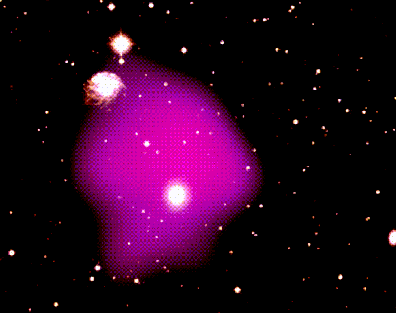
Superposed on an optical picture of a group of #galaxies is an image taken in #Xray light.

The X-ray picture, by #ROSAT, shows confined #hotgas highlighted in false red color, and provides clear evidence that the #gravity exerted in groups and clusters of galaxies exceeds all the individual component galaxies combined.

The extra gravity is attributed to #darkmatter.

#APOD classics: https://apod.nasa.gov/apod/ap950902.html

APOD: September 2, 1995 - Hot Gas and Dark Matter

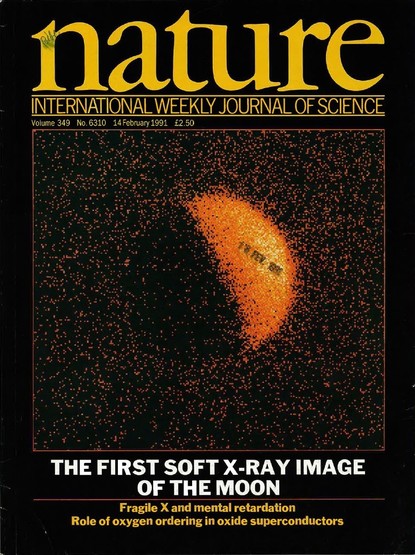
Here is a special Nature cover for the International #ObserveTheMoon Night!

The first soft X-ray image of the Moon, courtesy of reflected solar X-rays, captured by the ROSAT Satellite. The dark side of the Moon shadows a diffuse cosmic X-ray background.

https://www.nature.com/articles/349583a0

#moon #astronomy #astrophysics #astrodon #universe #space #science #research #nature #cover #naturecovers #rosat #satellite #xray

A soft X-ray image of the Moon - Nature

A soft X-ray image of the Moon obtained by the Röntgen Observatory Satellite ROSAT clearly shows a sunlit crescent, demonstrating that the Moon's X-ray luminosity arises from backscattering of solar X-rays. The Moon's optically dark side is also X-ray dark, and casts a distinct shadow on the diffuse cosmic X-ray background. Unexpectedly, the dark side seems to emit X-rays at a level about one per cent of that of the bright side; this emission very probably results from energetic solar-wind electrons striking the Moon's surface.

Nature