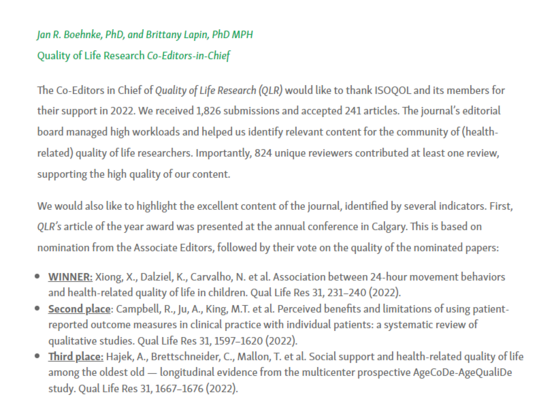
Newsletter reporting Quality of Life Research awards and statistics from 2022
https://www.isoqol.org/news-from-quality-of-life-research-2024/
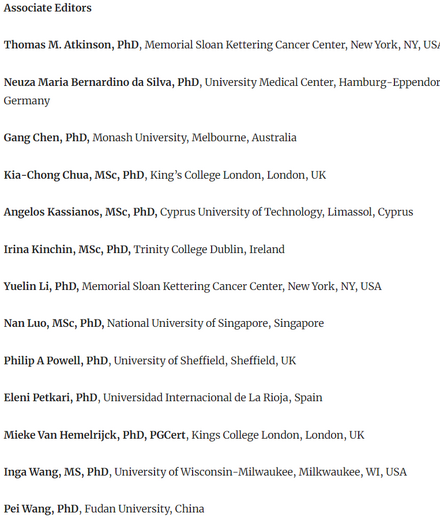
We (+ Brittany Lapin, Richard Skolasky) are immensely grateful to all authors submitting, our team of associate editors, and everyone else supporting the journal (e.g., peer-review, language editing)!
#QualityTALK #ISOQOL #HRQL #NightshiftEditor
News from “Quality of Life Research” | ISOQOL
Explore research from #ISOQOL23, abstracts now published:
https://rdcu.be/dr2hG
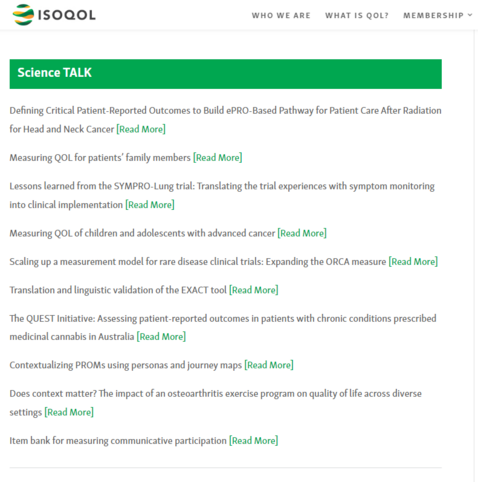
Have also a look at the October issue of #ISOQOL #QualityTALK, which highlights ten of the presentations:
https://www.isoqol.org/qualitytalk-18-october-2023/
#HRQL #Psychometrics #HealthEconomics #PatientCentered
Edit: spelling hashtag
30th Annual Conference of the International Society for Quality of Life Research
In #ISOQOL-s #QualityTALK, Carolyn Schwartz provides an insight into her development as a researcher
https://www.isoqol.org/the-story-behind-the-elephant-in-the-room-a-long-journey-begins-with-a-single-step/
Reflecting on research experiences with people living with Multiple Sclerosis, she realised that what was important to patients did not form a consistent hierarchy of domains for each patient over time. This led her into #ResponseShift research and she discusses her most recent #SysReview on the importance of the phenomenon in #RCTs #Trials:
https://jpro.springeropen.com/articles/10.1186/s41687-022-00510-6
The story behind “The Elephant in the Room”: A long journey begins with a single step* | ISOQOL
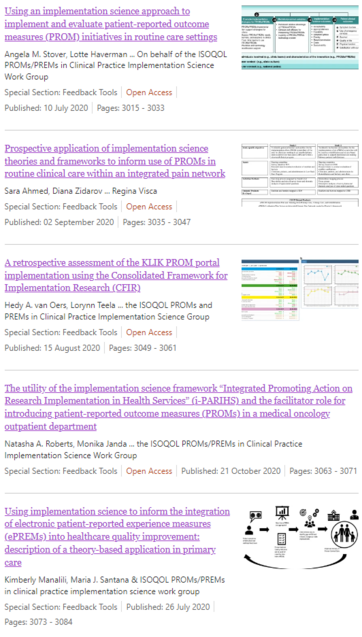
Members of #ISOQOL_CP discuss in #QualityTALK #ImplementationScience for #HRQL research:
https://www.isoqol.org/why-proms-in-clinical-practice-matter-an-introduction-to-the-clinical-practice-special-interest-group/
IS acknowledges dynamic relationships between individual clinicians and the wider context of the intervention (e.g., organizational context, structures, patient engagement). It is highly useful for developing PROMs and #FeedbackSystems.
The group published five articles explaining these ideas in more detail in our #FeedbackTools special issue:
https://link.springer.com/journal/11136/volumes-and-issues/30-11
#ISOQOL
Why PROMs in Clinical Practice Matter? An Introduction to the Clinical Practice Special Interest Group | ISOQOL
Implementing the FDA’s draft guidance on core PROs in cancer trials: the challenge of a modular approach | ISOQOL
In #ISOQOL's #QualityTALK newsletter:
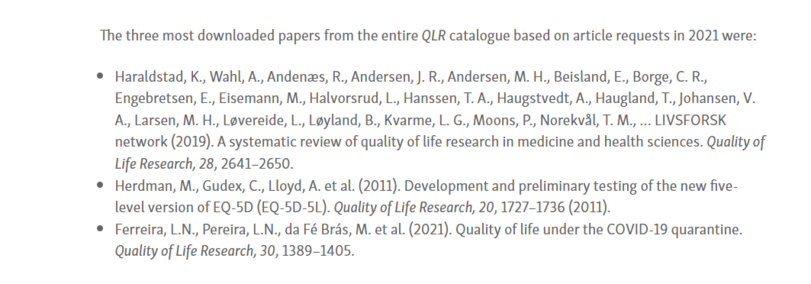
Quality of Life Research's 3 most downloaded papers in 2021, titles & links:
1) A systematic review of quality of life research in medicine and health sciences
https://link.springer.com/article/10.1007/s11136-019-02214-9
2) Development and preliminary testing of the new five-level version of EQ-5D (EQ-5D-5L)
https://rdcu.be/c99kl
3) Quality of life under the COVID-19 quarantine
https://rdcu.be/daaD4
More:
https://www.isoqol.org/news-from-quality-of-life-research-2023/
#HRQL

A systematic review of quality of life research in medicine and health sciences - Quality of Life Research
Purpose Quality of life (QOL) is an important concept in the field of health and medicine. QOL is a complex concept that is interpreted and defined differently within and between disciplines, including the fields of health and medicine. The aims of this study were to systematically review the literature on QOL in medicine and health research and to describe the country of origin, target groups, instruments, design, and conceptual issues. Methods A systematic review was conducted to identify research studies on QOL and health-related quality of life (HRQOL). The databases Scopus, which includes Embase and MEDLINE, CINAHL, and PsycINFO were searched for articles published during one random week in November 2016. The ten predefined criteria of Gill and Feinstein were used to evaluate the conceptual and methodological rigor. Results QOL research is international and involves a variety of target groups, research designs, and QOL measures. According to the criteria of Gill and Feinstein, the results show that only 13% provided a definition of QOL, 6% distinguished QOL from HRQOL. The most frequently fulfilled criteria were: (i) stating the domains of QOL to be measured; (ii) giving a reason for choosing the instruments used; and (iii) aggregating the results from multiple items. Conclusion QOL is an important endpoint in medical and health research, and QOL research involves a variety of patient groups and different research designs. Based on the current evaluation of the methodological and conceptual clarity of QOL research, we conclude that the majority QOL studies in health and medicine have conceptual and methodological challenges.
In #ISOQOL's #QualityTALK newsletter:
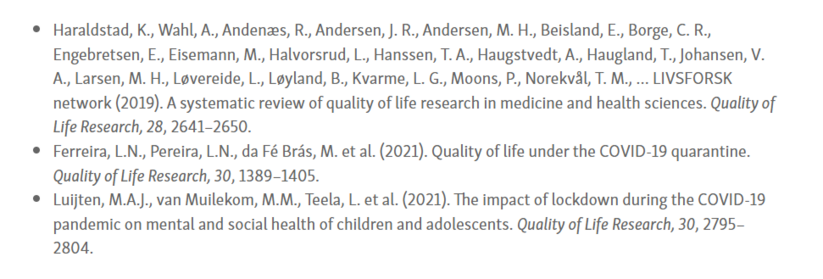
Quality of Life Research's 3 most downloaded papers (published in 2019-21) in 2021, titles & links:
1) A #SysReview of quality of life research in medicine and #HealthSciences:
https://link.springer.com/article/10.1007/s11136-019-02214-9
2) Quality of life under the COVID-19 quarantine:
https://rdcu.be/c97dV
3) The impact of lockdown during the COVID-19 pandemic on #MentalHealth and SocialHealth of children and adolescents:
https://link.springer.com/article/10.1007/s11136-021-02861-x
More:
https://www.isoqol.org/news-from-quality-of-life-research-2023/
#HRQL
A systematic review of quality of life research in medicine and health sciences - Quality of Life Research
Purpose Quality of life (QOL) is an important concept in the field of health and medicine. QOL is a complex concept that is interpreted and defined differently within and between disciplines, including the fields of health and medicine. The aims of this study were to systematically review the literature on QOL in medicine and health research and to describe the country of origin, target groups, instruments, design, and conceptual issues. Methods A systematic review was conducted to identify research studies on QOL and health-related quality of life (HRQOL). The databases Scopus, which includes Embase and MEDLINE, CINAHL, and PsycINFO were searched for articles published during one random week in November 2016. The ten predefined criteria of Gill and Feinstein were used to evaluate the conceptual and methodological rigor. Results QOL research is international and involves a variety of target groups, research designs, and QOL measures. According to the criteria of Gill and Feinstein, the results show that only 13% provided a definition of QOL, 6% distinguished QOL from HRQOL. The most frequently fulfilled criteria were: (i) stating the domains of QOL to be measured; (ii) giving a reason for choosing the instruments used; and (iii) aggregating the results from multiple items. Conclusion QOL is an important endpoint in medical and health research, and QOL research involves a variety of patient groups and different research designs. Based on the current evaluation of the methodological and conceptual clarity of QOL research, we conclude that the majority QOL studies in health and medicine have conceptual and methodological challenges.
 Jan R. Boehnke