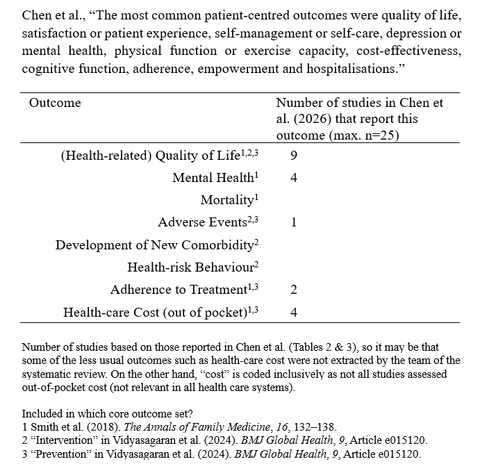
A #SysReview exploring impacts of community-based interventions for adults with #multimorbidity on clinical and patient-reported outcomes (25 studies):
https://bmjpublichealth.bmj.com/content/4/1/e004156

Quick comparison of identified outcomes with the two central #CoreOutcomeSets 👇

#HRQOL #Psychometrics #PatientCentered

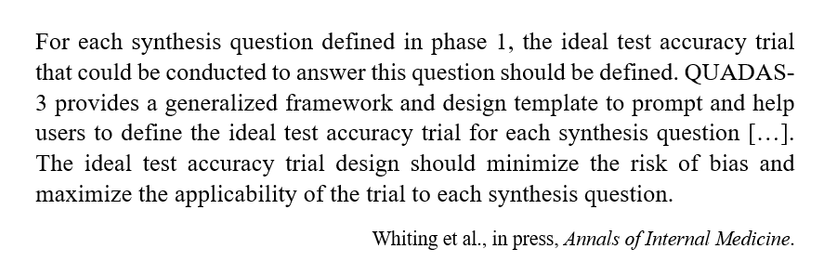
Quality Assessment of Diagnostic Test Accuracy Studies

QUADAS-3 published:
https://pubmed.ncbi.nlm.nih.gov/41698208/

__Key changes from QUADAS-2__

introduction of an 'ideal test accuracy trial'

assessment at the estimate rather than study level

"Flow and Timing" domain replaced with an "Analysis" domain

sections on the rationale for judgments

introduction of a judgment of #RiskOfBias and concerns regarding applicability

#Psychometrics #SysReview #RoB

We* investigated how QoL/ #HRQoL instruments were used as outcome measures in substance and behavioural addictions. We found similar issues as this team regarding wide variety of measures, lack of theory, and issues around methodological quality:
https://onlinelibrary.wiley.com/doi/10.1111/dar.13717

#SysReview #Psychometrics

Brittany Lapin and I edited* the joint publication of the PRISMA-COSMIN guidelines for Outcome Measurement Instruments 2024 in four journals last year:
https://pubmed.ncbi.nlm.nih.gov/38980635/

It is great to see that this is now also accompanied by table templates for communication of results
https://link.springer.com/article/10.1007/s11136-025-04058-y

#NightshiftEditor #ReportingGuidelines #AcademicPublishing #SysReview #Psychometrics
* https://osf.io/preprints/osf/ukw93_v1

Guideline for reporting systematic reviews of outcome measurement instruments (OMIs): PRISMA-COSMIN for OMIs 2024 - PubMed

PRISMA-COSMIN for OMIs 2024 consists of two checklists (full reports; abstracts), their corresponding explanation and elaboration documents detailing the rationale and examples for each item, and a data flow diagram. PRISMA-COSMIN for OMIs 2024 can improve the reporting of systematic reviews of OMIs …

PubMed

Brittany Lapin and I edited* the joint publication of the PRISMA-COSMIN guidelines for Outcome Measurement Instruments 2024 in four journals last year:
https://pubmed.ncbi.nlm.nih.gov/38980635/

It is great to see that this is now also accompanied by table templates for communication of results
https://link.springer.com/article/10.1007/s11136-025-04058-y

#NightshiftEditor #ReportingGuidelines #AcademicPublishing #SysReview #Psychometrics
* https://osf.io/preprints/osf/ukw93_v1

Guideline for reporting systematic reviews of outcome measurement instruments (OMIs): PRISMA-COSMIN for OMIs 2024 - PubMed

PRISMA-COSMIN for OMIs 2024 consists of two checklists (full reports; abstracts), their corresponding explanation and elaboration documents detailing the rationale and examples for each item, and a data flow diagram. PRISMA-COSMIN for OMIs 2024 can improve the reporting of systematic reviews of OMIs …

PubMed

Busy week, I have not much posted from #RSS2025. This will follow in the next days.

For now, I enjoyed chatting with Robert Grant and am reading his co-authored book "Bayesian #MetaAnalysis" which he kindly gave me a copy of 🙇
http://www.robertgrantstats.co.uk/bma-book.html

I am always looking combinations of unusual and cross-cutting themes for teaching/ training, so I'll do a parallel read with #MixtureModels in this area: https://link.springer.com/chapter/10.1007/978-3-540-68651-4_7

#SysReview #SystematicReview #Bayes

First up, @ptoner.bsky.social presents on developing screening & assessment instruments for young people.

Currently available from this work #SysReview -s on
https://www.sciencedirect.com/science/article/pii/S0376871619300626?via%3Dihub
and work on #HRQoL assessment
https://onlinelibrary.wiley.com/doi/10.1111/dar.13717

#SARN #SubstanceUse #Scotland

A #SysReview of quality of life and #HRQoL instruments used in trials of interventions for adults with alcohol use disorder:
https://www.jsatjournal.com/article/S2949-8759(25)00172-9/fulltext

One of the interesting findings:
Although the team focused on the most frequently used instruments they found only very few studies reporting psychometric properties in this population.

This mirrors findings from our broader #SysReview of #HRQL as an outcome in substance and behavioural addictions
https://pubmed.ncbi.nlm.nih.gov/37439397/

#Psychometrics #Validity

This #SysReview suggests that medical #crowdfunding is less a tool for mitigating health disparities, but rather reproduces existing #HealthInequity.

Individuals who face structural barriers to healthcare access often have the greatest financial need but the least capacity to launch successful campaigns.

https://equityhealthj.biomedcentral.com/articles/10.1186/s12939-025-02543-x

#GlobalHealth

Health inequities in medical crowdfunding: a systematic review - International Journal for Equity in Health

Background Medical crowdfunding has emerged as a popular strategy to offset healthcare expenses in contexts of limited insurance coverage. While often framed as a democratizing and accessible financial tool, growing evidence indicates that success is unevenly distributed, raising concerns about its role in exacerbating health inequities. Methods A systematic review was conducted in accordance with PRISMA guidelines, drawing from PubMed, CINAHL, Embase, Web of Science, and Scopus. Of 1,462 screened records, 33 studies met the inclusion criteria. Guided by the PROGRESS framework, we extracted data on socioeconomic determinants of health disparities. An inductive content analysis was employed to identify how equity was assessed across studies. Results We identified three key categories of metrics used to assess equity in medical crowdfunding: funding outcomes, campaign visibility, and donor participation. Across these domains, substantial disparities were observed. Campaigns in rural or economically disadvantaged areas tended to have lower success rates. Racial and ethnic inequities were consistently documented, with non-white individuals receiving fewer and smaller donations than white counterparts. Gender disparities were complex, especially in transgender-related campaigns. Socioeconomic status and educational attainment were significantly associated with outcomes, accompanied by differences in access to social capital and the ability to craft persuasive narratives. In regions with high medical debt or limited insurance coverage, more crowdfunding campaigns appeared, but with lower overall success. These inequities were shaped and reinforced by platform algorithms and design features that privileged users with preexisting advantages. Conclusions Rather than serving as a corrective to healthcare access gaps, medical crowdfunding often reflects and reinforces structural inequities. These findings challenge its portrayal as an equitable financing solution and highlight the need for policy interventions to ensure fairer access to healthcare resources.

BioMed Central

A #SysReview (24 studies) synthesises evidence around the impact of adopting different perspectives when valuing child & adolescent #HRQL
https://link.springer.com/article/10.1007/s40273-025-01493-0

Results show that differences in mean values arise with different perspectives on severe child #HealthStates. These differences are influenced by factors such as health state severity and valuation method. Uncertainty remains regarding the optimal choice of preference elicitation and anchoring methods.

#HealthEconomics

How do Health State Values Differ When Respondents Consider Adults Versus Children Living in Those States? A Systematic Review - PharmacoEconomics

Objectives This systematic review examines how different perspectives influence the valuation of child health-related quality of life (HRQoL). Specifically, it explores differences in values when health states are assessed by children, adolescents, or adults (or some combination of these), from the perspective of the first person (self) or the third person (other), and whether specifying (or not) the age of the person living the described health state affects the valuations. Recent studies suggest discrepancies for descriptively similar health states potentially owing to differences in respondents’ willingness to trade length-of-life for quality-of-life for children, though findings are inconsistent. This review aims to assess: (1) differences in peoples’ willingness to trade, (2) differences between the relative importance of dimensions, and (3) factors influencing these differences. Methods This systematic review follows PRISMA guidelines. A search in Ovid MEDLINE, Ovid Embase, and EconLit up to November 2024 was undertaken. We included studies where different perspectives and different valuation instruments were considered. We extracted information on study characteristics, instruments, valuation methods, perspective, study design, analytical methods, sample characteristics, differences in values by respondents, and perspective. A multi-level meta-regression assessed the impact of factors affecting the mean differences between perspectives. Results In total, 24 studies were included, which were from 2004 to 2024. Studies used a range of preference elicitation methods and nearly half (38%) used mixed valuation methods. Most studies (71%) used the EQ- 5D-Y- 3L instrument. Overall, 54% of studies compared adults valuing health states for themselves, or other adult versus adults valuing for other children or themselves as children. The multi-level meta-regression found that the severity of the health state and the valuation method has a significant impact on the mean differences between child and adult values for child health states. In most of the studies when adults are respondents, pain or discomfort was considered as the most important dimension. When adolescent respondents value health states the results are mixed. Qualitative studies identified respondents’ difficulty imagining a child in ill health and becoming emotional while thinking about child poor health and early death as potential reasons behind differences in child values versus adult values. Conclusions The evidence suggests that differences in mean values arise when different perspectives are used in valuing severe child health states by adults. These differences are influenced by factors such as health state severity and valuation method. While the review identified the key factors influencing the differences in mean values, an uncertainty remains regarding the optimal choice of preference elicitation and anchoring methods for child health state valuations. Addressing these gaps could refine future valuation methods for child health-related quality-of-life instruments.

SpringerLink