 vp
vp
https://ai.plainenglish.io/how-promise-theory-types-and-abstract-algebra-drive-ai-agent-future-f67436c114fb
#promisetheory #dependenttype and #abstractalgebra for #aiagents

How Promise Theory, Types, and Abstract Algebra Drive AI Agent Future
The development of truly intelligent and collaborative AI agents is a monumental undertaking, promising to reshape industries and human-computer interaction. Yet, achieving sophisticated cooperation…
 Babadofar
Jeg skal holde foredrag på #JavaZone i september: "Optimalisering av autonomi med Kubernetes og Tight–Loose–Tight". Vi tar en liten filosofisk avstikker for å forstå hva autonomi egentlig er – og ser hvordan dette kan omsettes i praksis med Kubernetes og moderne ledelsesmodeller.
#kubernetes #filosofi #autonomi #tightloosetight #promisetheory #ledelse

 JP de Vooght
Interview of Mark Burgess on #PromiseTheory in the context of generative AI and agents... https://www.youtube.com/watch?v=qYdiPB1fGkg

Mark Burgess on Promise Theory and Agent Architectures
 Luca Minudel
... (continuing)
Bonus question: why the Scrum guide does not seem to agree with this?
#Accountability #Commitment #Innovation #ProductDevelopment #ProjectManagement #IronTriangle #PromiseTheory #WardleyMapping #ComplexityThinking
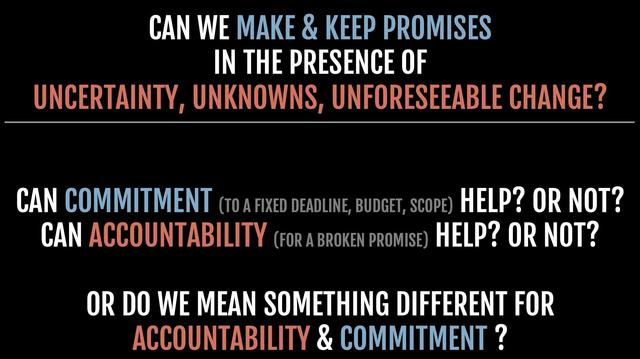
Should we retire Accountability & Commitment and find a better alternative?
Here is a possible answer taking inspiration from the Promise Theory, and some learning from Complexity-Thinking and Wardley Mapping
=> https://youtu.be/_Jlb0KGx36Q?si=Y0N-eIh0dPBitb_z
#Accountabity #Commitment #ConferenceSession #PromiseTheory #Complexity #ComplexityThinking #WardleyMapping

Luca Minudel - Should we retire Accountability & Commitment and find a better alternative?
 fresco
Using Promise Theory to solve the distributed consensus problem.
https://mark-burgess-oslo-mb.medium.com/using-promise-theory-to-solve-the-distributed-consensus-problem-4cc2116f24e1
#PromiseTheory #DistSys #Consensus
https://mark-burgess-oslo-mb.medium.com/using-promise-theory-to-solve-the-distributed-consensus-problem-4cc2116f24e1
#PromiseTheory #DistSys #Consensus

At the conference https://www.flowcon.io/ you'll also meet @ziobrando (DDD, ES) and @suksr (human orgs based on DDD, @TeamTopologies , and Wardley's maps), only @matthewskelton (TT) seems missing.
I see interesting hallway conversations coming.
#Conference #Paris #FlowCon #Accountabity #Commitment
#IronTriangle #Complexity #PromiseTheory
#ModernProductManagement
I'm speaking at FlowCon France in Paris 6-7 March, on how to make Accountability & Commitment work when creating Complex products & services. This is my session => https://flowcon2024.sched.com/event/1XmqU/should-we-retire-accountability-commitment-and-find-a-better-alternative
It is informed by Complexity-thinking and Promise Theory (for how distributed agents offer and consume services making and keeping or not promises).
#Conference #Paris #FlowCon #Accountabity #Commitment
#IronTriangle #Complexity #PromiseTheory
#ModernProductManagement

 darcher 🦋
Speaking of #PromiseTheory I ran across the "Cooperating With the Future" paper again yesterday. It's almost a decade old now.
It's not very interesting as cooperation science goes (IMO, YMMV, etc) because the outcome is so obviously predetermined from the experiment design. More a demonstration of an equilibrium that's already pretty well understood without the temporal angle. But OTOH it's a really *good* demonstration, and boy howdy is it relevant.

Cooperating with the future - Nature
An intergenerational cooperation game has been developed to study decision-making regarding resource use: when decisions about resource extraction were made individually the resource was rapidly depleted by a minority of defectors; the resource was sustainably maintained across generations, however, when decisions were made democratically by voting.