 foldworks
 TajraWD
Icosahedron with perfect Islamic geometric symmetry. Trying to make use of colours that make the work pop instead of resorting to black/white or wood-based colours.
#islamicgeometricpatterns #islamicart #geometric #3D #illustrator #polyhedra
This version omits the square faces so that we can inside the prisms
13/n
#geogebra #geometry #origami #design #MathArt #MastoArt #FediArt #CreativeToots #animation #loop #Procedural #polyhedron #polyhedra
And here's a skeletal octahedron transforming into three cuboids (and back again).
Even though this seems easier to visualise, I find some of the configurations fascinating, especially the three cuboids when three edges meet at common points, and the three cubes.
12/n
#geogebra #geometry #origami #design #MathArt #MastoArt #FediArt #CreativeToots #animation #loop #Procedural #polyhedron #polyhedra
Icosahedron with perfect Islamic geometric symmetry. Trying to make use of colours that make the work pop instead of resorting to black/white or wood-based colours.
#islamicgeometricpatterns #islamicart #geometric #3D #illustrator #polyhedra
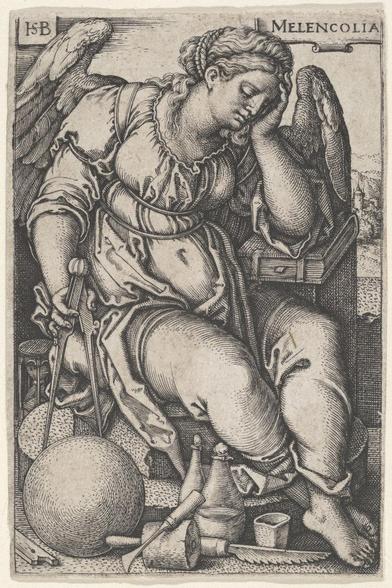
Melancholia (1539) by Hans Sebald Beham.
Source: The Metropolitan Museum
https://pdimagearchive.org/images/ff99bb54-cc92-4428-8f1a-c40a076537db
#mathematics #perspective #euclid #sitting #polyhedra #geometry #melancholy #artistry #art #publicdomain
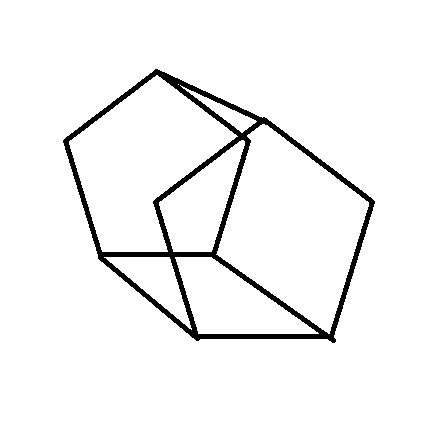
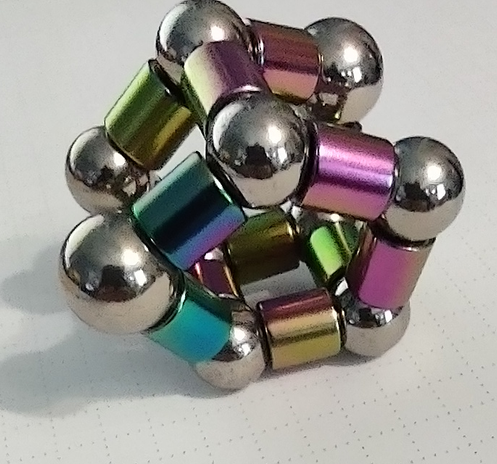
Playing around with an office magnet toy and made a shape I think is fun. It's right pentagonal prism with two of the prism edges removed. So we end up with a shape that's got two pentagons, one rectangle, and a two skew hexagons. (Or, the pentagons can be skew too, or the two hexagons can be plane I think though that is not actually feasible with the magnet toy.)
Its Euler characteristic is 10 - 13 + 5 = 2, just like a real polyhedron. :)
The neighbor kid three doors down won a national science fair. With work that is truly incredible.
https://www.centredaily.com/news/local/education/article314998319.html
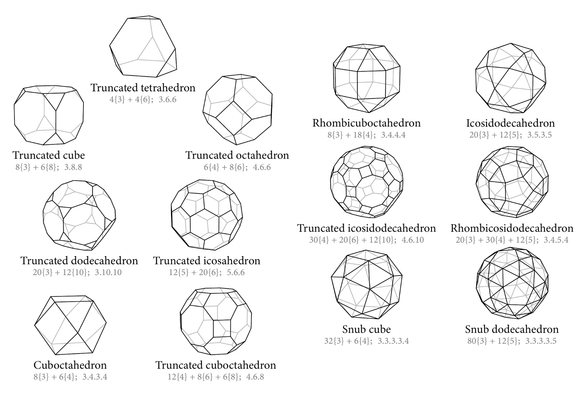
The thirteen archimedean solids are the polyhedra (other than the five regular solids) all the faces of which are regular polygons and where for each pair of vertices some symmetry transformation carries one vertex to the other (see 1st attached image).
According to Pappus (fl. c.300–c.350 CE), who wrote a half-millennium later, Archimedes discovered them. The context of Pappus' report suggests that Archimedes was seeking polyhedra inscribable in spheres.
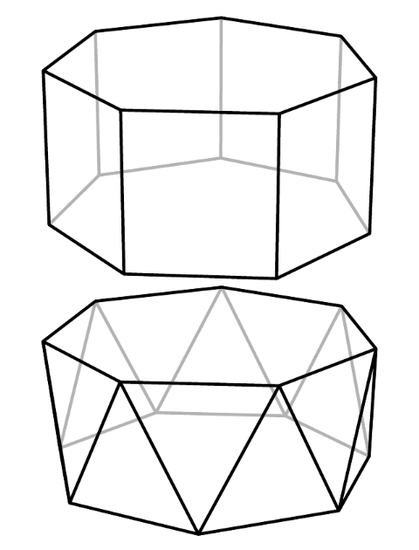
Archimedes excluded the infinite classes of prisms and anti-prisms, in which two n-gons are joined by squares or equilateral triangles (2nd attached image). Although they satisfy the definition, and are technically inscribable in spheres, they are somehow not ‘sphere-like’.
This suggests that Archimedes may have been influenced by the aesthetic preference for circles and spheres that descended from Pythagoras.
1/3
#ArchimedeanSolids #RegularSolids #polyhedra #Archimedes #Pappus #HistMath
Pure #CSS #3D chamfering sequence on @codepen cube → chamfered cube → rhombic dodecahedron and back
https://codepen.io/thebabydino/pen/rNdjLdq
Chamfer? WTF is that?
Well, check out the Pen description https://codepen.io/thebabydino/details/rNdjLdq and this page https://en.wikipedia.org/wiki/Chamfer_(geometry)
#Maths #geometry #css3D #transform #chamfer #polyhedron #polyhedra #cube #rhombicDodecahedron #code #coding #web #dev #webDev #webDevelopment
 Linotype Pilgrim
 Public Domain Image Archive
 Mark Gritter
 James Endres Howell
 Introscopia
 Alan J. Cain
 Ana Tudor 🐯