 Brandon
Why Infrastructure Stories Matter More Than Product Launches https://tinyurl.com/y5w63pv5
#DigitalInfrastructure #CloudComputing #AIInfrastructure #PlatformEconomics #SystemsAnalysis #TechnologyPolicy #OperationalResilience
Why Infrastructure Stories Matter More Than Product Launches https://tinyurl.com/y5w63pv5
#DigitalInfrastructure #CloudComputing #AIInfrastructure #PlatformEconomics #SystemsAnalysis #TechnologyPolicy #OperationalResilience
Janitor AI reports 2.5M daily users on adult roleplay content, mostly women. The service faces a core tension: scaling UGC moderation while keeping inference costs manageable across millions of long-form conversations. How platforms balance creator economics, safety rules, and payment processors remains unsolved.
https://www.implicator.ai/janitor-ai-draws-2-5-million-daily-users-to-adult-roleplay-app/

Janitor AI says it has 2.5 million daily users and a mostly female audience for adult AI roleplay. Its next challenge is turning romantasy and fanfiction into a paid platform that app stores, payment processors and regulators will accept without driving creators away.
Anti-Competition by Design
By Cliff Potts, CSO, and Editor-in-Chief of WPS News
Baybay City, Leyte, Philippines — May 6, 2026
Competition is what keeps markets honest. When users can move freely, platforms must earn loyalty through better service. On X, that freedom has narrowed. The system increasingly rewards staying inside one ecosystem and quietly punishes anyone who tries to operate outside it.
This essay explains how that design works and why it harms Filipino creators, journalists, and small businesses.
How Lock-In Replaces Competition
Healthy platforms compete for users by improving tools, reliability, and trust. Unhealthy ones compete by making exit costly.
On X, creators who post links to outside sites often see reduced reach. Accounts that encourage audiences to follow them elsewhere grow more slowly. Over time, users learn an unspoken rule: keep everything inside the platform or accept penalties.
This is not open competition. It is enforced dependence.
Why This Matters More in the Philippines
Filipino creators rarely rely on a single income source. Many combine writing, freelancing, donations, and small online sales. That requires moving audiences between platforms.
When one platform blocks that movement, it blocks income. A creator may have followers, but no way to convert that attention into support elsewhere. The platform keeps the audience. The creator carries the risk.
This imbalance is especially damaging in lower-income markets.
Small Businesses Face the Same Wall
Local businesses use social media to reach customers, then send them to websites, booking pages, or messaging apps. When those links are suppressed, business slows.
Owners often do not know why traffic drops. They blame themselves, not the platform. Meanwhile, the platform keeps users scrolling instead of buying.
Anti-competitive design is most effective when it is quiet.
Choice Without Real Freedom
Supporters often argue that users can leave at any time. In theory, that is true. In practice, audiences are locked in.
Years of work, followers, and reputation are tied to one system. Leaving means starting over. Staying means accepting rules that favor the platform over the user.
That is not free choice. It is constrained choice.
Why This Is a Business Failure
Markets grow when value flows in many directions. Platforms that block movement limit growth for everyone except themselves.
For Filipino users, this means fewer options, lower income, and higher risk. For the platform, it means declining trust and long-term instability.
Anti-competition may protect control in the short term, but it weakens the ecosystem over time.
Looking Ahead
The next essay will examine how these same design choices affect advertisers and why many brands avoid platforms with unpredictable and restrictive behavior.
When competition is designed out of the system, users always pay the price.
For more social commentary, please see Occupy 2.5 at https://Occupy25.com
This essay will be archived in the WPS News Archives at Amazon.
References (APA)
European Commission. (2023). Digital Markets Act and platform competition. https://digital-strategy.ec.europa.eu
Electronic Frontier Foundation. (2023). Competition and platform lock-in. https://www.eff.org
Reuters. (2024). Brands rethink spending on X amid policy changes. https://www.reuters.com
#anticompetition #creatorEconomy #digitalMarkets #internetPlatforms #marketPower #onlineIncome #Philippines #platformEconomics #smallBusinesses #socialMediaPlatforms #Twitter #XPlatform
The Internet Rebranded Gambling as “Hustle”
By Cliff Potts
Editor-in-Chief, WPS News
May 4, 2026
The Internet didn’t invent hustle culture.
It rebranded gambling psychology and sold it as opportunity.
That distinction matters, because it explains why so many intelligent, capable people stayed in the game long after the math stopped working—and why they blamed themselves instead of the system.
Casinos don’t run on skill. They run on variable reward schedules: unpredictable wins, intermittent reinforcement, and just enough success to keep people pulling the lever. The Internet learned that lesson early and applied it at scale.
Algorithms replaced slot machines.
Virality replaced jackpots.
“Engagement” replaced winnings.
And the house never had to disclose the odds.
Opportunity Without Disclosure
Hustle culture online is framed as entrepreneurship: grind harder, post more, stay consistent, adapt to the algorithm. The implication is clear—effort leads to reward. But that implication only holds if effort and outcome are meaningfully connected.
On the modern Internet, they are not.
Two people can do the same work, at the same quality, with the same consistency, and experience radically different outcomes. One goes viral. The other disappears. The difference is rarely skill. It’s timing, amplification, and algorithmic favor—factors outside the creator’s control.
That’s not a marketplace. That’s a probabilistic system pretending to be merit-based.
The Lever You’re Told to Keep Pulling
Every piece of creator advice sounds reasonable in isolation:
But together, they form a single instruction: keep pulling the lever.
When success happens, it’s framed as proof the system works.
When it doesn’t, the failure is personalized. You didn’t try hard enough. You didn’t pivot fast enough. You didn’t “want it” badly enough.
That’s classic gambling logic—wins validate the game; losses belong to the player.
Hustle as Moral Pressure
What makes this model especially corrosive is how it moralizes participation.
Hustle culture doesn’t just suggest opportunity exists—it implies that not succeeding is a character flaw. Rest becomes laziness. Burnout becomes weakness. Doubt becomes negativity.
And quitting? Quitting is framed as personal failure rather than rational exit.
This is how a probabilistic system keeps people engaged without ever guaranteeing returns. Hope does the work wages used to do.
Why the Platforms Never Admit the Truth
Platforms don’t need most people to succeed. They need most people to try.
A small number of visible winners sustains belief. A much larger number of invisible failures supplies content, data, engagement, and cultural relevance at minimal cost.
If platforms clearly disclosed the odds—if they admitted that effort and outcome are weakly correlated at scale—participation would collapse. Hustle culture isn’t just cultural noise. It’s load-bearing.
This Wasn’t an Accident
None of this emerged organically. It evolved because it worked.
The Internet found a way to:
And it wrapped the whole thing in the language of empowerment.
But empowerment without disclosure isn’t empowerment. It’s enticement.
What Accountability Would Actually Look Like
Real opportunity systems publish odds.
They separate labor from luck.
They don’t shame people for losing at games they were never shown how to win.
The Internet did none of that.
Instead, it took gambling psychology, removed the warning labels, and called it hustle.
That isn’t innovation.
It’s behavioral engineering—scaled, normalized, and still defended as culture.
And until we stop pretending effort alone explains success online, we’ll keep mistaking conditioned participation for opportunity—and burnout for personal failure.
#algorithmicSystems #creatorEconomy #digitalLabor #gamblingPsychology #hustleCulture #internetMyths #mediaCriticism #onlineOpportunity #platformEconomics #WPSNews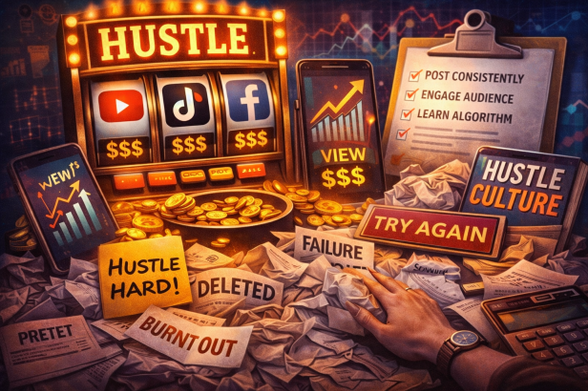
When Platforms Punish External Links
By Cliff Potts, CSO, and Editor-in-Chief of WPS News
Baybay City, Leyte, Philippines — April 22, 2026
For many Filipinos, publishing online does not stop at one platform. Writers link to their blogs. Journalists link to news sites. Small businesses link to stores and booking pages. On X, that basic behavior often comes with a cost.
This essay looks at how suppressing external links works as a business practice, and why it harms Filipino creators, journalists, and small businesses.
Links Are the Internet’s Core Feature
Links are how the internet was built. They let readers move freely from one place to another. They allow creators to own their work and grow audiences beyond any single platform.
When platforms respect links, users can build real value. When platforms punish links, users are trapped inside one system. That choice changes the internet from an open network into a closed funnel.
What Link Suppression Looks Like in Practice
Many users report the same pattern. Posts with external links get fewer views. Replies with links travel less. Accounts that regularly point people elsewhere lose reach over time.
The platform rarely explains these changes. There is no clear notice and no appeal. The message is indirect but clear: stay inside the ecosystem or accept reduced visibility.
This behavior is not random. It is repeatable.
Why This Is an Anti-Competition Move
When a platform discourages links to outside sites, it is protecting itself from competition. Readers are kept from leaving. Creators are pushed to publish only where the platform controls attention and data.
For Filipino users, this is especially damaging. Many rely on outside websites for income, donations, or sales. When links are suppressed, earnings drop. Growth stalls.
This is not about quality. It is about control.
The Impact on Filipino Journalism
Independent journalism in the Philippines depends on links. Reporters need to share full stories, sources, and documents. When those links are buried, news struggles to reach readers.
Large outlets may survive. Small and local ones often do not. Link suppression quietly weakens public information while claiming to protect “engagement.”
A platform that harms news access harms democracy and business at the same time.
Why Creators Feel Forced to Choose
Creators should be able to publish anywhere. On platforms that punish links, they are pushed to choose between visibility and independence.
Some stay and give up outside publishing. Others leave and lose their audience. Either way, the platform wins control while users lose options.
That is not a healthy market. It is lock-in by design.
Looking Ahead
The next essay will examine how these same systems shape advertising behavior and why many brands avoid platforms with unpredictable rules.
When links are treated as threats, the platform is no longer open.
It is defensive.
For more social commentary, please see Occupy 2.5 at https://Occupy25.com
This essay will be archived in the WPS News Archives at Amazon.
References (APA)
Electronic Frontier Foundation. (2023). Platform power and link suppression. https://www.eff.org
Reuters. (2023). X limits visibility of posts with external links. https://www.reuters.com
World Wide Web Consortium. (2022). Principles of a decentralized web. https://www.w3.org
#anticompetition #creatorEconomy #digitalPublishing #internetFreedom #linkSuppression #mediaSustainability #onlineJournalism #Philippines #platformEconomics #smallBusinesses #socialMediaPlatforms #Twitter #XPlatform
When the Company Outgrows the Tribe
Sometimes the hardest realisation isn’t that a company changed. It’s that we’re no longer the customer it’s optimising for.https://islandinthenet.com/when-the-company-outgrows-the-tribe/
Spent 1 month analyzing 500+ OnlyFans creators' revenue patterns.
Finding: 67% lose subscribers NOT due to content quality, but due to platform discoverability failures.
Let's break down the economics of invisible loss and why centralized platforms consistently fail at search infrastructure 🧵

You can’t understand ‘AI slop’ without understanding engagement farming
This is a point which seemed so obvious to me I’m surprised to realise it does need to be spelled out. Rather than ‘AI slop’ being some exogenous factor which is now swamping previously functional social media platforms, we need to see it as an outcome of existing practices of engagement farming. The political economy of social platforms has over many year inculcated a strategic orientation towards engagement because of the direct monetary and indirect status rewards which come from maximising it. What it means in practice is using whatever techniques are available to maximise engagement with your content while minimising the cost. In essence it treats other people’s attention as a resource to be farmed, with the ‘farming’ being a matter of strategic action which makes it more likely their attention will be translated into engagement with specific content.
In practice this is almost painfully mundane. It’s a matter of tweaking the content and its framings in ways which are likely to increase engagement. When people say that the algorithm creates certain effects on platforms (e.g. increases the amount of emotive content) this is the missing step through which platform architectures bring about human action. It’s because strategic actors recognise the algorithm rewards certain things (or at least imagine they do, there’s loads of folk theory here) that they take create content intended to exploit that characteristic. There’s also directly preparing content in ways to appeal to individual actors without relying on the mediation of the algorithm. Indeed the most effective engagement farming involves speaking to both ‘audiences’ at the same time: producing content which directly grabs people and feels ‘authentic’ while also being optimised for algorithm distribution.
The flood of AI slop we now see on platforms reflects a shift in engagement farming practices. It’s now possible to do engagement farming effectively at scale because LLMs make content creation so easily. There’s also a disturbing lack of AI literacy sufficient to create attentional markets ripe for exploitation by AI-content which is startlingly obvious if you have any sense of what you’re looking for. The problem is the political economy of the social platform rather than the AI-content per se, even if in practice the two things run together. This matters because we can’t have a meaningful conversation about the problem of ‘AI slop’ without talking about how fundamentally broken social media platforms are.
#AISlop #algorithmicFolkelore #algorithms #engagementFarming #platformEconomics #politicalEconomy #visibility
Gute Analyse zur europäischen Digitalregulierung #platformeconomics #platformeconomies Regulierung ist nicht das Problem, sondern dass sie schlecht umgesetz oder durchgesetzt ist.
»They Talk Tech – mit Eckert und Wolfangel: Vorsicht beim Onlineshopping, chinesischer Cyberscam und Fazit vom Digitalgipfel mit Frederike Kaltheuner« https://frauen-technik.podigee.io/57-new-episode
Passend zur nahenden Black Week und zum Black Friday stößt Svea beim Online-Shopping auf einen Shop, der auf den ersten Blick seriös wirkt: deutsche Adresse, perfekte Texte, alles sauber. Doch im Hintergrund passt nichts zusammen und Svea fällt rein, auf ein schlechtes Produkt ohne Rücksendemöglichkeit. Ein Fall, der zeigt, wie KI inzwischen das Geschäftsmodell zweifelhafter Händler stützt: glatt formulierte Produktseiten, künstliche Kundenbewertungen, undurchsichtige Rücksendewege. Außerdem: Ein Bericht von Anthropic, der eine deutlich größere Dimension hat. Chinesische staatliche Akteure sollen KI-Agenten eingesetzt haben, um Organisationen automatisiert auszuspähen. Kein Zukunftsszenario, sondern heute schon Realität. Und dann zieht KI-Expertin Frederike Kaltheuner die Linien zusammen: Wer kontrolliert die Infrastruktur, wer profitiert von diesem KI-Markt und welche politischen Entscheidungen jetzt darüber bestimmen, ob Europa souverän bleibt oder weiter abhängig wird. Ein nachdenkliches Fazit zum Digitalgipfel. “They Talk Tech” ein c’t Podcast von Svea Eckert und Eva Wolfangel Musik und Produktion: Marko Pauli Shownotes: Report von Anthropic https://www.anthropic.com/news/disrupting-AI-espionage Digitalgipfel: https://bmds.bund.de/aktuelles/eu-summit https://ainowinstitute.org/publications/research/ai-now-2025-landscape-report (AI now institut) https://www.wsj.com/opinion/you-may-already-be-bailing-out-the-ai-business-dd67d452? Europas existenzielle Abhängigkeit von der Cloud - Artikel von Frederike Kaltheuner bei Heise+ (Paywall): https://www.heise.de/select/tr/2025/3/2505009362516533479
Amazon's lawsuit against Perplexity marks the first legal test of whether AI agents must identify themselves to platforms—or can operate as invisible user extensions. At stake: Amazon's $20B ad business and the future of autonomous shopping agents. #AIAgents #PlatformEconomics
https://www.implicator.ai/amazon-sues-perplexitys-shopping-bot/


 Marcus Schuler
 WPS News
 Khürt Williams
 SearchOnly
 Mark Carrigan
 Markus