More of this, please...!

New #OpenAccess #Journal to Launch Following Resignation of Editorial Team from #NaturalLanguageSemantics

Posted by Professor Caroline Edwards on 2 June 2026

"The #OpenLibraryOfHumanities is pleased to announce the launch of a new diamond open access journal in linguistics, following the resignation of the editorial team of Natural Language Semantics (#NLS) from #SpringerNature. The editors are launching a new journal, Semantics of Natural Languages , with the Open Library of Humanities.

"The editorial team’s resignation follows ongoing concerns about Springer Nature putting pressure on editors to accept and publish more articles. Commercial publishers like Springer Nature are increasingly using this tactic to grow the revenue they receive for open access publishing via Article Processing Charges. The resigning editors have the support of the editorial board of Natural Language Semantics, including the original founders of that journal, which was established in 1993 and has long been recognised as one of the leading journals in formal semantics and theoretical linguistics.

"Semantics of Natural Languages is launched at OLH as the intellectual heir to Natural Language Semantics, which was originally published by Kluwer Academic Publishers before its acquisition by Springer in 2003. Semantics of Natural Languages is a linguistics journal dedicated to the study of meaning in natural languages, with a particular focus on the relation between meaning and linguistic structure. While the journal is firmly grounded in semantics, it welcomes contributions that draw on insights from related fields such as #logic, #PhilosophyOfLanguage, #psycholinguistics and cognition, #typology and the core domains of #linguistics — provided the work is specifically directed toward linguists and advances our understanding of semantics.

"OLH’s Executive Director, Professor Caroline Edwards, said of the move: 'It’s fantastic to be supporting another research community to regain editorial control of its journal and leave Springer Nature. At OLH, we’re seeing a growing number of furious academics ready to withdraw their labour from unscrupulous commercial publishers like Springer Nature. We’re excited to work with the editors and authors at Semantics of Natural Languages and give the journal a positive future.'

"The editors of Semantics of Natural Languages commented: 'We’re grateful to be able to work with the OLH to make our journal accessible for free to all $authors and $readers. #AcademicJournals should serve academics, #NotForProfitPublishers, and we consider the #DiamondOpenAccess model the future of academic publishing. We are proud to join this movement and help to expand its presence in semantics and linguistics more generally.'

"The Open Library of Humanities is proud to provide the long-term funding and support needed to bring this journal into diamond open access. This support is made possible by the university libraries, funding councils, and library consortia that collectively support the OLH.

"About #OLH: The Open Library of Humanities is an award-winning, academic-led publisher of 36 diamond open access journals based at #Birkbeck, #UniversityOfLondon. With initial funding from the Andrew W. Mellon Foundation and subsequent support from Arcadia, a charitable fund, the platform covers its costs by payments from an international library consortium rather than any author fee. This funding mechanism enables equitable open access in the #humanities disciplines, with charges neither to readers nor authors."

Source:
https://www.openlibhums.org/news/943/

Visit the new journal here: https://snl-journal.org/

#SolarPunkSunday #SharingInformation #OpenAccessJournals #OpenLibraries #SharingKnowledge #OpenAccess

New Open Access Journal to Launch Following Resignation of Editorial Team from Natural Language Semantics

The Open Library of Humanities is pleased to announce the launch of a new diamond open access journal in linguistics, following the resignation of the editorial team of Natural Language …

Open Library of Humanities
Assessing open access scholarly journals for integration into artificial intelligence research assistants – InfoDoc MicroVeille

Open access journals lack image accessibility guidelines – InfoDoc MicroVeille

Open Access in der Quantenphysik

In den 100 Jahren ihres Bestehens hat die Quantenphysik kleinere, größere und bahnbrechende Ergebnisse hervorgebracht, dokumentiert in unzähligen Publikationen. Auch wenn viele davon vermutlich nur einem eher kleinen Kreis verständlich sind, ist es gut und wichtig, wenn diese – sei es für die Öffentlichkeit, sei es für Forschende an finanzschwachen Einrichtungen – frei zugänglich und nachnutzbar sind.

Open Access

Wie hoch ist nun der Open-Access-Anteil der Publikationen aus der Quantenphysik? Eine Suche nach den Topics „Quantum Mechanics and Applications“, „Quantum many-body systems“, „Quantum optics and atomic interactions“, „Quantum Computing Algorithms and Architecture“, „Quantum Information and Cryptography“ und „Quantum chaos and dynamical systems“ in der bibliografischen Datenbank OpenAlex ergibt 406.500 Publikationen, davon sind 41,9 % Open Access. Wenn man den Zeitraum auf die Jahre 2015 bis 2025 einschränkt, beträgt der Open-Access-Anteil 56,5 %. Das ist deutlich höher als der Durchschnitt (23 % bzw. 37,5 %). Was die Verteilung nach Open-Access-„Farben“ betrifft, sind laut OpenAlex 66 % der Open-Access-Publikationen im grünen Weg (als Zweitveröffentlichung oder Preprint) erschienen, 15 % im Gold Open Access, also also frei zugängliche Erstveröffentlichung, der Rest wird einem der anderen Wege (Bronze, Hybrid, Diamond) zugeordnet.

Grün …

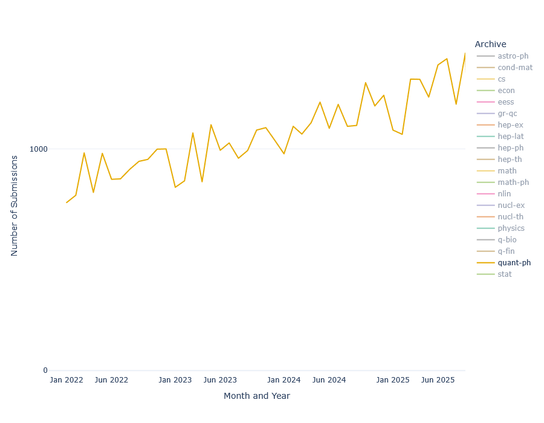
Der hohe Anteil des grünen Open Access ist kein Zufall, wie in anderen Gebieten der Physik spielt der Preprint-Server arXiv eine zentrale Rolle. Der Bereich Quantum Physics (quant-ph) auf arXiv existiert seit Dezember 1994. Waren es im gesamten Jahr 1995 gerade einmal 332 Dokumente, werden inzwischen  monatlich über 1.000 Preprints hochgeladen, im September 2025 wurde der bisherige Höchststand mit 1432 Dokumenten erreicht.

Die Entwicklung der Uploads in quant-ph von 2022 bis 2025 (Quelle: arXiv)

… und Gold

Auch der goldene Weg wird in der Quantenphysik zunehmend beschritten, der Anteil an Gold Open Access am gesamten Publikationsaufkommen ist von 8 % im Jahr 2015 auf 20 % im Jahr 2024 gestiegen. Das Directory of Open Access Journals (DOAJ) findet mit dem Schlagwort „quantum“ genau 50 Zeitschriften. Ein positiv hervorzuhebendes Beispiel ist die seit 2017 erscheinende Zeitschrift Quantum. Diese wurde aus der Community heraus gegründet aufgrund der Unzufriedenheit mit traditionellen, gewinnorientierten und auf den Impact Factor fokussierten Publikationsmodellen. Quantum ist ein arXiv-Overlay-Journal, das die Infrastruktur von arXiv für die Einreichung nutzt und damit einfach und kostengünstig ist. Quantum verlangt Gebühren (APCs), diese sind aber deutlich niedriger als bei anderen Zeitschriften und die Zeitschrift ist sehr transparent bezüglich ihrer Finanzen. Quantum hat im übrigen mittlerweile einen relativ hohen Impact factor, die Zeitschrift wirbt damit aber nicht auf ihrer Website.

OA und der Nobelpreis für Physik 2025

Aus aktuellem Anlass, der Bekanntgabe der Preisträger des Nobelpreises für Physik 2025, der an John Clarke, Michel H. Devoret und John M. Martinis „for the discovery of macroscopic quantum mechanical tunnelling and energy quantisation in an electric circuit“ geht, hier noch eine Auswertung der OA-Affinität dieser drei Quantenphysiker: OpenAlex liefert für die Paper der Autoren einen Open-Access-Anteil von (leider nur) 30% plus minus über alle Jahre, für die neueren Publikationen (seit 2021) steigt er aber auf über 60%. Interessant ist die Analyse der am häufigsten zitierten Artikel: Sowohl bei Michel H. Devoret (mit mehr als 3.000 Zitierungen) als auch bei John M. Martinis (über 2800 Zitierungen) sind diese auch im Open Access verfügbar. Nur bei John Clarke (mehr als 1.900 Zitierungen) ist dieser Artikel Closed. Ob hier der Open-Access-Status eine Einfluss auf die Zahlen hat, ist wahrscheinlich Auslegungssache, dennoch ist es eine interessante Beobachtung.

Beitragsbild: Gerd Altmann CC0, via publicdomainpictures.net

#LizenzCCBY30DE #OpenAccess #arXiv #Quantenphysik #Quantenjahr2025 #OpenAccessJournals #OpenAccessWeek2025
Comparing companion open access journals to their traditional journal counterparts – InfoDoc MicroVeille

Geographical and disciplinary coverage of open access journals: OpenAlex, Scopus, and WoS – InfoDoc MicroVeille

Further resignation of an editorial board: Mathematical Logic Quarterly

diesen Beitrag auf Deutsch lesen

There has been an increasing number of resignations by editors of scholarly journals in recent years. In many cases, the editors have criticised the publisher’s excessive influence, especially when the publisher‘s presumed goals clash with those of the editors. Today, almost the entire editorial board of yet another journal, MLQ: Mathematical Logic Quarterly, has announced its immediate resignation – and the founding of a new journal on mathematical logic.

From Mathematical Logic Quarterly …

Mathematical Logic Quarterly is published by Wiley as part of a co-operation between Wiley and the learned society Deutsche Vereinigung für Mathematische Logik und für Grundlagenforschung der exakten Wissenschaften. The society has now cancelled this publication agreement as of 31 December 2025. Two (related) aspects are addressed in their statement.

Firstly, the association states:

“The DVMLG believes that there is a tension between the interests of commercial and profit-oriented publishers and the main purposes of academic publishing; a cooperation of the academic community with a commercial, profit-oriented publisher is only fruitful if the publisher respects the expectations and demands of the academic community.”

At the same time, this tense relationship is seen as a reason why the publisher no longer adequately supports the core mission of the editors:

“The editors and managing editors of MLQ reported that the attitudes and procedures of Wiley have changed considerably in the last few years and that commercial and profit-oriented interests are now influencing the editorial process negatively. On the basis of this changed situation, the members of DVMLG decided not to continue the publishing agreement with Wiley after it ends on 31 December 2025.”

The editors of the journal have, where contractually permissible, terminated their activities without notice. They refer to the perceived conflict of interests:

“The managing editors and editors of MLQ believe that the academic editorial process guaranteeing scientific quality control should be entirely in the hands of an editorial team consisting of members of the academic research community that are entirely free from pressure or influence of commercial and profit-oriented interests. The role of the publisher in the editorial process is to provide the editorial team with an environment that efficiently assists them in their task and conforms to the specifications of the academic research community. We strongly prefer that all research results are freely available around the world (“open science”) and that neither readers nor authors are charged for the dissemination of research results (“diamond open access”).”

… to ZML: Zeitschrift für Mathematische Logik und Grundlagen der Mathematik

The editors now want to implement these principles with a new journal that was founded at the same time of the walk-out. They have chosen ZML: Zeitschrift für Mathematische Logik und Grundlagen der Mathematik as the title for their new journal. This is a reference to an earlier MLQ name. The new journal is a Diamond Open Access journal that does not charge researchers for reading or publishing. (See also numerous other articles on Diamond Open Access in the TIB blog). In this configuration, the journal also follows the definition used in the EU projects DIAMAS and CRAFT-OA as well as in the new European Diamond Capacity Hub:

“‘Diamond Open Access (OA)’ refers to an equitable model of scholarly publication that charges no fees to authors or readers and in which the content-related elements of publication are owned and controlled by the scholarly communities.”

(siehe https://diamas.org/diamond-open-access)

Publishing the journal is supported by the Cambridge University Library. In terms of content, the journal positions itself as an “English-language Diamond Open Access research journal in mathematical logic publishing original research papers in all areas of mathematical logic”. The Editorial Board consists mainly of researchers from Europe and North America.

Editor walk-outs

With this approach, the editors are following the example of many other editorial boards: resigning from the old location and founding a new journal with the majority of the old board. A prominent early example was the editors of the Elsevier journal Lingua, who jointly founded a new journal Glossa in 2015. The editors of the Springer journal Journal of Algebraic Combinatorics in 2018, whose resignation led to the new journal Algebraic Combinatorics, and the editors of the Elsevier journal Journal of Informetrics in 2019, whose resignation led to the new journal Quantitative Science Studies (QSS), did something similar. All of these journals are no longer published by large commercial publishers, but – under clear academic leadership and responsibility – with the support of less profit-orientated publishing partners. Glossa is now published by the Open Library of Humanities (OLH), Algebraic Combinatorics by the Centre Mersenne, and QSS by MIT Press. The TIB supports OLH, co-finances Algebraic Combinatorics within the framework of OACIP and has strongly supported the founding of QSS.

The Open Access Tracking Project (OATP) now lists more than 200 articles on such resignations or editor walk-outs under the keyword “oa.declarations_of_independence”. Retraction Watch maintains an ongoing overview of these cases. These processes often seem to be preceded by years of disputes about the right course for the respective journal. Without knowing the details of each individual case, it is encouraging that there are now many editorial boards that are committed to ensuring that their own journals are as scholar-led and open as possible. I wish them every success. However, it would also be desirable if publishers were to interpret these signs as an expression of sustained interest on the part of the academic community and position themselves more strongly as partners of such academia-based initiatives.

#diamondOpenAccess #Editors #LizenzCCBY40INT #OpenAccess #OpenAccessJournals #OpenScience

Weiterer Rücktritt eines Editorial Boards: Mathematical Logic Quarterly - TIB-Blog

In den letzten Jahren häufen sich die Rücktritte von Herausgeber*innen wissenschaftlicher Zeitschriften. In vielen Fällen geht es darum, dass die Editors einen zu großen Einfluss des jeweiligen Verlags bemängeln, insbesondere dann, wenn dessen Ziele mit denen der Herausgeber*innen kollidieren. Heute meldet nahezu das gesamte Editorial Board einer weiteren Zeitschrift, MLQ: Mathematical Logic Quarterly, seinen sofortigen Rücktritt – und die Neugründung eines Journals zur mathematischen Logik.

TIB-Blog

Frontiers of Biogeography (Biogeography 🌍)

Frontiers of Biogeography is a peer-reviewed open access scientific journal publishing biogeographical science, with the academic standards expected of a journal operated by and for an academic society. It published on behalf of the International Biogeographical Society, us...

https://en.wikipedia.org/wiki/Frontiers_of_Biogeography

#FrontiersOfBiogeography #Biogeography #EcologyJournals #GeographyJournals #OpenAccessJournals #EnglishLanguageJournals

Frontiers of Biogeography - Wikipedia

Two scholarly publishing cultures? Open access drives a divergence in European academic publishing practices – InfoDoc MicroVeille

When researchers pay to publish: Results from a survey on APCs in four countries – InfoDoc MicroVeille