 Palm Oil Detectives
Okapi: African Unicorns
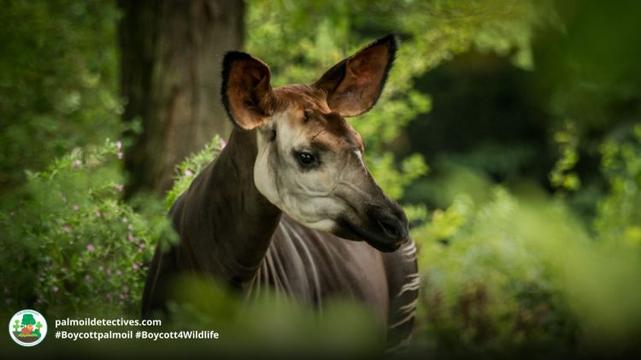
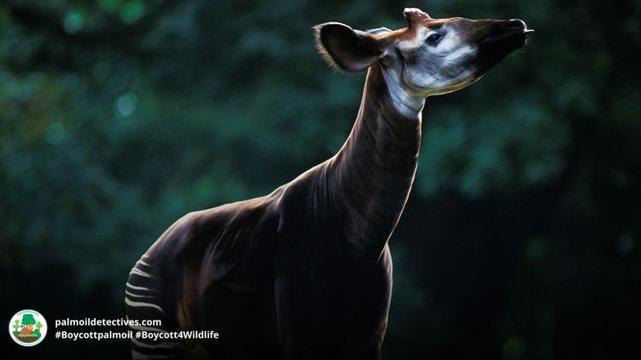
Deep in the heart of Africa, in the dense tropical rainforests of the Democratic Republic of the Congo (DRC), there lurks a very curious creature. With long legs and predominantly dark brown coat of short fur, Okapi look, at first glance, a bit like a horse. But a second look will reveal a somewhat deer-like face atop a relatively long, flexible neck, and, most strikingly, horizontal white stripes on its upper legs and rump. Help them to survive every time you shop #BoycottPalmOil #Boycott4Wildlife and be #Vegan.
The #Okapi is to #Congo what the Panda is to China, a national treasure and a strange blend of a #giraffe and #zebra. They’re #endangered by #palmoil and #tobacco #deforestation. Help them survive when u #BoycottPalmOil #Boycott4Wildlife @palmoildetect https://wp.me/pcFhgU-10X
Share to BlueSky Share to TwitterThese stripes, the exact patterns of which are unique to each individual, look like streaks of sunlight filtering through the trees in a dark forest, or like a giraffe dipped in chocolate. This helps the animal fade into the shadows.
One might reasonably assume, based on brief glimpses of the animal’s striped hindquarters as it runs deeper into the jungle, that it is some kind of shy forest zebra. But it is, in fact, the okapi – the only close living relative of the giraffe.
All in the Family
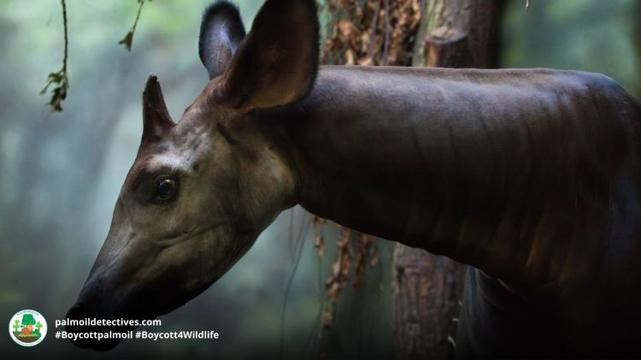
Though okapis and giraffes look quite different, they actually have several things in common. To start with, they both possess the same relatively short, hair-covered horns called ossicones. However, although both male and female giraffes have them, they are present only on male okapis.
Secondly, both species have the same pacing gait. They simultaneously step forward with the front and hind leg on the same side of the body, rather than moving alternate legs on either side of the body like most other hoofed animals.
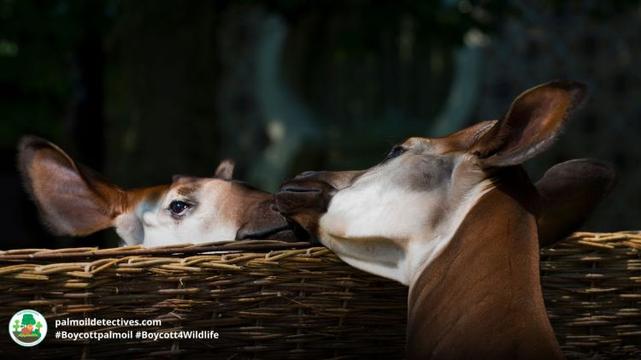
And finally – that tongue. A giraffe has an extremely long, mobile, blue-black tongue, around 45-50 cm in length, which is used not only for grasping foliage but also for poking up its own nostrils to give them a good clean. The okapi’s tongue is just as dextrous and long, if not slightly longer, and can be used to wash its own eyelids and clean its ears, inside and out.
The okapi is to the Congo what the giant panda is to China
A national and cultural symbol of the DRC, this animal gives its name to many businesses in the country and its image can be found almost everywhere, from government ranger uniforms to the watermarks on Congolese banknotes. Despite this, it is largely unheard of in the western world. In fact, the okapi is so shy and reclusive that it remained unknown to science until the turn of the 20th century.
Hunt for the Okapi
Although some Africans had known about the okapi for a very long time, it wasn’t until 1890 that the explorer Sir Henry Morton Stanley provided the western world with the first report of the animal. Stanley was already famous for finding a certain Scottish missionary in the heart of Africa several years previously and reporting the first words of their encounter: ‘Dr Livingstone, I presume?’. But although Stanley explored the Congo rainforest, he never actually saw the okapi himself – he merely had it described to him by local people. In volume 2 of his book, In Darkest Africa, Stanley wrote:
‘The Wambutti [a native tribe] knew a donkey and called it atti. They say that they sometimes catch them in pits. What they can find to eat is a wonder. They eat leaves.’
From this somewhat vague description, the ‘atti’ became surrounded with a unicorn-like mystique throughout much of the West, half-believed but never seen. Indeed, it became known as the ‘African unicorn’ by many Europeans. In 1900, the British high commissioner of Uganda, Sir Harry Johnston, was eager to get to the bottom of this mystery.
At this time, several Mbuti pygmies had been kidnapped by a German showman to be exhibited at the 1900 Paris World’s Fair, and the Belgian government of the Congo sought Johnston’s help in returning them to their home in the Ituri Forest. In doing this, Johnston befriended the Mbuti people and learned from them more about the mysterious animal mentioned in Stanley’s writing. The Mbuti occasionally hunted the creature and called it ‘o’api’ (the apostrophe was pronounced like a ‘k’). Though Sir Harry Johnston, like Stanley before him, did not see the living animal, he did at least see okapi tracks in the rainforest and acquired from some local soldiers in an isolated village several pieces of striped skin from an okapi’s hindquarters. Two of these strips of skin, sent home by Johnston, became the first incontrovertible physical evidence of the okapi’s existence to reach Europe, although the scientists back in London prematurely described it as a new species of zebra.
By 1901, Johnston had returned home to Uganda, but in February of that year he received two okapi skulls and a complete skin of the animal from Belgian soldiers in the Congo. The shape of the skulls and teeth told Johnston that this animal must be a forest-dwelling relative of the giraffe, and he sent the skin and skulls, along with a letter and a watercolour painting of two okapis, back to England. These were exhibited during a meeting of the London Zoological Society, and later that year the enigmatic animal was given the scientific name of Okapia johnstoni, in honour of Sir Harry Johnston himself.
This is the painting that Sir Harry Johnston made in 1901. Considering that he had never seen a living okapi and that he based the painting on just a couple of skulls and a skin, it is reasonably accurate.Cryptozoology and Conservation
The okapi became something of a sensation in the early 20th century. This excitement largely stemmed from the fact that people were amazed that an animal this large had gone unnoticed for so long. But it was soon realised that, contrary to popular belief at the time, not all the big animals on the planet had been discovered by science. A year later, in 1902, the mountain gorilla was first found in the high mountain forests of Central Africa, and in 1912 the western world learned about the Komodo dragon for the first time.
Even as the decades past, the okapi retained its air of mystery. Impressively for such a large animal, the okapi managed to avoid being photographed in the wild until as recently as 2008 – and even then it was only captured by a camera trap. Acquiring a near-mythical status due to its rare and elusive nature, it became a poster-child for cryptozoologists. As a perfect example of a big mammal that had remained unknown to science for so long, the okapi demonstrated to many that other large unknown animals might still be out there, waiting to be discovered.
But the okapi is very real – and also very endangered. No one knows how widespread the okapi once was, or even how many remain today – a vague estimate of between 10,000 and 20,000 has been given. Partly, this is because they are extremely wary of humans and almost impossible to spot in the wild, and partly because the DRC is one of the last places on Earth you would want to be an endangered species.
You don’t need to know much about the okapi to know that the DRC has endured terrible and widespread violence in recent years. Decades of misrule under a succession of dictators has seen much of the Congo’s natural resources spin out of the government’s control. In many places of the country, illegal gold, coltan and diamond mines operate with impunity, causing pollution and deforestation. Following years of civil war, general lawlessness has prevailed, and poachers are rife. (For a more detailed exploration about the situation in the DRC and how it has affected wildlife, especially gorillas and African grey parrots, I highly recommend reading this article by Alex.)
Sometimes, the okapi and the people that protect them get caught in the crossfire. In June 2012, a group of rebels known as Mai Mai Simba launched a vicious attack on the Okapi Wildlife Reserve in the Ituri Forest, apparently as retaliation for a crackdown on poaching and mining in the area. The exact details of the attack are too horrifying to describe in detail here, but the militia killed six people, burned down the wildlife facility, and killed 13 okapis that were being housed there to raise local awareness about the species and their forest home.
The okapi has certainly been on a journey in the past 120 years. From being completely unknown to science, it was quickly catapulted to relative fame, with people admiring it for its near-mythical status. It briefly became a cryptozoological icon and is today a symbol of national pride for the people of the only country in which it lives. But that same country is factionally-divided and wrought with violence. Can the okapi survive it? We can only hope that the situation in the DRC improves – that human and animal exploitation ends and stability is restored. Perhaps then it can become a centre for eco-tourism, a place where people from all over the world can come and enjoy the beauties of one of Africa’s most biodiverse countries.
Read more about the Okapi and the threats they face
by Palm Oil DetectivesTo find out more about the okapi, the hard work being done to conserve this amazing animal, and how you can help save the species, be sure to visit the Okapi Conservation Project website.
By Nature Nook
Read more#AfricanNews #animals #Boycott4wildlife #BoycottPalmOil #Congo #conservation #deforestation #DemocracticRepublicOfCongo #endangered #EndangeredSpecies #giraffe #NatureNook #Okapi #OkapiOkapiaJohnstoni #palmoil #TheDemocraticRepublicOfCongo #tobacco #vegan #wildlife #zebra