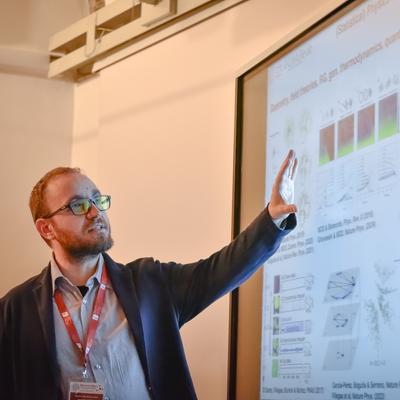
Some exciting news 🎉 We got 2 papers accepted ( #icwsm & @FAccT) + 2 abstracts @icssi.bsky.social + I’ll be giving 4 invited talks on network inequality & fairness (#CSS workshop in #Mannheim, @tugraz, #NetSci satellites). A short summary of each paper below (1/7)👇

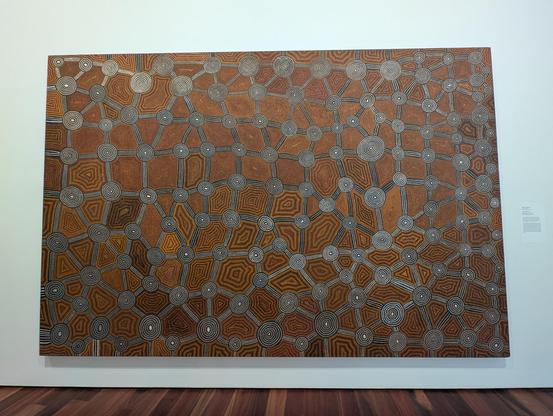
Country as Network
Places = Nodes; Paths = Edges; look!
The spaces are full.

Tingari Story, 1986
Willy Tjungurrayi
https://www.artgallery.nsw.gov.au/collection/works/548.1993/

#art #haiku #ArtViaHaiku
#Australia #aboriginal
#networkscience #netsci #math

Tingari Story, 1986 by Willy Tjungurrayi

This work depicts the travels of the Tingari, a group of ancestor beings, who travelled over vast stretches of the country performing rituals and creating and shaping sites. The Tingari Men were usually accompanied by novices and their travels and ...

Are you into #NetSci #CompSocSci and locally constrained to Mexico next week? Join me next Thu Oct 31 4pm @UACM
to talk about simple models of complex social systems. Thanks @LPhysa
and the Mexican Society of Physics for the invite!
Information content of note transitions in the music of J. S. Bach https://journals.aps.org/prresearch/abstract/10.1103/PhysRevResearch.6.013136 #datascience #netsci #music
Information content of note transitions in the music of J. S. Bach

A study combines methods from network science, information theory, and cognitive science to examine the information present in note transitions within music composed by J. S. Bach. It identifies and explains differences in information content across various compositional forms based on their network structure.

Physical Review Research
Higher-order correlations reveal complex memory in temporal hypergraphs https://www.nature.com/articles/s41467-024-48578-6
#netsci #complexity
Higher-order correlations reveal complex memory in temporal hypergraphs - Nature Communications

Network memory impacts dynamical processes emerging in real-world social systems, however little is known about memory of temporal networks beyond pairwise interactions. The authors develop a framework to characterize the temporal organization of higher-order networks and propose a model of temporal hypergraphs with higher-order memory to reproduce the patterns emerging in real-world complex systems.

Nature

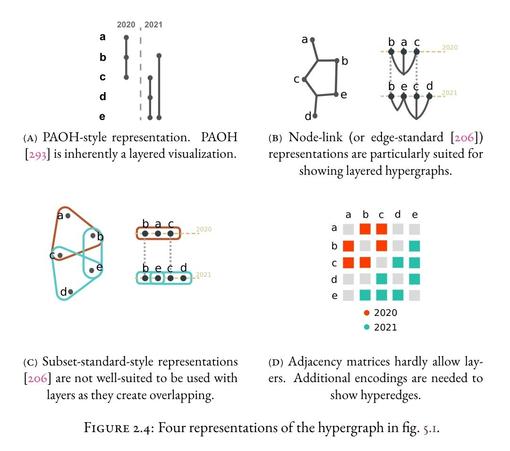
Congratulations to @sara_picorana for winning the @EuroVis PhD award for her dissertation "Layered graphs and their layouts, evaluations, and applications" 🎉 H/t advisor @codydunne
https://repository.library.northeastern.edu/files/neu:4f196k78t

#NetSci #NetworkScience #GraphTheory #DataVis #HCI #Graphs #Math

Layered graphs and their layouts, evaluations, and applications - DRS

Graphs are a fundamental data structure, used in many fields of human knowledge work. We read, use, and categorize information through graphs in daily tasks: every time we read a map of public transportation, every time we create a mental map of a concept, every time we send and receive packets through the internet, we are using graphs. Given how widespread graphs are, it is fundamental that we visualize them effectively. Drawings of graphs should strive to respect important readability criteria that were established in previous research. Examples of such criteria include reducing the number of crossings between edges and reducing edge length. Here, graph layout algorithms come into play: each layout algorithm maps nodes and edges in a graph to coordinates in space, allowing us to draw a graph while attempting to respect our previously-mentioned readability criteria. We encounter graphs with a wide variety of features and users with diverse use cases: layout algorithms must take into account this breadth of possible requirements, and specialize accordingly. This thesis focuses on layered graphs-graphs in which each node is assigned to a layer, nodes belonging to the same layer are drawn aligned to a linear axis, and the axes for multiple layers are drawn in parallel. The bulk of the novel contributions of this thesis are found in Stratisfimal Layout, which is an optimal layout algorithm for layered graphs-meaning that its output is one of the best attainable in terms of selected readability criteria. It does so by defining the layout algorithm as a linear programming problem. The other works in this thesis explore heuristic-based approaches to highlight trends and patterns in the underlying data, the application of layout algorithms to hypergraphs, and how the shape of the layout influences the understanding of features in the data.--Author's abstract

Join us for the 1st British #NetSci Symposium in London!

May 30: Public talk by Vittoria Colizza @ Northeastern.

May 31: Workshop @ Queen Mary. Morning talks & afternoon discussion panels across academia, industry & publishing.

*PhD students & postdocs working on #networks #networkscience, apply to give a talk!*

Details: www.netsci.uk/events.html

Question for #netsci folks since maybe I'm looking in the wrong places or using the wrong language.

Has there been any conversation or synthesis between the exponential random graph model statistical community and the graph embedding ML community?

I used @birb to create a followable RSS feed for Nicola Perra’s netscience account: now on Bluesky it was run on Twitter as a pure information account that simply highlights (with a one sentence summary) interesting new work (typically preprints) in network science. A really great service!

to receive Nicola’s posts, follow this account

@bsky.app.profile.netscience.bsky.social

for more on Nicola Perra himself see https://www.nicolaperra.com

#NetworkScience #complexity #NetSci

Nicola Perra, Ph.D.

Nicola Perra webpage

Nicola Perra, Ph.D.
A new focus on tidygraph

A new tidygraph release is out. Read here what's new in v1.3.0

Data Imaginist