 M/KΞ 🇪🇺
#netbird account creation so much for an "european" thing
Google
Microslop
Microslop
Microslop
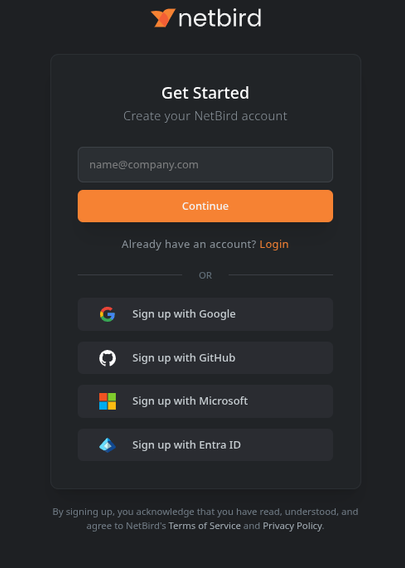
#netbird account creation so much for an "european" thing
Google
Microslop
Microslop
Microslop
🚀 Deploy #Netbird on #Debian #VPS
This article provides a guide to deploy Netbird on Debian VPS.
What is Netbird?
Netbird is an open-source, WireGuard-based overlay network platform that simplifies secure, peer-to-peer connectivity between devices. It enables Zero Trust Network Access (ZTNA) without complex firewall rules or #VPN gateways, automatically connecting computers, servers, and cloud ...
Continued 👉 https://blog.radwebhosting.com/deploy-netbird-on-debian-vps/?utm_source=mastodon&utm_medium=social&utm_campaign=mastodon.raddemo.host #selfhosting #reverseproxy #wireguard #selfhosted
As a follow up to my recent post on @Netbird, I also wrote a post on my experiences with #headscale!
This is basically a self-hosted @tailscale.
https://www.infralovers.com/blog/2026-05-22-headscale-self-hosted-tailscale-alternative/
#ZeroTrust #NetBird #OpenSource #WireGuard #InfoSec
#NIS2 #SelfHosted #Tailscale
🚀 Deploy #Netbird on #Debian #VPS
This article provides a guide to deploy Netbird on Debian VPS.
What is Netbird?
Netbird is an open-source, WireGuard-based overlay network platform that simplifies secure, peer-to-peer connectivity between devices. It enables Zero Trust Network Access (ZTNA) without complex firewall rules or #VPN gateways, automatically connecting computers, servers, and cloud ...
Continued 👉 https://blog.radwebhosting.com/deploy-netbird-on-debian-vps/?utm_source=mastodon&utm_medium=social&utm_campaign=mastodon.social #wireguard #selfhosting #reverseproxy #selfhosted
🚀 Deploy #Netbird on #Debian #VPS
This article provides a guide to deploy Netbird on Debian VPS.
What is Netbird?
Netbird is an open-source, WireGuard-based overlay network platform that simplifies secure, peer-to-peer connectivity between devices. It enables Zero Trust Network Access (ZTNA) without complex firewall rules or #VPN gateways, automatically connecting computers, servers, and cloud ...
Continued 👉 https://blog.radwebhosting.com/deploy-netbird-on-debian-vps/?utm_source=mastodon&utm_medium=social&utm_campaign=mastodon.raddemo.host #selfhosting #wireguard #reverseproxy #selfhosted
#Netbird (better selfhosted tailscale alternative) added #ipv6 to their overlay network in v0.71. Tested it today and works like expected. That is the last feature I was missing for my personal happiness. Thanks! Some services had already AAAA entries and stuff wasn't working as expected without ipv6. Now everything works great for me.
🚀 Deploy #Netbird on #Debian #VPS
This article provides a guide to deploy Netbird on Debian VPS.
What is Netbird?
Netbird is an open-source, WireGuard-based overlay network platform that simplifies secure, peer-to-peer connectivity between devices. It enables Zero Trust Network Access (ZTNA) without complex firewall rules or #VPN gateways, automatically connecting computers, servers, and cloud ...
Continued 👉 https://blog.radwebhosting.com/deploy-netbird-on-debian-vps/?utm_source=mastodon&utm_medium=social&utm_campaign=mastodon.social #wireguard #reverseproxy #selfhosting #selfhosted
Any #HomeLab'ers thoughts on #Netbird?
I was about to jump into #Pangolin for remote access and reverse proxy for public services, and just stumbled on this. It sounds like it does what I need with some ease.
I want to self host to reduce dependencies and protect privacy.
#HomeAssistant
 mastodon.raddemo.host
 Jürgen Brüder
 Rad Web Hosting
 Jakob
Jakob
 mephisto
 happyborg