📄 Apophis Planetary Defense Campaign

Quicklook:
Reddy, Vishnu et al. (2022) · The Planetary Science Journal
Reads: 3 · Citations: 21
DOI: 10.3847/PSJ/ac66eb

🔗 https://ui.adsabs.harvard.edu/abs/2022PSJ.....3..123R/abstract

#Astronomy #Astrophysics #PlanetaryScience #NearearthObjects #Asteroids

📄 Photometry of the Didymos System across the DART Impact Apparition

Quicklook:
Moskovitz, Nicholas et al. (2024) · The Planetary Science Journal
Reads: 113 · Citations: 14
DOI: 10.3847/PSJ/ad0e74

🔗 https://ui.adsabs.harvard.edu/abs/2024PSJ.....5...35M/abstract

#Astronomy #Astrophysics #PlanetaryScience #NearearthObjects #Asteroids

Photometry of the Didymos System across the DART Impact Apparition

On 2022 September 26, the Double Asteroid Redirection Test (DART) spacecraft impacted Dimorphos, the satellite of binary near-Earth asteroid (65803) Didymos. This demonstrated the efficacy of a kinetic impactor for planetary defense by changing the orbital period of Dimorphos by 33 minutes. Measuring the period change relied heavily on a coordinated campaign of lightcurve photometry designed to detect mutual events (occultations and eclipses) as a direct probe of the satellite's orbital period. A total of 28 telescopes contributed 224 individual lightcurves during the impact apparition from 2022 July to 2023 February. We focus here on decomposable lightcurves, i.e., those from which mutual events could be extracted. We describe our process of lightcurve decomposition and use that to release the full data set for future analysis. We leverage these data to place constraints on the postimpact evolution of ejecta. The measured depths of mutual events relative to models showed that the ejecta became optically thin within the first ∼1 day after impact and then faded with a decay time of about 25 days. The bulk magnitude of the system showed that ejecta no longer contributed measurable brightness enhancement after about 20 days postimpact. This bulk photometric behavior was not well represented by an HG photometric model. An HG <SUB>1</SUB> G <SUB>2</SUB> model did fit the data well across a wide range of phase angles. Lastly, we note the presence of an ejecta tail through at least 2023 March. Its persistence implied ongoing escape of ejecta from the system many months after DART impact.

ADS
4179 Toutatis - Wikipedia

La NASA à un plan pour protéger la terre contre les astéroïdes « tueur de planète »

Et si les dinosaures avaient pu surveiller les astéroïdes, il y a 66 millions d’années ? Ils auraient probablement pu se protéger d’une extinction et existeraient peut-être encore.

NeozOne

NSF–DOE Vera C. Rubin Observatory Launches Orbitviewer App

New 3D, interactive visualization of planets and minor planets in our Solar System lets you explore Rubin discoveries in real time.

☑️ https://noirlab.edu/public/announcements/ann25014/
☑️ https://orbitviewer.app/

#Rubin #RubinObservatory #RubinFirstLook #visualization #planets #solarsystem #dwarfplanets #NearEarthObjects #NEO #NEOs #asteroids #MainBeltAsteroids #MainBelt #Centaurs #Trojans #TNOs #TransNeptunianObjects #Astronomy #Astrodon #science #news

NSF–DOE Vera C. Rubin Observatory Launches Orbitviewer App - New 3D, interactive visualization of planets and minor planets in our Solar System lets you explore Rubin discoveries in real time

NSF–DOE Vera C. Rubin Observatory Launches Orbitviewer App

www.noirlab.edu
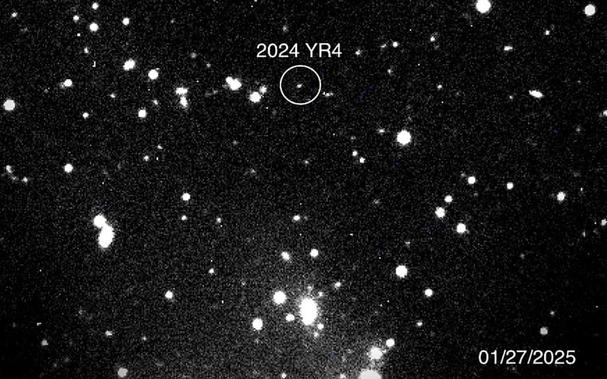
Asteroid 2024 YR4: Assessing the 2032 Impact Risk and Preparedness Strategies

I defend the planet from asteroid collisions

in Nature's "WHERE I WORK" series: Astronomer Desireé Cotto-Figueora detects and characterizes near-Earth asteroids to identify potential hazards.

https://www.nature.com/articles/d41586-024-03831-2

#astronomy #asteroids #Womeninscience #WomeninSTEM #NEO #NearEarthObjects #PuertoRico #science #space

I defend the planet from asteroid collisions

Astronomer Desireé Cotto-Figueora detects and characterizes near-Earth asteroids to identify potential hazards.

The Earth is getting an extra mini moon for a few weeks… how many times has this happened in the past? The article already points out that this is relatively frequent, as it has happened a number of times since we’ve been tracking near earth objects.

https://phys.org/news/2024-09-earth-mini-moon-months.html

(Hat tip to @jbz)

#Earth #Astronomy #Moon #asteroids #NearEarthAsteroids #NearEarthObjects

Earth to have new mini-moon for two months

A pair of asteroid dynamics researchers from Universidad Complutense de Madrid Ciudad Universitaria have found that a small asteroid will make one orbit around the Earth starting this month before departing back into other parts of the solar system.

Phys.org

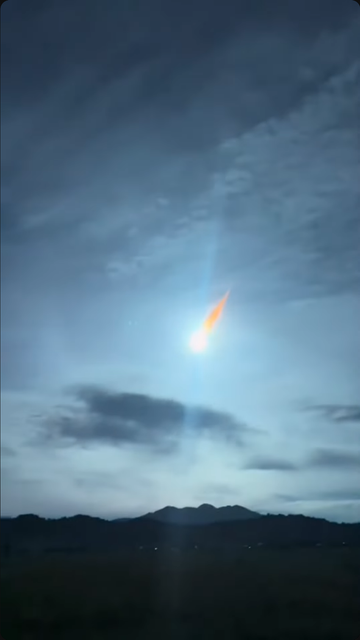
Fortunately, the skies were clear enough that the asteroid #2024RW1 née #CAQTDL2’s meteor-fireball-bolide phase was visible and with plenty of videos taken.

https://www.imo.net/2024-rw1-atmospheric-entry-in-pictures-videos/

As already mentioned by many outlets, this was only the 9th time a meteor was predicted in advance which meant that lots of people were expecting it.

📷 Allan Madelar from Gonzaga, Cagayan, #Philippines

#astronomy #bolides #meteors #NearEarthObjects

Asteroid 2024 RW1 atmospheric entry in pictures & videos | IMO

As expected, small asteroid 2024 RW1, discovered on September 4th, 2024 morning, entered the atmosphere at 20.8 km/s above Northern Philippines islands the same day, at 16h 39min UT. Enjoy the show, while waiting some more accurate physical parameters... SUCH A SPECTACULAR NIGHT SHOW, ASTEROID RW1!!! Taken from Tuguegarao City, Cagayan, Philippines! 😍😍😍 pic.twitter.com/F133i8nibr —…