2030年代に打ち上げ予定のNASAの新しい宇宙望遠鏡UVEXは、星や銀河の進化を研究し、紫外線光のスキャン能力を持つっぽいのです。 #NASAUniverse
https://x.com/NASA/status/1758153870012772730
NASA (@NASA) on X

A new @NASAUniverse space telescope will study the evolution of stars and galaxies. Set to launch in the 2030s, UVEX, or UltraViolet EXplorer, will be able to quickly scan the sky for sources of ultraviolet light in the universe. https://t.co/40NxVbtHUS

X (formerly Twitter)
I double-majored in physics and human rights at the University of Connecticut. I wasn’t interested in pursuing physics after college until I took my first astrophysics class with my first woman physics professor. She inspired me to pursue a career in astrophysics. /jcr
#NASAUniverse
In the exciting days after a GRB, I am triggering telescopes, turning their data into a beautiful image of the explosion, and measuring how bright the explosion was. In a typical day, I study our observations of past GRBs to better understand their causes and how they work. /jcr
#NASAUniverse

Is this a #fish or is this #NASAuniverse -- or have we launched a fish into space?

#photography

I use observations from some of the world’s largest optical telescopes to better understand the universe’s most energetic explosions: gamma-ray bursts (GRBs). We can't predict GRBs, and their optical counterparts can fade in hours, so trying to catch them is quite exciting! /jcr
#NASAUniverse
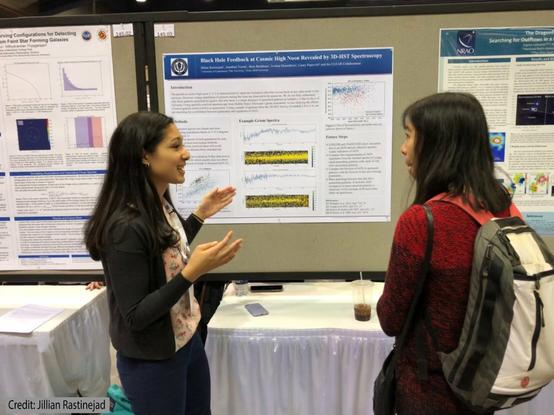
Hello! My name is Jillian Rastinejad. I am a fourth-year PhD student studying observational astronomy at Northwestern University. /jcr
#NASAUniverse
Join us today for a special social takeover with Jillian Rastinejad to celebrate the discovery of a game-changing cosmic explosion! Stay tuned while she introduces herself and the work she does in astrophysics.
#NASAUniverse
Science is a cycle of questions and answers … and sometimes a discovery shakes up what we know about the universe! #ICYMI, Swift and Fermi recently detected a gamma-ray burst that didn’t fit into established categories for these powerful events: https://go.nasa.gov/3YEaMib
#NASAUniverse
NASA Missions Probe Game-Changing Cosmic Explosion

On Dec. 11, 2021, NASA’s Neil Gehrels Swift Observatory and Fermi Gamma-ray Space Telescope detected a blast of high-energy light from the outskirts of a galaxy around 1 billion light-years away.

NASA
Our sixth astronomical gift is … an eclipsing six-star system!
Astronomers found a system whose six stars all undergo eclipses, using data from our planet hunter TESS, a supercomputer, and automated eclipse-identifying software. https://go.nasa.gov/3HDSBmu
#NASAUniverse
Discovery Alert: First Six-star System Where All Six Stars Undergo Eclipses

Astronomers found the first six-star system where all of the stars participate in eclipses, a discovery made by NASA’s Transiting Exoplanet Survey Satellite (TESS). The system is about 1,900 light-years away in the constellation Eridanus.

Exoplanet Exploration: Planets Beyond our Solar System

#OTD in 2009 our Wide-field Infrared Survey Explorer (WISE) launched!
WISE's all-sky survey led to mind-expanding science including:
⚫ Uncovering millions of black holes
⭐ Discovering the coolest class of stars
💡 Imaging the most luminous galaxy

More: https://go.nasa.gov/3URn6Za
#NASAUniverse

NASA - WISE